Pseuderanthemum multiflorum (Acanthaceae), a new species from Thailand
DOI:
https://doi.org/10.20531/tfb.2026.54.2.12Keywords:
conservation status, flora, morphology, taxonomyAbstract
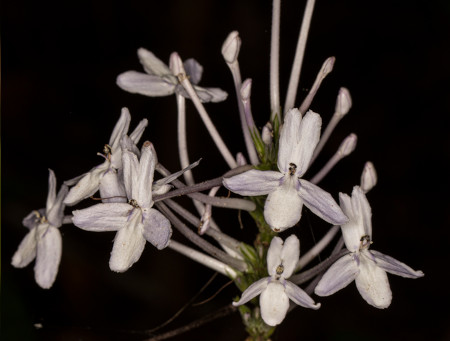
Pseuderanthemum multiflorum (Acanthaceae), a new species known only from Thailand, is here described and illustrated. It is distinguished from P. graciliflorum by inner corolla tube and pistil being glabrous instead of puberulous and by calyx lobes 4.5–6 mm long instead of 3–4 mm long. Comparison of morphological characteristics are provided.
Downloads
References
Bremekamp, C.E.B. (1965). Delimitation and subdivision of the Acanthaceae. Bulletin of the Botanical Survey of India. 7(1–4): 21–30.
Chaikong, P. (2001). Taxonomy of subtribe Barleriinae (Acanthaceae) in northeastern Thailand. M.Sc. Thesis, Khon Kaen University, Thailand.
Choopan, T. (2013). Systematic study of Acanthaceae, subfamilies Nelsonioideae and Acanthoideae (Pseuderanthemum), in Thailand. Ph.D. thesis, Suranaree University of Technology, Thailand.
Choopan, T., Grote, P.J., Chayamarit, K. & Simpson, D.A. (2018). An annotated checklist of the genus Pseuderanthemum Radlk. (Acanthaceae) in Thailand. Thai Forest Bulletin (Botany) 46(1): 90–111.
Craib, W.G. (1912). Contributions to the flora of Siam: Dicotyledones. Aberdeen, Scotland: University of Aberdeen.
Hansen, B. (1989). Notes on SE Asian Acanthaceae 1. Nordic Journal of Botany 9(2): 209–215.
Imlay, J.B. (1938). The taxonomy of the Siamese Acanthaceae. Ph.D. thesis, Aberdeen University, Scotland.
Imlay, J.B. (1939). Contribution to the Flora of Siam. Bulletin of Miscellaneous Information (Royal Gardens, Kew) 1939(3): 109–150.
IUCN (2012). IUCN Red List Categories and Criteria: Version 3.1. Second edition. Gland, Switzerland and Cambridge, United Kingdom.
IUCN Standards and Petitions Committee (2024). Guidelines for Using the IUCN Red List Categories and Criteria, Version 16. Prepared by the Standards and Petitions Committee. Available from: https://www.iucnredlist.org/documents/RedListGuidelines.pdf (accessed 4 July 2026).
Manzitto-Tripp, E.A., Darbyshire, I., Daniel, T.F., Kiel, C.A. & McDade, L.A. (2022). Revised classification of Acanthaceae and worldwide dichotomous keys. Taxon. 71(1): 103–153. https://doi.org/10.1002/tax.12600
McDade L.A. & Moody, M.L. (1999). Phylogenetic relationships among Acanthaceae: evidence from noncoding trnL-trnF chloroplast DNA sequences. American Journal of Botany 86: 70–80.
McDade, L.A., Masta, S.E., Moody, M.L. & Waters, E. (2000). Phylogenetic relationships among Acanthaceae: Evidence from two genomes. Syst. Bot. 25: 106–121. https://doi.org/10.2307/2666677
POWO (2026). Plants of the world online. Kew: Royal Botanic Gardens. https://powo.science.kew.org/ (accessed 4 July 2026)
Scotland, R.W., Endress, P.K. & Lawrence, T.J. (1994). Corolla ontogeny and aestivation in the Acanthaceae. Botanical Journal of the Linnean Society. 114(1): 49–65.
Scotland, R.W. & Vollesen, K. (2000). Classification of Acanthaceae. Kew Bulletin. 55(3): 513–589.
Singh, R.K. (2023). Pseuderanthemum imlayae R. Kr. Singh, a replacement name for P. axillare J. B. Imlay (Acanthaceae). Annales Botanici Fennici 60: 115. https://doi.org/10.5735/085.060.0118
Turner, I.M. (2016). Rather for the nomenclaturist than for the scientific botanist: The Botanical Cabinet of Conrad Loddiges & Sons. Taxon 65(5): 1107–1149. https://doi.org/10.12705/655.13
Downloads
Published
How to Cite
Issue
Section
License
Copyright (c) 2026 The Forest Herbarium

This work is licensed under a Creative Commons Attribution-NonCommercial-NoDerivatives 4.0 International License.

