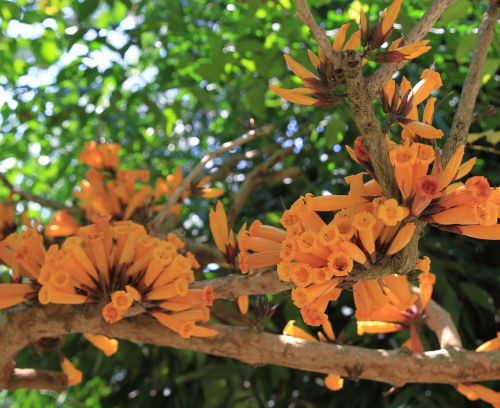
A taxonomic revision of Mayodendron (Bignoniaceae) in Thailand
DOI:
https://doi.org/10.20531/tfb.2026.54.1.05Keywords:
plant anatomy, Lamiales, lectotypification, palynology, plant taxonomyAbstract
A taxonomic revision of Mayodendron (Bignoniaceae) in Thailand is presented. One species, M. igneum, is recognized and provided with an updated morphological description, comparison with related species, illustrations, distribution, habitat and ecological data, phenology, conservation assessment, vernacular names, uses, and a list of specimens examined. Based on the reproductive morphological characters, Mayodendron can be distinguished from Radermachera by the type and position of the inflorescences, the morphology of the calyx and corolla, and the size and characteristics of the fertile stamens. The specimen Brandis 1357 at HBG [HBG522936] is designated as the lectotype of M. igneum. This species is assessed as Least Concern (LC) according to the IUCN criteria. Leaflet and wood anatomy, as well as pollen morphology of M. igneum are characterized. The species has bifacial leaflets with anomocytic stomata, diffuse-porous wood with hetero- or homocellular rays, and prolate-spheroidal to subprolate pollen with heterobrocate reticulate sculpturing and four aperture types.
Downloads
References
APG IV (2016). An update of the Angiosperm Phylogeny Group classification for the orders and families of flowering plants: APG IV. Botanical Journal of the Linnean Society 181(1): 1–20. https://doi.org/10.1111/boj.12385
Bachman, S., Moat, J., Hill, A.W., de la Torre, J. & Scott, B. (2011). Supporting red list threat assessments with GeoCAT: geospatial conservation assessment tool. ZooKeys 150: 117–126. https://doi.org/10.3897/zookeys.150.2109
Balslev, H. & Chantaranothai, P. (eds) (2023). Flora of Thailand 4(3.3): Leguminosae-Papilionoideae. The Forest Herbarium, Department of National Parks, Wildlife and Plant Conservation. Prachachon Co. Ltd., Bangkok, 227 pp.
Boonthasak, W. & Ngernsaengsaruay, C. (2021). The genus Dolichandrone (Fenzl) Seem. (Bignoniaceae) in Thailand. Biodiversitas 22(3): 1,120–1,128. https://doi.org/10.13057/biodiv/d220306
Clarke, C.B. (1884). Bignoniaceae. In: J.D. Hooker (ed.), The Flora of British India 4: 376–386. L. Reeve & Co., London.
Dop, P. (1930). Bignoniacées. In: P.H. Lecomte, F. Gagnepain. & F. Pellegrin (eds), Flore Générale de l'Indo-Chine 4: 565–607. Masson et Cie, Éditeurs, Paris.
Erdtman, G. (1945). Pollen Morphology and Plant Taxonomy V. On the occurrence of tetrads and dyads. Svensk Botanisk Tidskrift Utgifven af Svenska Botaniska Foreningen 39: 286–297.
Erdtman, G. (1952). Pollen Morphology and Plant Taxonomy: Angiosperms 1. Almquist and Wiksell, Stockholm, Sweden, 539 pp.
Fischer, F., Theisen, I. & Lohmann, L.G. (2004). Bignoniaceae. In: K. Kubitzki & J.W. Kadereit (eds), The Families and Genera of Vascular plants: Flowering Plants, Dicotyledons: Lamiales (except Acanthaceae including Avicenniaceae) Vol. 7, pp. 9–38. Springer-Verlag Berlin Heidelberg.
Gasson, P. & Dobbins, D.R. (1991). Wood anatomy of the Bignoniaceae, with a comparison of trees and lianas. IAWA Journal 12:389–417.
Gledhill, D. (2002). The Names of Plants, 3rd ed. Cambridge University Press, UK, 326 pp.
IPNI (2025). International Plant Names Index. The Royal Botanic Gardens, Kew, Harvard University Herbaria & Libraries and Australian National Herbarium. https://www.ipni.org/. Accessed 20 August 2025.
IUCN Standards and Petitions Committee (2024). Guidelines for Using the IUCN Red List Categories and Criteria Version 16. Standards and Petitions Committee. Downloaded from https://www.iucnredlist.org/documents/redlistguidelines.pdf
Johansen, D.A. (1940). Plant Microtechnique. McGraw-Hill, New York, 523 pp.
Kermanee, P. (2008). Techniques of Plant Tissue. Kasetsart University, Bangkok, 289 pp. (in Thai).
Kurz, S. (1871). On some new or imperfectly known Indian plants. Journal Asiatic Society of Bengal Part 2, Natural History 40(1): 45–78.
Kurz, S. (1875). Lord Mayo’s Tree (Mayodendron), A New Genus from Martaban. Preliminary Report on the Forest and other Vegetation of Pegu, Appendix D t. 1. C. B. Lewis, Baptist Mission Press, Calcutta.
Kurz, S. (1877). Bignoniaceae. In: Forest Flora of British Burma 2: 228–239. The Superintendent of Government Printing, Calcutta.
Meeprom, N., Ngernsaengsaruay, C. & Boonthasak, W. (2022). A taxonomic revision of Santisukia Brummitt (Bignoniaceae) in Thailand. Kew Bulletin 77(2): 555–567. https://doi.org/10.1007/s12225-022-10028-1
Metcalfe, C.R. & Chalk, L. (1957). Anatomy of the Dicotyledons: Leaves, Stem, and Wood in Relation to Taxonomy, with Notes on Economic Uses 1. Oxford University Press, Oxford, 1459 pp.
Ngernsaengsaruay, C., Meeprom, N., Boonthasak, W., Attasook, Y. & Thunthawanich, R. (2023). A taxonomic revision of Thai Fernandoa Welw. ex Seem. (Bignoniaceae). PhytoKeys 235: 249–270. https://doi.org/10.3897/phytokeys.235.112839
Olmstead, R.G., Zjhra, M.L., Lohmann, L.G., Grose, S.O. & Eckert, A.J. (2009). A molecular phylogeny and classification of Bignoniaceae. American Journal of Botany 96(9): 1,731–1,743. https://doi.org/10.3732/ajb.0900004
Pire, S.M. & Dematteis, M. (2007). Pollen aperture heteromorphic in Centaurium pulchellum (Gentianaceae). Grana 46: 1–12.
Pooma, R. & Suddee, S. (eds) (2014). Tem Smitinand’s Thai Plant Names, Revised Edition 2014. Office of the Forest Herbarium, Forest and Plant Conservation Research Office, Department of National Parks, Wildlife and Plant Conservation, Bangkok, 828 pp.
Poomsripanon, T., Srinual, A. & Kesonbua, W. (2019). Leaf epidermal anatomy and classification of some Bignoniaceae species in Thailand. Thai Journal of Botany 11(2): 129–150.
POWO (2025). Plants of the World Online. Facilitated by the Royal Botanic Gardens, Kew. Published on the internet; https://powo.science.kew.org/. Accessed 20 August 2025.
Punt, W., Hoen, P.P., Blackmore, S., Nilsson, S. & Thomas, A.L. (2007). Glossary of pollen and spore terminology. Review of Palaeobotany and Palynology 143: 1–81. https://doi.org/10.1016/j.revpalbo.2006.06.008
Radcliffe-Smith, A. (1998). Three-language List of Botanical Name Components, Whistable Litho Ltd., Kent, UK, 143 pp.
Santanachote, K. (1981). A Palynological Study of the Thai Bignoniaceae. M.Sc. Thesis, Chulalongkorn University, Bangkok. (in Thai).
Santisuk, T. (1974). Bignoniaceae. Thai Forest Bulletin (Botany) 8: 1–48.
Santisuk, T. (1987). Bignoniaceae. In: T. Smitinand, & K. Larsen (eds), Flora of Thailand 5(1): 32–66. The Forest Herbarium, Department of National Parks, Wildlife and Plant Conservation. Chutima Press, Bangkok, Thailand.
Santisuk, T. & Vidal. J.E. (1985). Bignoniacées. In: J.-F. Leroy (ed.), Flore du Cambodge du Laos et du Vietnam 22: 1–71. Muséum National d'Histoire Naturelle, Paris.
Simpson, M.G. (2010). Plant Systematics, 2nd ed. Elsevier Academic Press, Burlington, MA, USA, San Diego, CA, USA, 752 pp.
Stearn, W.T. (1992). Botanical Latin: History, Grammar, Syntax, Terminology and Vocabulary, 4th ed. Redwood Books, Trowbridge for David & Charles Publishers, England, 546 pp.
Thiers, B. (2025, continuously updated). Index Herbariorum: A Global Directory of Public Herbaria and Associated Staff. New York Botanical Garden’s Virtual Herbarium. http://sweetgum.nybg.org/science/ih/. Accessed 20 August 2025.
Turland, N.J., Wiersema, J.H., Barrie, F.R., Greuter, W., Hawksworth, D.L., Herendeen, P.S., Knapp, S., Kusber, W.H., Li, D.Z., Marhold, K., May, T.W., McNeill, J., Monro, A.M., Prado, J., Price, M.J. & Smith, G.F. (2018). International Code of Nomenclature for algae, fungi, and plants (Shenzhen Code) adopted by the Nineteenth International Botanical Congress Shenzhen, China, July 2017. Glashütten: Koeltz Botanical Books, Regnum Vegetabile 159. https://doi.org/10.12705/Code.2018
van Steenis, C.G.G.J. (1976). Conspectus of the genera Radermachera and Fernandoa in Indo-Malesia (Bignoniaceae). Blumea 23(1): 121–138.
Zhang, Z.-Y. & Santisuk, T. (1998). Bignoniaceae. In: C.Y. Wu, P.H. Raven & D.Y. Hong (eds), Flora of China 18: 213–225. Science Press, Beijing; Missouri Botanical Garden Press, St. Louis.
Downloads
Published
How to Cite
Issue
Section
License
Copyright (c) 2026 The Forest Herbarium

This work is licensed under a Creative Commons Attribution-NonCommercial-NoDerivatives 4.0 International License.

