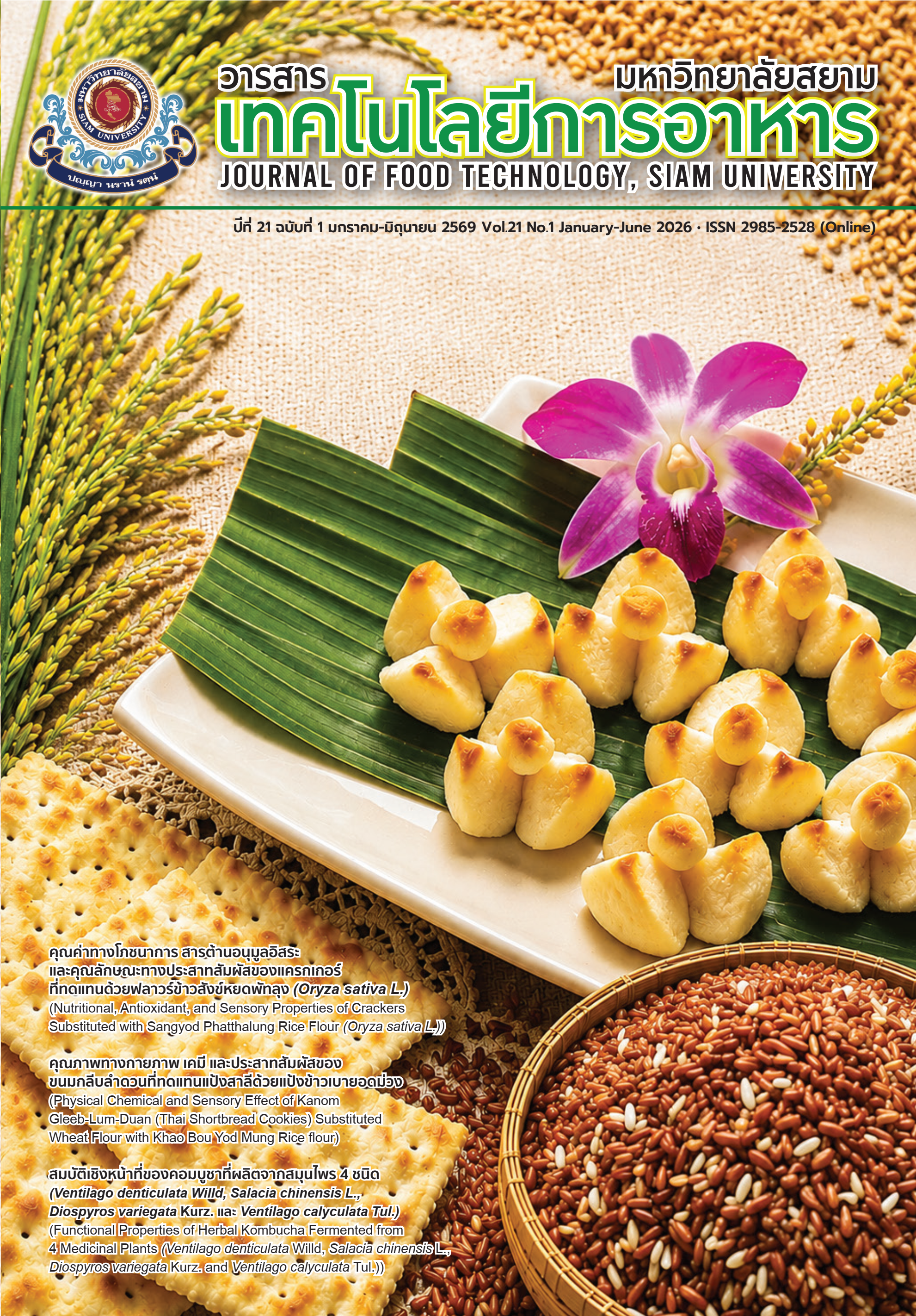
Nutritional, Antioxidant, and Sensory Properties of Crackers Substituted with Sangyod Phatthalung Rice Flour (Oryza sativa L.)
Article Sidebar
Main Article Content
Abstract
This study aimed to investigate the effect of partial substitution of wheat flour with Sangyod Phatthalung rice flour in cracker production with the substitution levels of 0, 25, 50, and 75% were evaluated for their effects on physical properties, nutritional composition, antioxidant activity, and sensory attributes. The results showed that the increased proportion of Sangyod Phatthalung rice flour significantly decreased (p≤0.05) the lightness (L*), redness (a*), yellowness (b*), hardness and water activity (aw) of the crackers, while the crispness, protein, fat, crude fiber, ash, total phenolic content (TPC), and antioxidant activities (DPPH and FRAP) were significantly increased (p≤0.05). Sensory evaluation revealed that crackers containing 50% Sangyod Phatthalung rice flour substitution received the highest overall acceptability score, at a moderate liking level (7.02). These findings suggest that Sangyod Phatthalung rice flour possesses considerable potential for the development of value-added crackers with improved nutritional quality, enhanced antioxidant activity, and favorable consumer acceptance.
Article Details

This work is licensed under a Creative Commons Attribution-NonCommercial-NoDerivatives 4.0 International License.
Copyrights of all articles in the Journal of Food Technology available in print or online are owned by Siam University and protected by law.
References
Maximize Market Research. (2023). Crackers market worldwide industry analysis, Future plans and forecast. Market Research. Online] Available from https://www.maximizemarketresearch.com/market-report/global-crackers-market/114649/. [Accessed July 19, 2025].
Zydenbos, S. and Humphrey, T.V. (2003). Biscuits, cookies and crackers nature of the products. encyclopedia of food sciences and nutrition. 2016: 524-528. doi:10.1016/B0-12-227055-X/00103-6
Kohyama, K., Nishinari, K. and Nishibata, T. (1997). Rheological studies on the gel–sol transition of food hydrocolloids. Food Hydrocolloids. 11(4): 387–393. doi:10.1016/S0268-005X(97)80037-5
Huang, Y., Chen, Z., Chen, B., Li, J., Yuan, X., Wang, W., Dai, T., Chen, H., Wang, Y., Wang, R., Wang, P., Guo, J., Dong, Q., Liu, C., Wei, Q., Cao, D. and Liu, L. (2023). Dietary sugar consumption and health: umbrella review. The British Medical Journal. 5(381): 1-18. doi:10.1136/bmj-2022-071609
Rossukon, W., Sridonpai, P. and Prachansuwan, A. (2024). Effects of nut and legume powder substitution in crackers prepared with wheat flour on postprandial plasma glucose response among healthy Thai adults. Malaysian Journal of Nutrition. 30(1): 95–106. doi:10.31246/mjn-2023-0056
Vasques, C.T., Mendes, M.P., Silva, D.M.B. and Monteiro, A.R.G. (2020). Reduction in sodium chloride content in saltine crackers through an edible coating. Czech Journal of Food Sciences. 38(4): 237 241. doi:10.17221/221/2019 CJFS
The Thai Rice Mills Association (TRMA). (2022). Report on wholesale rice prices in Bangkok market. The Thai Rice Mills Association. [Online] Available from https://www.bangkokbiznews.com. [Accessed July 19, 2025]. (in Thai).
Kovaleva, A. and Ryazantseva, I. (2019). Development of healthy crackers: Reducing sodium and replacing sugar with sweeteners. Food Science Journal. 15(3): 145–152. doi:10.1039/9781788016155-00439
Siamrath. (2025). Sangyod rice a native rice variety from Phatthalung, registered as GI. Siamrath. [Online] Available from https://siamrath.co.th. [Accessed July 19, 2025]. (in Thai).
Laokuldilok, T., Shoemaker, C.F., Jongkaewwattana, S. and Tulyathan, V. (2011). Antioxidants and antioxidant activity of several pigmented rice brans. Journal of Agricultural and Food Chemistry. 59(1): 193–199. doi:10.1021/jf103649q
Saeton, S. (2012). Sangyod rice from Phatthalung: the first rice variety in the world to receive Geographical Indication (GI) certification. Kasetsart University Agricultural Library. [Online] Available from https://agkb.lib.ku.ac.th/rd/search_detail/result/378876. [Accessed July 19, 2025]. (in Thai).
Sompong, R., Siebenhandl-Ehn, S., Linsberger-Martin, G., and Berghofer, E. (2011). Physicochemical and antioxidative properties of red and black rice varieties from Thailand, China and Sri Lanka. Food Chemistry. 124(1): 132-140. doi:10.1016/j.foodchem.2010.05.115
Yawadio, R., Tanimori, S., and Morita, N. (2007). Identification of phenolic compounds isolated from pigmented rice and their aldose reductase inhibitory activities. Food Chemistry. 101(4): 1616-1625. doi:10.1016/j.foodchem.2006.04.016
Office of Agricultural Economics (OAE). (2020). Nutritional Value of Sangyod rice. [Online] Available from https://oae.go.th/home. [Accessed July 19, 2025]. (in Thai).
Guo, H., Ling, W., Wang, Q., Liu, C., Hu, Y., Xia, M. and Feng, X. (2012). Effect of anthocyanin-rich extract from black rice on hyperlipidemia and insulin resistance in fructose-fed rats. Plant Foods for Human Nutrition Journal. 62(1): 1-6. doi:10.1007/s11130-006-0031-7
Chalermchaiwat, P., Jangchud, K., Jangchud, A., Charunuch, C., and Priyawiwatkul, W. (2015). Antioxidant activity, free gamma-aminobutyric acid content, selected physical properties and consumer acceptance of germinated brown rice extrudates as affected by extrusion process. Food Science and Technology. 64(1): 490–496. doi:10.1016/j.lwt.2015.04.066
Kovaleva, A., Galchenko, S. and Kolchanov, A. (2021). Development of technology and formulation of cracker of high nutritional value. BIO Web of Conferences. 32(2021): 1-4. doi:10.1051/bioconf/20213203013
Uivarasan, A.M., Cozmuta, L.M., Lukinac, J., Jukić, M., Šelo, G., Peter, A., Nicula, C. and Cozmuta, A.M. (2024). Whole black rice flour improves the physicochemical, glycemic, and sensory properties of cracker snacks. Foods: An Open Access journal 13(10): 1503. doi:10.3390/foods13101503
AOAC. (2000). Official methods of analysis of AOAC International (21st ed). The Association of Official Analytical Chemists, Gaithersburg, MD, USA.
Faris, N.A., Tamimi, J.Z., Ghamdi, F.A., Baridi, N.A., Zaheb, R.A., Jabryn, D.H., Jahani, A.H. and Mousa, L.A. (2021). Total phenolic content in ripe date fruits (Phoenix dactylifera L.): A systematic review and meta-analysis. Saudi Journal of Biological Sciences, 28(6): 3566–3577. doi:10.1016/j.sjbs.2021.03.033
Hansakul, P., Srisawat, U., Itharat, A. and Lerdvuthisopon, N. (2011). Phenolic and flavonoid contents of Thai rice extracts and their correlation with antioxidant activities using chemical and cell assays. Journal of the Medical Association of Thailand. 94(7): 122–130. (in Thai)
Chairerk, N., Pongyeela, P. and Chungsiriporn, J. (2021). Ethanol extraction of active ingredients and antioxidants from germinated sangyod rice. Applied Science and Engineering progress. 14(1): 52-59. doi:10.14416/j.asep.2019.03.003
Junli, Lv., Lu,Y., Yingjian,L.,Yuge, N., Linwei, L., Costa, J. and Liangli, Y. (2012). Phytochemical compositions, and antioxidant properties, and antiproliferative activities of wheat flour. Food Chemistry. 135(2): 325–331. doi:10.1016/j.foodchem.2012.04.141
Yamsaray, M., Sreewongchai,T., Phumichaib, C. and Chalermchaiwat, P. (2022). Yield and nutritional properties of improved red pericarp Thai rice varieties. ScienceAsia. 49: 155–160. doi:10.2306/scienceasia1513-1874.2022.144
Wangpankhajorn, P., Maneechot, S., Junsi, M., Jannu, T. and Samakradhamrongthai, R.S. (2020). Effect of substitution of wheat flour with Sungyod rice flour on physical and sensory qualities in cookies. Journal of Science and Technology. 9(2): 56-63. (in Thai).
Luo, M.R., Cui, G. and Rigg, B. (2001). The development of the CIE 2000 colour-difference formula: CIEDE2000. Color Research & Application. 26(5): 340- 350. doi:10.1002/col.1049
Piyawat, U., Wattanachant, S. and Nitithamyong, A. (2021). Physicochemical properties and antioxidant activity of gluten-free crackers substituted with Riceberry flour. Molecules. 26(13): 3982. doi:10.3390/molecules26133982
Suwonsichon, S. (2021). Sensory evaluation of food: Principles and practices. Kasetsart University Agricultural Library. [Online] Available from https://kukr.lib.ku.ac.th/kukr_es/BKN_AGRO/search_detail/result/341121%0A [Accessed May 21, 2025].
Gómez, M., Ronda, F., Blanco, C.A., Caballero, P.A. and Apesteguía, A. (2007). Effect of dietary fiber on dough rheology and bread quality. European Food Research and Technology. 224(1): 109–117. doi:10.1007/s00217-006-0299-7
Pongpinyopap, S. and Lerttrakarnnon, P. (2017). Physicochemical properties and antioxidant activity of Sangyod rice. Journal of Agricultural Science. 48(1): 61–70. (in Thai).
Frey, M. (2024). Flour Nutrition Facts and Health Benefits. Verywellfit. [Online] Available from https://www.verywellfit.com/flour-nutrition-facts-calories-and-health-benefits-4119166. [Accessed May 21, 2025].
Punfujinda, C., Pongprajak, A., Anunvrapong, A., Boukaew, S. and Chumkaew K. (2025). Nutritional properties, bioactive compounds, antioxidant activities, and consumer acceptance of butter cake enhanced with Sangyod rice (Oryza sativa L.) flour. Journal of Innovative Research and Scientific Studies. 8(1): 924-938. doi:10.53894/ijirss.v8i1.4469
United States Department of Agriculture. (2024). FoodData Central: Wheat flour, whole-grain. U.S. Department of Agriculture. FoodData Central. [Online] Available from https://fdc.nal.usda.gov/fdc-app.html#/food-details/170379/nutrients. [Accessed May 21, 2025].
Ministry of Public Health Notification. (2013). Food in a Hermetically Sealed Container. Faolex. [Online] Available from https://faolex.fao.org/docs/pdf/tha159844.pdf. [Accessed May 21, 2025].
Ministry of Public Health Notification. (2013). Food category 2 – Standardized or quality-defined food in hermetically sealed containers. Food. [Online] Available from https://food.fda.moph.go.th. [Accessed April 7, 2025].
Srisawat, U., Panunto, W., Kaendee, N., Tanuchit, S., Itharat, A., Lerdvuthisopon. N. and Hansakul, P. (2010). Determination of phenolic compounds, flavonoids, and antioxidant activities in water extracts of Thai red and white rice cultivars. The Journal of the Medical Association of Thailand. 7:83-91. doi:10.1055/s-0030-1264431.
Lekjing, S., Noonim, P., Boottajean, S. and Chantawong, P. (2019). Effect of substitution of wheat flour with Sangyod brown rice flour on physicochemical and sensory qualities in snack product. Khon Kaen Agricultural Journal. 24(1): 679-684. (in Thai).
