
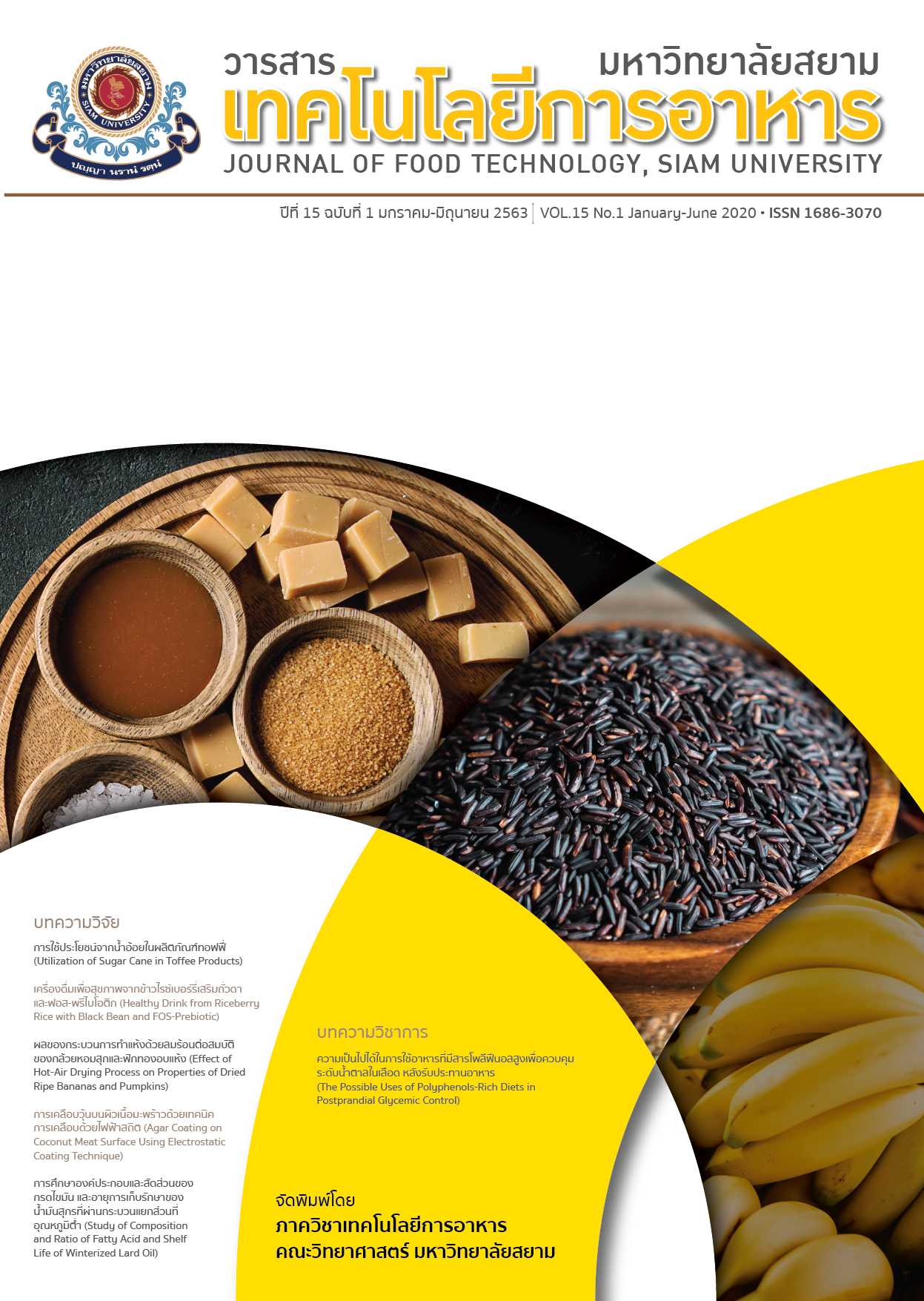
การใช้ประโยชน์จากน้ำอ้อยในผลิตภัณฑ์ทอฟฟี่
Article Sidebar
Main Article Content
บทคัดย่อ
งานวิจัยนี้มีวัตถุประสงค์เพื่อศึกษาสูตรที่เหมาะสมในการผลิตทอฟฟี่ โดยวางแผนการทดลองแบบมิกเจอร์ดีไซน์ ซึ่งประกอบด้วยน้ำอ้อยก้อนร้อยละ 0 ถึง ร้อยละ 40 น้ำตาลทรายขาวร้อยละ 0 ถึง ร้อยละ 40 และกลูโคสไซรัปร้อยละ 0 ถึง ร้อยละ 60 ได้ส่วนประกอบหลักของทอฟฟี่จำนวน 7 สูตร วิเคราะห์สมบัติทางกายภาพและทดสอบการยอมรับทางประสาทสัมผัสกับผู้ทดสอบที่ผ่านการฝึกฝน พบว่า ปริมาณกลูโคสไซรัปมีบทบาทสำคัญต่อความหนืด ความแข็ง ความชื้นและค่าสีของทอฟฟี่ โดยสูตรที่เหมาะสมในการผลิตทอฟฟี่คือสูตรที่มีน้ำอ้อยก้อน น้ำตาลทรายขาว และกลูโคสไซรัปร้อยละ 40 0 และ 60 ตามลำดับ เป็นสูตรที่ได้คะแนนเฉลี่ยการยอมรับด้านลักษณะปรากฏ (7.13+0.74) กลิ่น (7.27+0.88) การเคี้ยว (7.07+0.70) ความเหนอะ (7.00+0.85) เนื้อสัมผัส (7.07+0.80) รสชาติ (7.20+1.08) และความชอบรวม (7.13+0.92) สูงที่สุด การศึกษาผลของอุณหภูมิที่แตกต่างกันต่อคุณภาพของทอฟฟี่ พบว่า ค่าความชื้นของทอฟฟี่มีแนวโน้มลดลงเมื่อเพิ่มอุณหภูมิ ค่าความแข็งและความหนืดแปรผันตรงกับอุณหภูมิ และค่าความสว่าง (L*) มีแนวโน้มลดลงเมื่ออุณหภูมิในการกวนเพิ่มขึ้น อุณหภูมิที่เหมาะสมในการผลิตทอฟฟี่คือ 120 องศาเซลเซียส เป็นเวลา 15 นาที นอกจากนี้การพัฒนากลิ่นและรสชาติของทอฟฟี่ให้มีความหลากหลายด้วยการเติมกาแฟ ชาเขียว โกโก้ หรือมะนาวผง ซึ่งมีคะแนนการยอมรับทางประสาทสัมผัสจากผู้ทดสอบไม่แตกต่างกันในทางสถิติ เนื่องจากน้ำอ้อยซึ่งเป็นวัตถุดิบที่หาได้ง่ายในท้องถิ่น จึงเหมาะแก่การนำมาแปรรูปเป็นผลิตภัณฑ์ทอฟฟี่ เพื่อสร้างมูลค่าเพิ่มให้กับผลิตผลทางการเกษตร และทำให้ได้ผลิตภัณฑ์อาหารที่หลากหลายเป็นทางเลือกใหม่ให้กับผู้บริโภค
Article Details
บทความทุกบทความในวารสารเทคโนโลยีการอาหาร ทั้งในรูปแบบสิ่งพิมพ์ และในระบบออนไลน์ ถือเป็นลิขสิทธิ์ของมหาวิทยาลัยสยาม และได้รับการคุ้มครองตามกฎหมาย
เอกสารอ้างอิง
[2] Hhowthawee, S. (2003). Sugar technology. Kasetsart University Press. Bangkok.
[3] Maneechai, T. and Pinsirodom, P. (2013). Physicochemical composition, phenolic content and antioxidant properties of sugarcane juice and optimum condition for hydrolysis of sucrose in sugarcane juice by invertase. [Online] Available from http://www.lib.ku.ac.th/KUCONF/ 2556/KC5106008.pdf. [Accessed April, 10, 2017].
[4] Thai industrial standards institute. (2016). Community product standards: Toffee (256/2559). [Online] Available from https://www.tisi.go.th. [Accessed April, 10, 2017].
[5] Duncan, D.B. (1995) Multiple range and multiple F Tests. Biometrics. 11: 1 – 42.
[6] Kaewnoo, T and Phonrak, H. (2017). Sugar science. Journal Sugar. 1(1): 33-51.
[7] Thai industrial standards institute. (2004). Community product standards: Cane sugar (508/2547). [Online] Available from https://www.tisi.go.th. [Accessed April, 10, 2017].
[8] Pedcharat, K., Saetang, D., Tungsatitporn, D., and Sakulyunyongsuk, N. (2012) Development of candy from Thai herb: reduce inflammation. Research Report. Faculty of home economics technology. Rajamangala University of Technology Phra Nakhon. Bangkok.
[9] Songtip, P., Jangchud, K., and Wuttijumnong, P. (2007). Study of optimum ratio of sweeteners to produce snack bar from brown rice and herb. [Online] Available from http://www.lib.ku.ac.th/KUCONF/ KC4506042.pdf. [Accessed April, 10, 2017].
[10] Phunjabhud, N. and Hongrak, K. (2012) Study on mango varieties and optimum glucose syrup in mango toffee production. The 2nd National and International Graduate Study Conference. Silpakorn University.
[11] Sriroth, K. and Piyachomkwan, K. (2007). Starch Technology. Kasetsart University Press, Bangkok.
[12] Niyomrath, R. (2012). Energy saving stove for stew coconut sugar by local raw material in Bang Khon Thi District, Samut Songkhram province. Research Report. Suan Sunandha Rajabhat University. Bangkok.
[13] Thai industrial standards institute. (2009). Thai industrial standards institute: Sugar (56/2552). [Online] Available from https://www.tisi.go.th. [Accessed April, 10, 2017].
[14] Pornchaloempong, P. and Rattanapanone, N. Evaporation. [Online] Available from http://www.foodnetworksolution.com. [Accessed April, 10, 2017].
[15] Rattanapanone, N. (2014). Food chemistry. Bangkok Odeon store.
[16] Rungsadthong, V. (2014). Food processing technology. King Mongkut's University of Technology North. Text and Journal Publication Co.,Ltd. Bangkok.
[17] Charoenrein, S and Reepholkul, K. (2013). Glass transition of sugar during production of peanut brittle. Food. 43(3): 74-81.
[18] Ajandouz, E.H., Tchiakpe, L.S., Dalle Ore, F., Benajiba, A. and Puigserver, A. (2001). Effects of pH on caramelization and maillard reaction kinetics in fructose-lysine medel systems. JFS: Food Chemistry and Toxicology. 66(7): 926-931.
[19] Jhantakul, S., Hongrattanavorakit, S., Boonyarutkalin, T., Owajariyapitak, D., Phonphanpipat, S., Deejali, P., and Tapin, S. (2016). The development of incense sticks product from lime skin. Research Report. Faculty of home economics technology. Rajamangala University of Technology Phra Nakhon. Bangkok.
[20] Thepkhon, T. (2013). Green tea catechins and storage stability. KKU Science Journal. 41(1): 46-55.
[21] Bunteongjit, D. (2004). Green tea. Journal Department of Science Service Ministry of Science and Technology. 52(164): 10-14.
[22] Suphamityotin, P. (2013). Fruit and vegetable technology. Bangkok. Odeon store.
[23] Rungsrangtham, N. (2006) Changes volatile compounds in roasted arabica coffee beans during storage. Master’s thesis. Silpakorn University. Nakhon Pathom.
[24] Wongnai, W. (2016). Cocoa: the best food and magic medicine of all ages. Horticultural Science Society of Thailand. 32(1): 4-6.
