
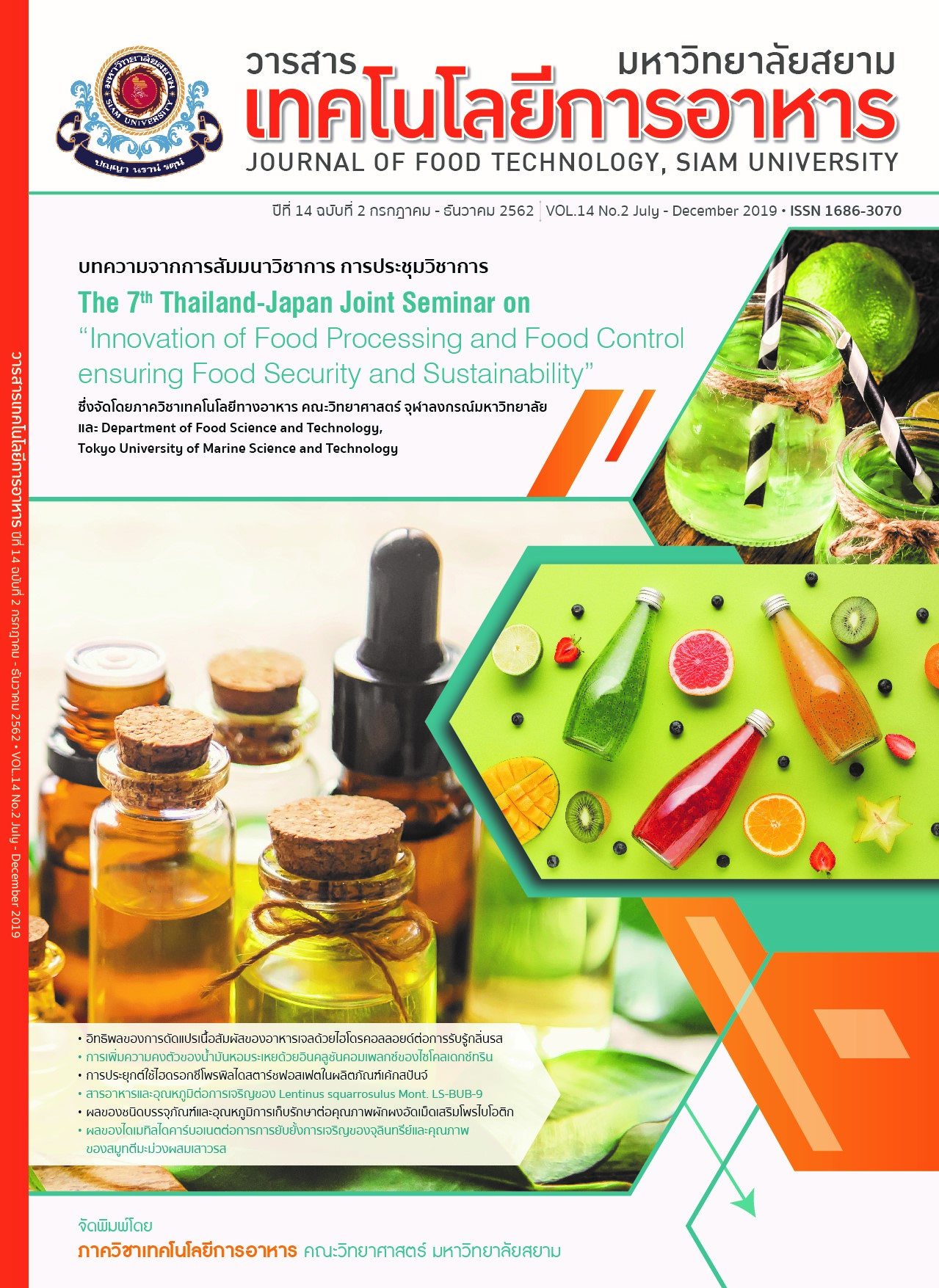
การเพิ่มความคงตัวของน้ำมันหอมระเหยด้วยอินคลูชันคอมเพลกซ์ของไซโคลเดกซ์ทริน
Article Sidebar
Main Article Content
บทคัดย่อ
สารระเหยให้กลิ่นที่เป็นเอกลักษณ์เฉพาะตัวในน้ำมันหอมระเหยจากพืช ส่วนใหญ่ไม่คงตัวและระเหยได้ง่ายเมื่อผ่านกระบวนการแปรรูปหรือเก็บรักษาไว้เป็นเวลานาน ประกอบกับน้ำมันหอมระเหยมีสมบัติในการละลายน้ำที่ไม่ดี การใช้เทคนิคการห่อหุ้ม (encapsulation) เป็นการช่วยให้น้ำมันหอมระเหยมีความคงตัวมากขึ้น ซึ่งการห่อหุ้มน้ำมันหอมระเหยด้วยไซโคลเดกซ์ทริน (CDs) เกิดเป็นสารประกอบอินคลูชัน ช่วยให้มีความคงตัวและมีสมบัติการละลายน้ำได้ดีขึ้น การเตรียมสารประกอบอินคลูชันขึ้นอยู่กับสมบัติของน้ำมันหอมระเหยและชนิดของ CDs สารประกอบอินคลูชันระหว่างน้ำมันหอมระเหยกับ CDs จะมีความคงตัวต่อความร้อนและรังสี ทำให้มีสมบัติในการต้านอนุมูลอิสระ ต้านการเจริญของจุลินทรีย์ และเพิ่มความสามารถในการละลายน้ำให้ดีขึ้นได้ นอกจากนี้ยังสามารถควบคุมการปลดปล่อยของสารระเหยให้กลิ่นในน้ำมันหอมระเหยได้อีกด้วย และด้วยคุณสมบัติเด่นนี้ทำให้สามารถประยุกต์ใช้สารประกอบอินคลูชันของน้ำมันหอมระเหยกับ CDs ในอุตสาหกรรมอาหารและยาได้หลากหลาย
Article Details
บทความทุกบทความในวารสารเทคโนโลยีการอาหาร ทั้งในรูปแบบสิ่งพิมพ์ และในระบบออนไลน์ ถือเป็นลิขสิทธิ์ของมหาวิทยาลัยสยาม และได้รับการคุ้มครองตามกฎหมาย
เอกสารอ้างอิง
[2] Bakkali, F., Averbeck, S., Averbeck, D., and Idaomar, M. (2008). Biological effects of essential oils a review. Food Chemistry. 46: 446-475.
[3] Calo, J. R., Crandall, P. G., O’Bryan, C. A., and Ricke, S. C. (2015). Essential oils as antimicrobials in food systems: a review. Food Control. 54: 111-119.
[4] Del Valle, E. M. M. (2004). Cyclodextrins and their uses: A review. Process Biochemistry. 39: 1033-1046.
[5] Fenyvesi, E., Gruiz, K., Verstichel, S., Wilde, B. De., Leitgib, L., Csabai, K., and Szaniszlo, N. (2005). Biodegradation of cyclodextrins in soil. Chemosphere. 60: 1001–1008.
[6] Kfoury, M., Hadaruga, N. G., Hadaruga, D. I., and Fourmentin, S. (2016). Chapter 4; Cyclodextrins as encapsulation material for flavors and aroma. In Grumezescu, A. M. (Ed.) Encapsulations. Elsevier Inc. pp. 127-192.
[7] Connors, K. A. (1997). The stability of cyclodextrin complexes in solution. Chemical Reviews. 5: 1325-1357.
[8] Ponce C. P., Buera, M., and Elizalde, B. (2010). Encapsulation of cinnamon and thyme essential oils components (cinnamaldehyde and thymol) in beta-cyclodextrin: Effect of interactions with water on complex stability. Journal of Food Engineering. 99: 70–75.
[9] Szejtli, J. (1998). Introduction and general overview of cyclodextrin chemistry. Chemical Reviews. 98(5): 1743–1753.
[10] Astray, G., Gonzalez, B. C., Mejuto, J. C., Rial, O. R., and Gandara, S. J. (2009). A review on the use of cyclodextrins in foods. Food Hydrocolloids. 23: 1631-1640.
[11] Abarca, R. L., Rodriguez, F. J., Guarda, A., Galotto, M. J., and Bruna, J. E. (2016). Characterization of beta-cyclodextrin inclusion complexes containing an essential oil component. Food Chemistry. 196: 968-975.
[12] Cheirsilp, B., and Rakmai, J. (2016). Inclusion complex formation of cyclodextrin with its guest and their applications. Biology, Engineering and Medicine. 2(1): 1-6.
[13] Kfoury, M., Auezova, L., Ruellan, S., and Greige-Gerges, H. (2015). Complexation of estragole as pure compound and as main component of basil and tarragon essential oil with cyclodextrins. Carbohydrate polymers. 118: 156-164.
[14] Zhang, Y., Zhang, H., Wang, F., and Wang L. (2018). Preparation and Properties of Ginger Essential beta-cyclodextrin/ chitosan inclusion complexes. MDPI. 8: 305-318.
[15] Liu, H., Yang, G., Tang, Y., Cao, D., Qi, T. Qi, Y., and Fan, G. (2013). Physicochemical characterization and Pharmacokinetics evaluation of beta-caryophyllene/beta-cyclodextrin inclusion complex. International Journal of Pharmaceutics. 450: 304-310.
[16] Higuchi, T., and Connors, K. A. (1965). Phase solubility techniques. In Advances in Analytical Chemistry Instrument; Wiley-Interscience: New York, NY, USA, Volume 4, pp. 56–63.
[17] Mourtzinos, I., Salta, F., Yannakopoulou, K., Chiou, A., and Karathanos, V. T. (2007). Encapsulation of Olive Leaf Extract in β-Cyclodextrin. Journal of Agricultural and Food Chemistry. 55: 8088-8094.
[18] Marques, H. M. C. (2010). A review on cyclodextrin encapsulation of essential oils and volatiles. Flavour and Fragrance Journal. 25: 313-326.
[19] Szejtli, J., and Szente, L. (1979). Stabilization of volatile, oxidizable flavour substances by β-cyclodextrin. Planta Medica. 36(3): 292–293.
[20] Partanen, R., Ahro, A., Hakala, M., Kallio, H., and Forssell, P. (2002). Microencapsulation of caraway extract in β-cyclodextrin and modified starches. European Food Research and Technology. 214: 242-247.
[21] Locci, E., Lai, S., Piras, A., Marongiu, B., and Lai, A. (2004). 13C‐CPMAS and 1H‐NMR Study of the Inclusion Complexes of β-Cyclodextrin with Carvacrol, Thymol, and Eugenol Prepared in Supercritical Carbon Dioxide. In Smith, R. J. (Ed.) Chemistry and Biodiversity. Wiley-VHCA AG. pp. 1241-1400.
[22] Hill, L. E., Gomes, C., Matthew, T. T. (2013). Characterization of beta-cyclodextrin inclusion complexes containing essential oils (trans-cinnamaldehyde, eugenol, cinnamon bark, and clove bud extracts) for antimicrobial delivery applications. Food Science and Technology. 51(1): 86-93.
[23] Ciobanu, A., Mallard, I., Landy, D., Brabiec, G., Nistorc, D., and Fourmentin, S. (2012). Inclusion interactions of cyclodextrins and crosslinked cyclodextrin polymers with linalool and camphor in Lavandula angustifolia essential oil. Carbohydrate Polymers. 87: 1963–1970
[24] Ruktanonchai, U. R., Srinuanchai, W., Saesoo, S., Sramala, I., Puttipipatkhachorn, S., and Soottitantawat, A. (2011). Encapsulation of citral isomers in extracted lemongrass oil with cyclodextrins: molecular modeling and physicochemical characterizations. Bioscience, Biotechnology, and Biochemistry. 75(12): 2340-2345.
[25] Liang, H., Yuan, Q., Vriesekoop, F., and Lv, F. (2012). Effects of cyclodextrins on the antimicrobial activity of plant-derived essential oil compounds. Food Chemistry. 135(3): 1020-1027.
[26] Arana, S. A., Estarron, E. M., Obledo, V. E. N., Padilla, C. E., Silva, V. R., and Lugo, C. E. (2010). Antimicrobial & antioxidant activities of Mexican oregano oil with different composition when microencapsulated in β-CD. The Society for Applied Microbiology. 50: 585-590.
[27] Rakmai, J., Cheirsilp, B., Cid, A., Agrasar, T. A., Mejuto, C. J., and Gandara., S. J. (2018). Chapter 11; Encapsulation of Essential Oils by Cyclodextrins: Characterization and Evaluation. In Arora, P., and Dhingra, N. (Eds.) A Versatile Ingredient. IntechOpen. pp. 263-290.
[28] Rosenberg, M., Kopelman, I. J., and Talmon, Y. (1990) Factors affecting retention in spray-drying microencapsulation of volatile materials. Journal of Agricultural and Food Chemistry. 38: 1288-1294.
[29] Suppavorasatit, I., De Mejia, E. G., and Cadwallader, K. R. (2011). Optimization of the enzymatic deamidation of soy protein by protein-glutaminase and its effect on the functional properties of the protein. Journal of Agricultural and Food chemistry. 59(21): 11621-11628.
[30] Suppavorasatit, I., Lee, S. Y., and Cadwallader, K. R. (2013). Effect of enzymatic protein deamidation on protein solubility and flavor binding properties of soymilk. Journal of Food Science, 78(1): C1-C7.
[31] Kunarayakul, S., Thaiphanit, S., Anprung, P., and Suppavorasatit, I. (2018). Optimization of coconut protein deamidation using protein-glutaminase and its effect on solubility, emulsification, and foaming properties of the proteins. Food Hydrocolloid. 79: 197-207.
[32] Silva, M. C. E., Galhano, C. I. C., and Silva, A. M. G. M. (2007). A new sprout inhibitor of potato tuber based on carvone/β-cyclodextrin inclusion compound. In Albrecht, M. (Ed.) Journal of Inclusion Phenomena and Macrocyclic Chemistry. Springer. pp. 121-124.
