
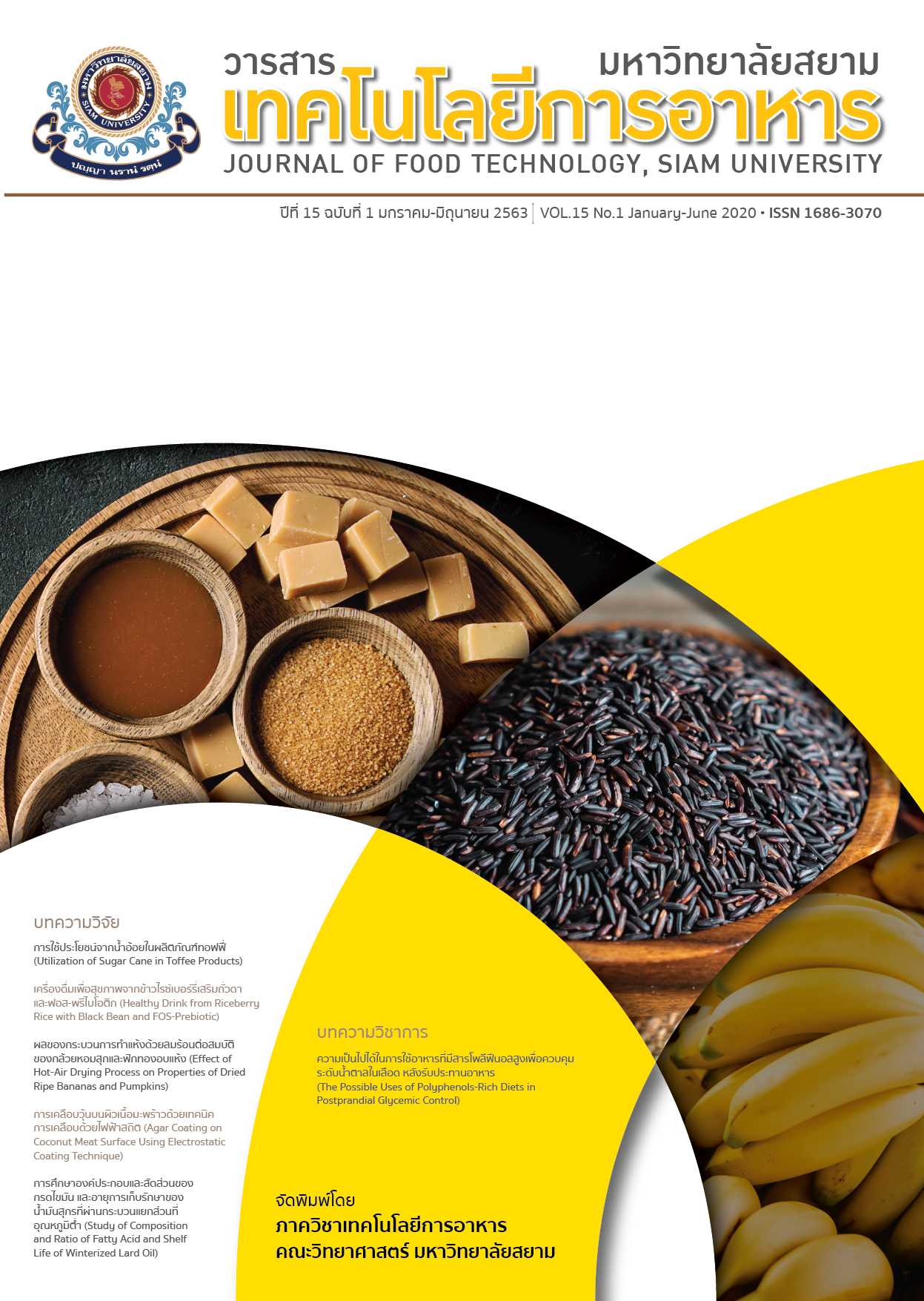
การศึกษาองค์ประกอบและสัดส่วนของกรดไขมัน และอายุการเก็บรักษาของน้ำมันสุกรที่ผ่านกระบวนแยกส่วนที่อุณหภูมิต่ำ
Article Sidebar
Main Article Content
บทคัดย่อ
งานวิจัยนี้ศึกษาองค์ประกอบและสัดส่วนของกรดไขมันและอายุการเก็บรักษาของน้ำมันสุกรคูโรบูตะและสุกรสามสายเพื่อใช้เป็นข้อมูลพื้นฐานในการผลิตน้ำมันสุกรเชิงอุตสาหกรรมต่อไป น้ำมันสุกรทั้ง 2 สายพันธุ์ถูกผลิตจากการให้ความร้อนมันสุกรบดที่อุณหภูมิ 90-140 องศาเซลเซียส 1 ชั่วโมง และแยกส่วนที่อุณหภูมิต่ำ 2 ขั้นตอน คือ 28 องศาเซลเซียส 48 ชั่วโมง และ 26 องศาเซลเซียส 48 ชั่วโมง ผลผลิตน้ำมันหลังการให้ความร้อนมันสุกรคูโรบูตะและสุกรสามสายคือ ร้อยละ 60.96 และ 59.14 ตามลำดับ หลังการแยกส่วนที่อุณหภูมิต่ำได้ผลผลิตน้ำมันสุกรสามสายร้อยละ 25.13 และสุกรคูโรบูตะร้อยละ 20.54 น้ำมันสุกรคุโรบูตะมีกรดไขมันอิ่มตัว (SFA) กรดไขมันไม่อิ่มตัวเชิงเดี่ยว (MUFA) และกรดไขมันไม่อิ่มตัวเชิงซ้อน (PUFA) ร้อยละ 34.28, 42.37 และ 18.37 ตามลำดับ น้ำมันสุกรสามสายมี SFA, MUFA และ PUFA ร้อยละ 33.76, 41.41 และ 19.83 ตามลำดับ น้ำมันสุกรคูโรบูตะมีกรดไขมันโอเมก้า 3, 6, 7 และ 9 เท่ากับ 1.03, 17.32, 2.24 และ 40.11 กรัม/100 กรัม น้ำมันสุกรสามสายมีกรดไขมันโอเมก้า 3, 6, 7 และ 9 เท่ากับ 1.15, 18.68, 2.04 และ 39.35 กรัม/100 กรัม ตามลำดับ น้ำมันสุกรทั้งสองสายพันธุ์ไม่มีไขมันทรานส์ อายุการเก็บรักษาเฉลี่ยของน้ำมันสุกรคูโรบูตะและน้ำมันสุกรสามสายที่อุณหภูมิ 24±1 องศาเซลเซียส ในสภาวะมีแสง คือ 75 วัน และ 60 วัน ตามลำดับ
Article Details
บทความทุกบทความในวารสารเทคโนโลยีการอาหาร ทั้งในรูปแบบสิ่งพิมพ์ และในระบบออนไลน์ ถือเป็นลิขสิทธิ์ของมหาวิทยาลัยสยาม และได้รับการคุ้มครองตามกฎหมาย
เอกสารอ้างอิง
Orsavova, J., Misurcova, L., Ambrozova, J.V., Vicha, R., and Mlcek, J. (2015). Fatty acids composition of vegetable oils and its contribution to dietary energy intake and dependence of cardiovascular mortality on dietary intake of fatty acids. International Journal of Molecular Sciences. 16: 12871-12890.
Rohman, A., Triyana, K., Sismindari, and Erwanto, Y. (2012). Differentiation of lard and other animal fats based on triacylglycerols composition and principal component analysis. International Food Research Journal. 19(2): 475-479.
Mattson, F.H. and Lutton, E.S. (1958). The specific distribution of fatty acids in the glycerides of animal and vegetable fats. Journal of Biological Chemistry. 233(4): 868-871.
Kostik, V., Memeti, S., and Bauer, B. (2013). Fatty acid composition of edible oils and fats. Journal of Hygienic Engineering and Design. 4: 112-116.
Scanes, C.G. (2018). Animal Products and Human Nutrition. Animals and Human Society. 41–64.
Woodgate, S.L. and van der Veen, J.T. (2014). Fats and Oils – Animal Based. Food Processing: Principles and Applications. 2nd Edition. John Wiley & Sons, Ltd.
Arnold, L.A. and Cleveland, R.S. Winterized vegetable oil and process of producing the same. United State Patent Office. US2,607,695. Patented Aug. 19, 1952.
Ritruengdech, K., Sajjapibul, C., and Klinkesorn, U. (2550). Quality Improvement Of Lard Using Dry Fractionation. in: 33rd Congress on Science and Technology of Thailand (STT.33) : Science and technology for global sustainability 18-20 October 2007. Faculty of Agro-Industry, Kasetsart University, Bangkok.
Gooding, C. Winterization process. United States Patent Office. US3,048,491. Patented Aug. 7, 1962.
Wootton, J.C. Process for the improved winterization of oil. United State Patent Office. US3,360,533. Patented Dec. 26, 1967.
Morrison, W.H. and Thomas, J.K. (1976). Removal of waxs from sunflower seed oil by miscella refining and winterization. Journal of the American Oil Chemists' Society. 53(7): 485-486.
Pushpinder, S.P. (1980). Winterization of oils and fats. Journal of the American Oil Chemists' Society. 57(11): A848-A850.
Yokochi, T., Usita, M.T., Kamisaka, Y., Nakahara, Y., and Suzuki, O. (1990). Increase in the ɤ- linolenic acid content by solvent winterization of fungal oil extracted from Mortierella genus. Journal of the American Oil Chemists' Society. 67(11): 846-851.
Campos, R., Narine, S.S., and Marangoni, A.G. (2002). Effect of cooling rate on the structure and mechanical properties of milk fat and lard. Food Research International. 35: 971-981.
Lopez-Martinez, J.C., Campra-Madrid, P., and Guil-Guerrero, J.L. (2004). ɤ- linolenic acid enrichment from Borago officinalis and Echium fastuosum seed oils and fatty acids by low temperature crystallization. Journal of Bioscience and Bioengineering. 97(5): 294-298.
Takahashi, H. (2004). Swine Breeding Systems to Enhance Pork Quality in Japan. Swine Improvement Federation. 29th Annual, 81-87.
Ravansook, S. (2004). Swine Breeding Systems of Charoen Pokphand Companies (CP) in Southeast Asia. Swine Improvement Federation. 29th Annual, 77-80.
Campbell, N.A. and Reece, J.B. (2001). Biology 6th edition. Benjamin Cummings, San Francisco.
Finucane, O.M., Lyons, C.L., Murphy, A.M., Reynolds, C.M., Klinger, R., Healy, N.P., Cooke, A.A., Coll, R.C., McAllan, L., Nilaweera, K.N., O’Reilly, M.E., Tierney, A.C., Morine, M.J., Alcala-Diaz, J.F., Lopez-Miranda, J., O’Connor, D.P., O’Neill, L.A., McGillicuddy, F.C., and Roche, H.M. (2015). Monounsaturated fatty acid–enriched high-fat diets impede adipose NLRP3 inflammasome–mediated IL-1β secretion and insulin resistance despite obesity. Diabetes. 64(6): 2116-2128.
Garg, A. (1998). High-monounsaturated-fat diets for patients with diabetes mellitus: a meta-analysis. The American Journal of Clinical Nutrition. 67(3): 577S–582S.
Yun, J. M. and Surh, J. (2012). Fatty acid composition as a predictor for the oxidation stability of Korean vegetable oils with or without induced oxidative stress. Preventive Nutrition and Food Science. 17(2): 158–165.
