
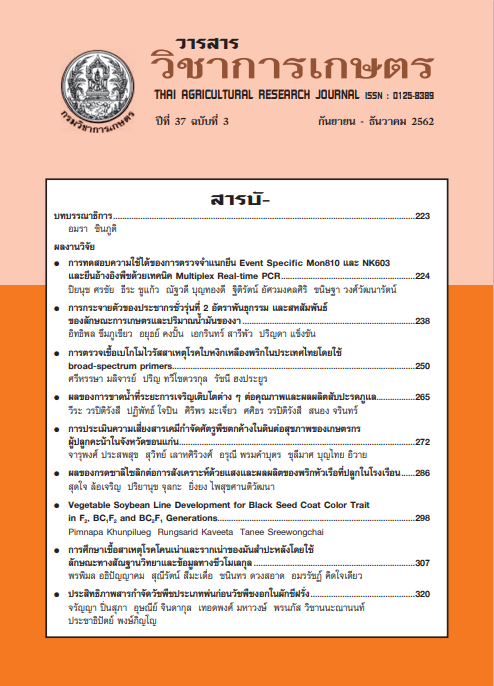
การทดสอบความใช้ได้ของการตรวจจำแนกยีน Event Specific Mon810 และ NK603 และยีนอ้างอิงพืชด้วยเทคนิค Multiplex Real-time PCR
DOI:
https://doi.org/10.14456/thaidoa-agres.2019.19คำสำคัญ:
ข้าวโพดดัดแปลงพันธุกรรม; multiplex real-time PCR; Mon810; NK603; การทดสอบ ความใช้ได้บทคัดย่อ
ข้าวโพดดัดแปลงพันธุกรรมได้รับการยอมรับให้มีการขายเชิงพาณิชย์ในหลายประเทศโดยสายพันธุ์ที่ได้รับการอนุญาตให้ปลูกมากที่สุด ได้แก่ ข้าวโพดทนทานสารกำาจัดวัชพืชไกลโฟเสท (NK603 event) และต้านทานแมลง (Mon810 event) แต่การนำเข้าสินค้าเกษตรของบางประเทศจะต้องผ่านการประเมินความปลอดภัยทางชีวภาพและผ่านการตรวจวิเคราะห์จำแนกสายพันธุ์ของพืชดัดแปลงพันธุกรรมก่อน ปัจจุบันห้องปฏิบัติการระดับสากลตรวจจำแนกสายพันธุ์พืชดัดแปลงพันธุกรรมด้วยเทคนิค simplex real-time PCR ซึ่งมีขั้นตอนในการตรวจสอบหลายขั้นตอนส่งผลให้มีโอกาสเกิดความผิดพลาดได้สูง และใช้ระยะเวลาในการตรวจสอบนาน จึงได้พัฒนาวิธีการจำแนกสายพันธุ์ข้าวโพดดัดแปลงพันธุกรรมสายพันธ์ุ Mon810 และ NK603 ร่วมกับยีนอ้างอิงพืชด้วยเทคนิค multiplex real time PCR โดยวัตถุประสงค์ของงานวิจัยครั้งนี้คือการทดสอบความใช้ได้ของวิธีการดังกล่าว ผลการทดลองพบว่า เทคนิค multiplex มีความจำเพาะในการตรวจจำแนกยีนข้าวโพดดัดแปลงพันธุกรรมสายพันธ์ุ Mon810 และ NK603 ได้ถูกต้อง 100%ค่าพารามิเตอร์ของปฏิกิริยาอยู่ในเกณฑ์ที่ยอมรับได้ดังนี้ ค่า PCR efficiency 97-112% ค่า linearity (R2) และค่า Slope เท่ากับ 0.99 อยู่ในช่วง -3.38 ถึง -3.07 ตามลำดับ และระดับการปนเปื้อนต่ำทีสุ่ดที่สามารถตรวจสอบได้ คือ0.1% และไม่พบการเกิด false positive และfalse negative สรุปได้ว่าเทคนิคการตรวจสอบ Mon810 NK603 และยีน HMG รวมกันในปฏิกิริยาเดียว แบบ multiplex real-time PCR สามารถใช้เป็นวิธีการตรวจจำแนกยีนของตัวอย่างข้าวโพดดัดแปลงพันธุกรรมและผลิตภัณฑ์จากข้าวโพดได้
เอกสารอ้างอิง
ปิยรัตน์ ธรรมกิจวัฒน์ ปิยนุช ศรชัย ฐิติรัตน์ อัศวมงคลศิริ และพงศกร สรรค์วิทยากุล. 2562. การพัฒนาเทคนิค Triplex real-time PCR เพื่อตรวจคัดกรองข้าวโพดดัดแปลงพันธุกรรมตามมาตรฐาน ISO/IEC 17025. วารสารวิชาการเกษตร. ปีที่ 36 ฉบับที่ 3: 316-331
วีระพงศ์ ลุลิตานนท์. 2557. เทคนิคเรียลไทม์พีซีอาร์ Real-time PCR. บริษัท ดีทรีโอ จำกัด. กรุงเทพมหานคร. 157 หน้า
Alary, R., A. Serin, D. Maury and P. Joudrier. 2003. Comparison of simplex and duplex real-time PCR for quantification of GMO in maize and soybean. Food control 13:235-244.
Broeders, S., I, Huber, L. Grohamann, G. Berben, I. Taverniers, M. Mazzara, N. Roosens and D. Morisset. 2014. Guidelines for validation of qualitative real-time PCR methods. Trends in Food Science and Technology 37:115-126.
Bustin, SA., T. Nalon. 2004. Primer and Probes. Pages 279-328. In: Bustin SA. Eds. A-Z of quantitative PCR. La Jolla, California: International university line.
Cankar, K., D. Stebih, T. Dreo, J. Zel and K. Gruden. 2006. Critical points of DNA quantification by real-time PCR-effects of DNA extraction method and sample matrix on quntification of GMO. BMC Biotechnology. 15pp.
Charles Delobel, C., E. Grazioli, S. Larcher, M. Mazzara and G. Van Den Eede. 2008. Event Specific method for the quantification of maize line LY038 using real-time PCR-Validation report and protocol. EUR 23647 EN. Luxembourg: Publication office of the European Union. JRC48919 (ISBN 978-92-79-11047-4).
Debode, F., E. Janssen and G. Berben. 2013. Developement of 10 new screening PCR assays for GMo detection targeting promoters (pFMV, pNOS, pSSuAra, pTA29, pUbi, pRice actin) and terminator (t35S, tE9, tOCS, tg7). Eur. Food Res. Technol. 236:659-669.
Del Gaudio, S., Cirillo, A., Di Bernardo, G. and M. Cipollaro. 2012. Verification of real-time PCR methods for qualitative and quantitative testing of genetically modified organism. J. Food Qual. 35: 442-447.
Ellison, S.LR., C. A. English, M. J. Burns and J. T. Keer. 2006. Routes to improving the reliability of low level DNA analysis using real-time PCR. BMC Biotechnology. 11 pp.
Hugo, R.P., I.R. Martin and H.V. Ruben. 2002. Detection and quantification of transgenes in grains by multiplex and real time PCR. J. Agric. Food Chem. 50(16): 4431-4436.
ISAAA .2018. ISAAA's GM Approval Database. http://www.isaaa.org/gmapprovaldatabase/.
JRC-EURL GMFF-ENGL. 2011. JRC- Compendium of reference methods for GMO analysis. Luxembourg: Publication office of the European Union. 259 p. (http://publications.jrc.ec.europa.eu/repository/bitstream/111111111/22754/1/gmo-jrc_reference%20report_2011_publ.pdf)
Kramkowska, M., T. Grzelak and K. Czyzewska. 2013. Benefits and risks associated with genetically modified food products. Ann. Agr. Envir. Med. 20(3): 413-419.
Lab Life-Real-Time PCR. 2015. Compare and contrast: multiplex vs singleplex PCR. Roche Life Science. Posted on September 19,2015. Available at: (https://www.lifescience.roche.com/en_th/blog/lab-life/real-time-pcr/compare-and-contrast-multiplex-vs-singleplex-pcr.html) AccessedL 12 August, 2018.
Mazzara M., Savini C., Munaro B., Foti N. and Van Den E.G. 2007. Event-specific method for the quantification of maize line MIR604 using Real-time PCR-Validation report and protocol-maize seeds sampling and DNA extraction. EUR 22913 EN.Luxembourg: OPOCE. In Compendium of reference methods for GMO analysis. 2010.
Rogriguez, A., M. Rodriguez, J.J. Cordoba and MJ. Andrade. 2015. Design of primers and probes for quantitiative real-time PCR method. Methods Mol Biol. 1275:31-56
Roger, S.O. and A.J. Bendich. 1985. Extraction of DNA from milligram amounts of fresh herbarium and mummified plant tissues. Plant Molecular Biology. 5:69-76.
Shrestha H.K., H. Kae-Kang and C. Men-Chi. 2010. Detection of genetically modified maize (Zea mays L.) in seed samples from Nepal. Afr. J. Biotechnol. 9(34): 5581-5589.
Sornchai, P., T. chookaew, N. Kaewnuy, T. Assawamongkolsiri and K. Wongwathanarat. 2018. Developing of Genetically Modified Maize, Mon810 and NK603 Detection Method using Multiplex Real-time PCR technique. Pages 27-40. In: Proc. 15th KU-KPS National Conference Proceeding. Dec. 6-7,2018. Nakhon Pathom.
Turkec, A., H. Kazan, B. Karacanli and S. J. Lucas. 2015. DNA extraction technique compared for accurate detection of genetically modified organism (GMOs)) in maize food and fee products. J. Food Sci. Technol. 52(8): 5164-5171.
Vallone, PM. And JM. Butler. 2004. Auto dimer: a screening tool for primer-dimer and hairpin structures. Biotechniuqes. 37: 226-231.
ดาวน์โหลด
เผยแพร่แล้ว
รูปแบบการอ้างอิง
ฉบับ
ประเภทบทความ
สัญญาอนุญาต
ลิขสิทธิ์ (c) 2020 วารสารวิชาการเกษตร

อนุญาตภายใต้เงื่อนไข Creative Commons Attribution-NonCommercial-NoDerivatives 4.0 International License.
วารสารวิชาการเกษตร

