
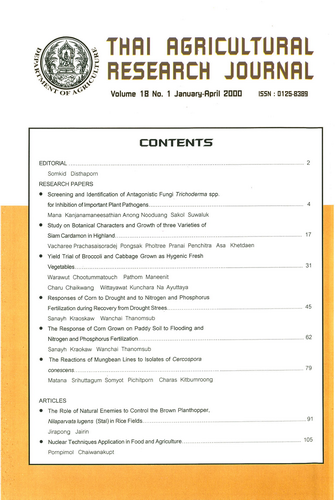
The Role of Natural enemies to Control the Brown Planthopper. Nilaparvata Iugens (Stal) in Rice fields
DOI:
https://doi.org/10.14456/thaidoa-agres.2000.7Keywords:
natural enemies, rice brown planthopperAbstract
Large number of natural enemies are available in the paddy field. their roles in suppressing brown plsnyhopprt (BPH), Nilaparvata lugens (Stal), population has been for a long time in considered important. Recently by survery, over 85 species of natural enemies of the BPH have been recorded, comprise of 45 species of parasites and pathogens and more than 41 species of predators. Most important of natural enemies in Thailand are egg parasites such as Anagrus spp. and Paracentrobia spp. They are belonging to the Mymarids and Trichogrammatids respectively. Dryinids have been identified as nymph and adult parasites such as Pseudogonatopus spp. Cytorhinus sp. And Tythus sp. They are in Miridae and have been considered an effective predator. Other predators included carabids, common carnivorous beetles, Ophionea sp., coccinellids beetles, Micraspis spp. and spiders, lycosa sp. and Tetragnatha spp., were also effective predators.
Downloads
Published
How to Cite
Issue
Section
License

This work is licensed under a Creative Commons Attribution-NonCommercial-NoDerivatives 4.0 International License.
Thai Agricultural Research Journal

