
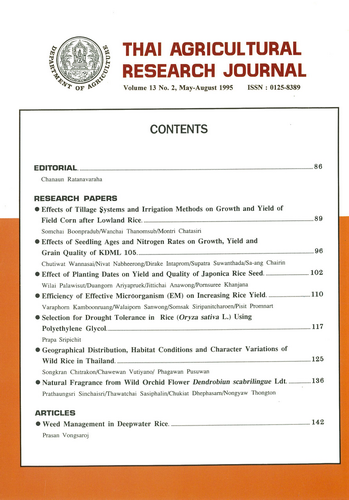
Effects of Tillage Systems and Irrigation Methods on growth and Yield of field of field Corn After Lowland Fice
DOI:
https://doi.org/10.14456/thaidoa-agres.1995.8Keywords:
Zea mays L., irrigation, tillage methods; growt, yieldAbstract
Corn (Zea mays L.) is one of the dryland crops grown in rice-basd cropping systems, however, yield this crop is generally low. One of the factors contributing to low yield is the poor management in terms of soil and water management to the environment of the rice paddy. Field study was conducted on sandy loam texture at the farm of Phitsanulok Field Crops Experiment Station during 1993 and 1994 in dry seasom (December - May). The objectives of this study were to determine the effect of the irrigation and tillage methods on growth, grain yield and their profits of field corn in paddy field under irrigated conditions. The results showed that maximum grain yield and profit were obtained under broad seedbed preparation (double row) with minimum tillage method when no-tillage (rice stubble) was compared. A delay in flowering was observed in no-tillage plot. Flowering date, plant height and number of ear per unit area were affected by methods of tillage and irrigation.
Downloads
Published
How to Cite
Issue
Section
License

This work is licensed under a Creative Commons Attribution-NonCommercial-NoDerivatives 4.0 International License.
Thai Agricultural Research Journal

