
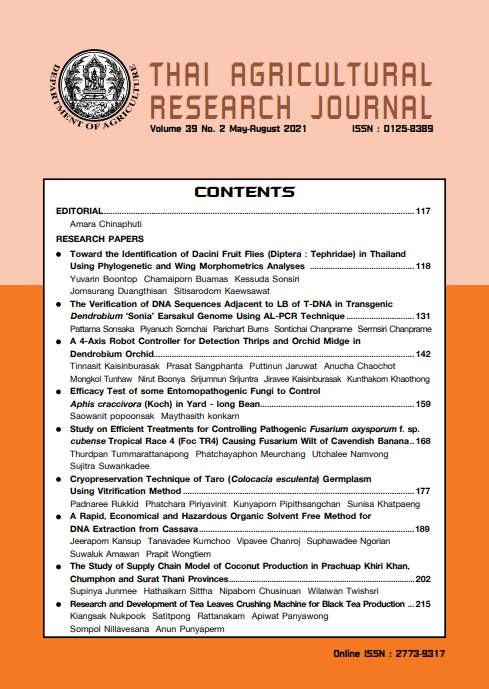
Study on Efficient Treatments for Controlling Pathogenic Fusarium oxysporum f.sp. cubense Tropical Race 4 (Foc TR4) Causing Fusarium Wilt of Cavendish Banana
DOI:
https://doi.org/10.14456/thaidoa-agres.2021.14Keywords:
Fusarium oxysporum f. sp. cubense Tropical race 4, Fusarium wilt, Cavendish BananaAbstract
The effective treatments for controlling Fusarium wilt in Cavendish banana. were investigated. The objective of the study was to compare the efficacy of biological, chemical and natural material treatments for controlling pathogenic Fusarium oxysporum f.sp. cubense Tropical race 4 (Foc TR4) causing Fusarium wilt in Cavendish banana, at Chiangsaen Plant Quarantine Station, Chiang Rai Province from October 2020 to September 2021. Results revealed that all 5 treatments namely, calcium oxide, CaO (1 g/200 ml), ashes (1 g/200 ml), Trichoderma harzianum-DOA (107 spores/ml), Bacillus subtilis (3 g/L) and captan (3 g/L) were effective in controlling Foc TR4. Treated plants showed 35% - 50% disease severity which was statistically significant (p < 0.01) different from 100 % disease incidence
of the control treatment that received only Foc TR4 inoculation. Rhizosphere soil samples of each treatment were determined for the population of Foc TR4. Results showed that in treated soils the population of Foc TR4 was ranged from 1.8 x 10² to 25 x 102 CFU/g whereas the population of Foc TR4 control treatment was 1.3 x 10³ CFU/g. Results of the experiment suggested that, adding calcium oxide, ash, T. harzianum-DOA, B. subtilis or captan in the bottom of the pit or mixing the soil around the Cavendish banana alone or in combination would reduce the severity of Fusarium wilt.
References
อภิรัชต์ สมฤทธิ์ ยุทธศักดิ์ เจียมไชยศรี และสุณีรัตน์ สีมะเดื่อ. 2556. การทดสอบประสิทธิภาพเชื้อรา Trichoderma harzianum ในการควบคุมโรคตายพรายของกล้วยน้ำว้าที่มีสาเหตุจากเชื้อรา Fusarium oxysporum f. sp. cubense ในสภาพแปลงปลูก ใน: รายงานความก้าวหน้าประจำปี 2556. สำนักวิจัยพัฒนาการอารักขาพืช กรมวิชาการเกษตร จตุจักร กรุงเทพฯ.
Al-Ani, L.K.T. 2017. PGPR: A good step to control several of plant pathogens. pp.398-410. In: Singh, H.B., Sarma, B.K. and C. Keswani, (Eds), Advances in PGPR Research. CABI, UK.
Bhimani M.D., Golakiya B.B. and L.F. Akbari. 2018. Evaluation of different fungicides against fenugreek wilt (Fusarium oxysporum Schlecht.). Int. J. Chem. Stud. 6: 29-34
Ghag, S.B., U.K.S. Shekhawat and T.R. Ganapathi. 2015. Fusarium wilt of banana: biology, epidemiology and management. Int. J. Pest Manag 61: 250–263.
Höper, H., C. Steinberg and C. Alabouvette .1995. Involvement of clay type and pH in the mechanism of soil suppressivness to Fusarium wilt of flax. J. Soil bio. Biochem. 27: 955-967.
Laith, K.T. and F.A. Shaymaa. 2018. Antagonistic of some Trichoderma against Fusarium Oxysporum f. sp. cubense Tropical Race 4 (FocTR4). Pages 35-38. In: International Conference on Research in Education and Science (ICRES) April 28-May1, 2018, Marmaris/Turkey.
Luis, P.V., M.A. Dita and L.E. Martínez. 2014. Technical Manual Prevention and diagnostic of Fusarium Wilt (Panama disease) of banana caused by Fusarium oxysporum f. sp. cubense Tropical Race 4 (TR4). FAO, Rome Italy. 74 pp.
Mohammed, A.M., L.K.T. AL-Ani, L. Bekbayeva and B. Salleh. 2011. Biological Control of Fusarium oxysporum f. sp. cubense by Pseudomonas fluorescens and BABA in vitro. World Appl. Sci. J. 15: 189–191.
Peng, H.X.X., K. Sivasithamparama and D.W.W. Turner. 1999. Chlamydospore germination and Fusarium wilt of banana plantlets in suppressive and conducive soils are affected by physical and chemical factors. J. Soil Biol. Biochem. 31: 1363-1374.
Ploetz, R. C. 2005. "Panama disease, an old nemesis rears its ugly head: Part 1, the beginnings of the banana export trades". J. Plant Health Prog. 6: 18-31.
Ram, N., Gireesh C. and Chandra S.A. 2020 In vitro evaluation of fungicides against growth of Fusarium oxysporum f. sp. cubense causing panama wilt disease of Banana. International J. Chem. Stud. 8(1): 191-194.
.
Downloads
Published
How to Cite
Issue
Section
License
Copyright (c) 2021 Thai Agricultural Research Journal

This work is licensed under a Creative Commons Attribution-NonCommercial-NoDerivatives 4.0 International License.
Thai Agricultural Research Journal

