
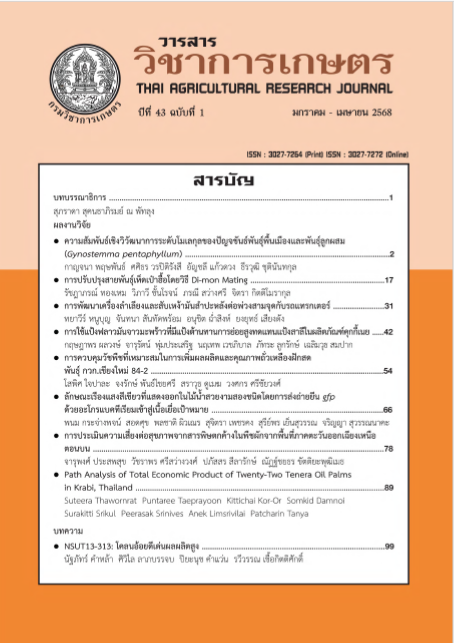
การใช้แป้งฟลาวมันจาวมะพร้าวที่มีแป้งต้านทานการย่อยสูงทดแทนแป้งสาลีในผลิตภัณฑ์คุกกี้เนย
DOI:
https://doi.org/10.14456/thaidoa-agres.2025.4คำสำคัญ:
มันจาวมะพร้าว, แป้งฟลาว, การเก็บรักษา, แป้งต้านทานการย่อย, คุกกี้เนยสดบทคัดย่อ
มันจาวมะพร้าว (Dioscorea alata L.) เป็นพืชหัวสกุลกลอยที่มีแป้งสะสมในรากปริมาณสูง มีศักยภาพในการนำมาผลิตเป็นอาหาร หัวมันจาวมะพร้าวที่มีขนาดและลักษณะไม่เป็นที่ต้องการของผู้บริโภคเกิดการสูญเสีย จึงมีการหาวิธีเพิ่มมูลค่าหัวมันจาวมะพร้าวดังกล่าว โดยนำมาผลิตเป็นแป้งฟลาวเพื่อใช้เป็นส่วนผสมของผลิตภัณฑ์อาหาร จึงทำ การศึกษาคุณค่าทางโภชนาการของแป้งฟลาวมันจาวมะพร้าว อายุการเก็บรักษาในบรรจุภัณฑ์ 3 ชนิด ได้แก่ ถุงพลาสติก (PE) ถุงพลาสติกสุญญากาศ (LLDPE) และถุงอลูมิเนียมฟอยล์ (AF) ที่ระยะเวลาการเก็บรักษา 0 2 4 และ 6 เดือน และการใช้ทดแทนแป้งสาลีในผลิตภัณฑ์คุกกี้เนยในอัตราส่วน 0 25 50 75 และ 100% ของน้ำหนักแป้ง ผลการศึกษา พบว่า แป้งฟลาวมันจาวมะพร้าวไม่มีกลูเตน มีปริมาณคาร์โบไฮเดรต โปรตีน เส้นใย อมิโลส และแป้งต้านทานการย่อย 83.48 6.70 10.72 19.20 และ 54.25% ตามลำดับ การเก็บรักษาแป้งในถุง AF สามารถรักษาคุณภาพแป้งได้ดีที่สุด มีความชื้น ปริมาณน้ำอิสระ และปริมาณสารพิษอะฟลาทอกซิน บี 1 ต่ำกว่าการเก็บรักษาในถุง PE และ LLDPE การใช้แป้งฟลาวมันจาวมะพร้าวทดแทนแป้งสาลีในผลิตภัณฑ์คุกกี้ 50% ได้รับคะแนนความชอบโดยรวมสูงที่สุด 6.8 และไม่แตกต่างจากคุกกี้สูตรที่ใช้แป้งสาลีเพียงอย่างเดียว คุกกี้จากแป้งสาลีมีปริมาณแป้งต้านทานการย่อย 0.24% ในขณะที่คุกกี้ที่ทดแทนแป้งสาลีด้วยแป้งฟลาวมันจาวมะพร้าว 50% มีปริมาณแป้งต้านทานการย่อย 11.65% สูงกว่าคุกกี้จากแป้งสาลีเพียงอย่างเดียว 48.54 เท่า ทำให้สามารถนำหัวมันจาวมะพร้าวที่มีขนาดและลักษณะไม่เป็นที่ต้องการมาใช้ประโยชน์ได้เพิ่มขึ้น
เอกสารอ้างอิง
ดุลย์จิรา สุขบุญญสถิตย์ บุษยา เรืองศักดิ์ วาทิตย์ ศรีทอง และโสภิดา เชื้อขุดทด. 2560. ผลของการใช้แป้งมันเทศทดแทนแป้งสาลีต่อคุณลักษณะของคุกกี้. แก่นเกษตร. 45(พิเศษ 1): 1060-1065.
ธนาภร รติธรรมธร. 2560. แป้งต้านทานการย่อย. วารสารวิทยาศาสตร์บูรพา. 22(1): 166-176.
น้ำฝน ชูพูล รุ่งทิพย์ รัตนพล และจินตนา เจริญเนตรกุล. 2566. การใช้แป้งข้าวสายพันธุ์ กข43 ทดแทนแป้งสาลีในผลิตภัณฑ์คุกกี้. วารสารวิชชา มหาวิทยาลัยราชภัฏนครศรีธรรมราช. 42(2): 124-133.
ประกาศกระทรวงสาธารณสุข ฉบับที่ 414. 2563. เรื่อง มาตรฐานอาหารที่มีสารปนเปื้อน. หน้า 17-18. ใน: ราชกิจจานุเบกษา เล่ม 137 ตอนพิเศษ 118 ง. แหล่งข้อมูล: www.ratchakitcha.soc.go.th/DATA/ PDF/2563/E/118/T_0017.PDF. สืบค้น: 25 มีนาคม 2567.
เพ็ญขวัญ ชมปรีดา. 2550. วิธีการประเมินความแตกต่างของผลิตภัณฑ์ การประเมินคุณภาพทางประสาทสัมผัสและการยอมรับของผู้บริโภค. ภาควิชาพัฒนาผลิตภัณฑ์ คณะอุตสาหกรรมการเกษตร มหาวิทยาลัยเกษตรศาสตร์. กรุงเทพฯ. 268 หน้า.
ภัคศจี คงศีล. 2565. การศึกษาความหลากหลายทางพันธุกรรมของพืชหัวสกุลกลอย (Dioscorea sp.) เพื่อความมั่นคงทางอาหาร. ใน: รายงานการวิจัยพัฒนาและวิศวกรรมฉบับสมบูรณ์. สำนักงานพัฒนาวิทยาศาสตร์และเทคโนโลยีแห่งชาติ. 121 หน้า.
รัตนาภรณ์ กุลชาติ ศศิธร ประพรม รัชนีวรรณ ชูเชิด และสุพจน์ สัตยากุล. 2566. มันจาวมะพร้าวพืชอัตลักษณ์จังหวัดชัยภูมิ. กสิกร. 96(4): 32-36.
รุจิรา ปรีชา สุนันทา วงศ์ปิยชน และงามชื่น คงเสรี. 2543. การใช้แป้งข้าวทดแทนแป้งสาลีในผลิตภัณฑ์เค้กและคุกกี้. หน้า 553-607. ใน: รายงานการวิจัยชุดโครงการวิจัยข้าวและผลิตภัณฑ์ข้าว. สำนักพิมพ์มหาวิทยาลัยเกษตรศาสตร์. กรุงเทพฯ.
ศูนย์นวัตกรรมเทคโนโลยีหลังการเก็บเกี่ยว. 2546. Water Activity กับการควบคุมอายุการเก็บรักษาผลิตภัณฑ์อาหาร. แหล่งข้อมูล: http://www.phtnet.org/ 2003/09/26/. สืบค้น: 25 มีนาคม 2567.
สำนักงานมาตรฐานผลิตภัณฑ์อุตสาหกรรม. 2521. มาตรฐานผลิตภัณฑ์อุตสาหกรรมแป้งมันสำปะหลัง. ใน: เอกสาร มอก.ที่ 274-2521. สถาบันอาหาร กระทรวงอุตสาหกรรม.
อริสรา รอดมุ้ย และอรอุมา จิตรวโรภาส. 2549. การผลิตคุกกี้โดยใช้แป้งข้าวหอมนิลทดแทนแป้งสาลีบางส่วน. วารสารเทคโนโลยีการอาหาร มหาวิทยาลัยสยาม. 3(1): 37-43.
Al-Dmoor, H. 2013. Correlation study between volume and overall acceptability of cake with properties of hard wheat flour. American Journal of Agricultural and Biological Sciences. 8(2): 149-155.
AOAC. 2019. Official Methods of Analysis of the Association of Official Analytical Chemists: Official Methods of Analysis of AOAC International. 21st Edition, AOAC, Washington DC.
Englyst, H.N., S.M. Kingman and J.H. Cummings. 1992. Classification and measurements of nutritionally important starch fraction. European Journal of Clinical Nutrition. 46(Suppl 2): S33-50.
Gibson, T.S., V.A Solah and B.V. McClearyt. 1997. A procedure to measure amylose in cereal starches and flours with concanavalin A. Journal of Cereal Science. 25(2): 111-119.
Goswami, T.K. and S. Mangaraj. 2011. Advances in polymeric materials for modified atmosphere packaging (MAP). pp. 163-242. In: Multifunctional and Nanoreinforced Polymers for Food Packaging. Woodhead Publishing.
Guo, L., H. Chen, Y. Zhang, S. Yan, X. Chen and X. Gao. 2023. Starch granules and their size distribution in wheat: Biosynthesis, physicochemical properties and their effect on flour-based food systems. Computational and Structural Biotechnology Journal. 21: 4172-4186.
He, Z.H., A.H. Liu, R. J. Peña and S. Rajaram. 2003. Suitability of Chinese wheat cultivars for production of northern style Chinese steamed bread. Euphytica. 131(2): 155–163.
Lamberti, M. and F. Escher. 2007. Aluminum foil as a food packaging material in comparison with other materials. Food Reviews International. 23(4): 407–433.
Li, M. and T.C. Lee. 1996. Effect of cysteine on the functional properties and microstructures of wheat flour extrudates. Journal of Agricultural and Food Chemistry. 44(7): 1871-1880.
Marynin, A., V. Pasichny, S. Litvynchuk, L. Khomichak, I. Kuznietsova and S. Vysotska. 2021. Influence of water activity on the properties of wheat flour. Ukrainian Food Journal. 10(2): 375-386.
McCleary, B.V. and D.A. Monaghan, 2002. Measurement of resistant starch. Journal of AOAC International. 85(3): 665-675.
Mouritsen, O.G. 2015. The science of taste. Flavour. 4: 1-2.
Ngoma, K., M.E. Mashau and H. Silungwe. 2019. Physicochemical and functional properties of chemically pretreated Ndou sweet potato flour. International Journal of Food Science. 2019(1): 4158213.
Raleng, A., M. Ramarathinam and A. Mishra. 2014. Effect of packaging materials on storage stability of protein rich flour from deoiled sesame cake. International Journal of Advanced Research. 2(12): 248-254.
Ratnasari, D., N. Rustanti, F. Arifan and D. Afifah. 2018. The effects of treatments on batu banana flour and percentage of wheat substitution on the resistant starch, in vitro starch digestibility content and palatability of cookies made with banana (Musa balisiana Colla) flour. pp. 1-8. In: IOP conference series: Earth and environmental science, 3rd international conference on tropical and coastal region eco development 2017. 2–4 October 2017, Yogyakarta, Indonesia. 116 p.
Richard, J.L. 2007. Some major mycotoxins and their mycotoxicosis-An overview. International Journal of Food Microbiology. 119(1-2): 3-10.
Sullivan, D.M. and D.E. Carpenter. 1993. Method of analysis for nutrition labeling. AOAC International, Arlington. 624 p.
Takeda, Y., S. Hizukuri and B.O. Juliano. 1987. Structure rice amylopectins with low and high affinities for iodine. Carbohydrate Research. 168(1): 79-88.
Tamanna, N. and N. Mahmood. 2015. Food processing and Maillard reaction products: Effect on human health and nutrition. International Journal of Food Science. 2015(1): 526762.
Wieser, H., P. Koehler and K.A. Scherf. 2020. Principles of wheat hypersensitivities. pp. 149-159. In: Wheat - An Exceptional Crop: botanical features, chemistry, utilization, nutritional and health aspects. Elsevier.
ดาวน์โหลด
เผยแพร่แล้ว
รูปแบบการอ้างอิง
ฉบับ
ประเภทบทความ
สัญญาอนุญาต
ลิขสิทธิ์ (c) 2025 วารสารวิชาการเกษตร

อนุญาตภายใต้เงื่อนไข Creative Commons Attribution-NonCommercial-NoDerivatives 4.0 International License.
วารสารวิชาการเกษตร

