
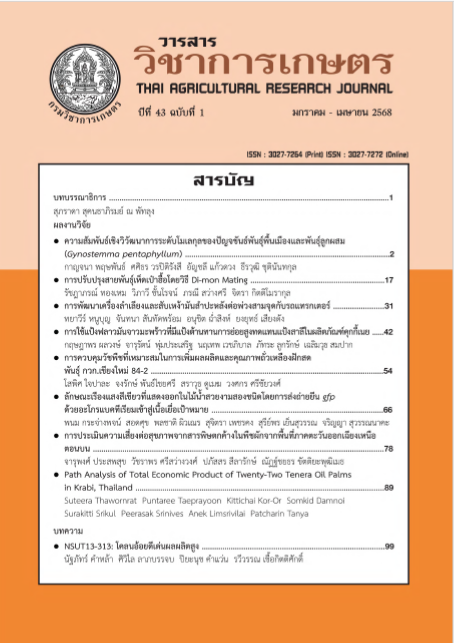
Path Analysis of Total Economic Product of Twenty-Two Tenera Oil Palms in Krabi, Thailand
DOI:
https://doi.org/10.14456/thaidoa-agres.2025.8คำสำคัญ:
correlation coefficient, regression, oil yield, kernel yield, fresh fruit bunchบทคัดย่อ
The indirect factor that holds significant appeal for farmers and the oil palm industry in assessing the potential of Tenera oil palm plantations is the total economic product (TEP). This comprehensive study, conducted at the Hong Sila Agriculture and Industry Company Limited in Krabi, Thailand, evaluated the factors influencing the TEP from twenty-two Tenera oil palms. The factors considered in TEP were fresh fruit bunch (FFB) recorded for 11 years from 2011 to 2021 and bunch components evaluated for four years from 2017 to 2020 using a randomized complete block design with four replicates. The results revealed that the factors influencing TEP were oil yield (OY) and kernel yield (KY), with OY having a more direct impact than KY. The kernel to bunch (KTB) and oil to bunch (OTB) multiplied by FFB are equal to KY and OY, so these two factors were factor affections. The factors that directly influenced OY were FFB and OTB, with no significant correlation between FFB and OTB and a small indirect effect of FFB through OTB. The strong direct effect of character on KY was obtained from KTB, followed by FFB, with a higher total effect of KTB over FFB. The average TEP in 22 Tenera oil palms was 64.41 kg/palm/year, with T22 giving the highest TEP at 74.55 kg/palm/year, while T12 displayed the lowest TEP at 53.86 kg/palm/year. TEP is the one parameter known for Tenera's potential to get more profit from the factors of FFB, OTB, and KTB, which was the one purpose for plant breeding to calculate for the selection process.
เอกสารอ้างอิง
Ataga, C.D. 1995. Character interrelationships and path coefficient analysis for oil yield in the oil palm. Annals of Applied Biology. 127(1): 157-162.
Basiron, Y. 2001. New palm-based products. Journal of Oleo Science. 50(5): 295-303.
Balakrishna, P., R. Pinnamaneni, K.B. Pavani and R.K. Mathur. 2018. Correlation and path coefficient analysis in Indian oil palm genotypes. Journal of Pure and Applied Microbiology. 12(1): 195-206.
Corley, R.H.V. 2018. Studies of bunch analysis 1-variation within and between palms. Journal of Oil Palm Research. 30(2): 196-205.
Department of Standards Malaysia. 2005. Malaysian Standard MS 157:2005 Oil Palm Seed for Commercial Planting-Specification (Third revision). Department of Standards Malaysia, Malaysia.
Krualee, S., S. Sdoodee, T. Eksomtramage and V. Sereeprasert. 2013. Correlation and path analysis of palm oil yield components in oil palm (Elaeis guineensis Jacq.). Agriculture and Natural Resources. 47(4): 528-533.
Kushairi, A., N. Rajanaidu and B.S. Jalani. 2001. Response of oil palm progenies to different fertilizer rates. Journal of Oil Palm Research. 13(1): 84-96.
Mandal, P.K. and M.K. Babu. 2018. Bunch Analysis of Oil Palm. National Research Centre for Oil Palm, India. 8 p.
Myint. K.A., M.D. Amiruddin, M.Y. Rafil, M.Y. Abdsamad, S.I. Ramlee, Z. Yaakub and Y. Oladosu. 2021. Character interrelationships and path analysis for yield components in MPOB-Senegal oil palm germplasm. Sains Malaysiana. 50(3): 699-709.
Nor Azwani, A.B., A.M. Fadila, A. Mohd Din, N. Rajanaidu, A. Norziha, M. Suzana, M. Marhalil, Y. Zulkifli and A. Kushairi. 2020. Potential oil palm genetic materials derived from introgression of germplasm (MPOB-Nigeria, MPOB-Zaire and MPOB-Cameroon accessions) to advanced (AVROS) breeding population. Journal of Oil Palm Research. 32(4): 569-581.
Norziha, A., Z. Zamri, Y. Zulkifli, A.M. Fadila and M. Marhalil. 2024. Selection criteria of MPOB-Angola germplasm collection for yield improvement of the oil palm. Oil Crop Science. 9(1): 20–28.
Office of Agricultural Economics. 2017. The Twenty-Year Agriculture and Cooperative Strategy (2017-2036) and the Five-Year Agriculture Development Plan under the Twelfth National Economic and Social Development Plan (2017-2021). Ministry of Agriculture and Cooperatives, Bangkok. 94 p. (in Thai)
Office of Agricultural Economics. 2024. Agricultural Statistics of Thailand 2023. Office of Agricultural Economics Bangkok. 224 p. (in Thai)
Okoye, M.N., C.O. Okwuagwu, M.I. Uguru, C.D. Ataga and E.C. Okolo. 2007. Genotype by trait relations of oil yield in oil palm (Elaeis guineensis Jacq.) based on GT biplot. African Crop Science Conference Proceedings. 8: 723-728.
Okoye, M.N., C.O. Okwuagwu and M.I. Uguru. 2009. Population improvement for fresh fruit bunch yield and yield components in oil palm (Elaeis guineensis Jacq.). American-Eurasian Journal of Scientific Research. 4(2): 59-63.
Ooi, S.C. 1978. The Breeding of Oil Palm Malaysia. Tropical Agriculture Series No. 11, Malaysia.
Othman, N., M.S. Tahir and L. Joremi. 2022. On the duration of trade competitiveness: the case of the Malaysian palm-based oleochemical industry. Heliyon. 8(11): e11903.
R Core Team. 2021. R: A language and environment for statistical computing. R foundation for statistical computing. Available at: https://www.r-project.org/. Accessed: March 3, 2022.
Sara, de A.R., R. N. V. da Cunha, R. Lopes, E. Barcelos, R. N. C. da Rocha and W. A. A. de Lima. 2018. Correlation and path analysis for yield components in Dura oil palm germplasm. Industrial Crops and Products. 112: 724-733.
Suzana, M., Y. Zulkifli, M. Maehalil, N. Rajanaidu and M. Ong-Abdullah. 2020. Principal component and cluster analysis on Tanzania oil palm Elaeis guineensis Jacq. germplasm. Journal of Oil Palm Research. 32(1): 24-33.
Tanya, P., Y. Hadkam, P. Taeprayoon and P. Srinives. 2013. Estimates of repeatability and path coefficient of bunch and fruit traits in Bang Boet Dura oil palm. Journal Oil Palm Research. 25(1): 108-115.
Thai Meteorological Department. 2021. Daily observation report. Available at: https://www.tmd.go.th/ service/tmdData. Accessed: January 20, 2022.
Walkley, A. and A. Black. 1934. Estimation of soil organic carbon by the chromic acid titration method. Soil Science. 37: 29-38.
Wright, S. 1921. Correlation and causation. Journal of Agricultural Research. 20(7): 557-585.
Wright, S. 1923. The theory of path coefficients a reply to Niles’s criticism. Genetics. 8(3): 239-255.
United States Department of Agriculture. 2023. Oilseeds: World Markets and Trade. Foreign Agricultural Service/USDA Global Market Analysis, United States. 38 p.
University of Illinois at Urbana-Champaign. 2004. Methods (SOPs). Soils lab, University of Illinois at Urbana-Champaign, Department of Crop Sciences. Available at: https://margenot.cropsciences.illinois.edu/methods-sops/. Accessed: January 20, 2022.
ดาวน์โหลด
เผยแพร่แล้ว
รูปแบบการอ้างอิง
ฉบับ
ประเภทบทความ
สัญญาอนุญาต
ลิขสิทธิ์ (c) 2025 วารสารวิชาการเกษตร

อนุญาตภายใต้เงื่อนไข Creative Commons Attribution-NonCommercial-NoDerivatives 4.0 International License.
วารสารวิชาการเกษตร

