
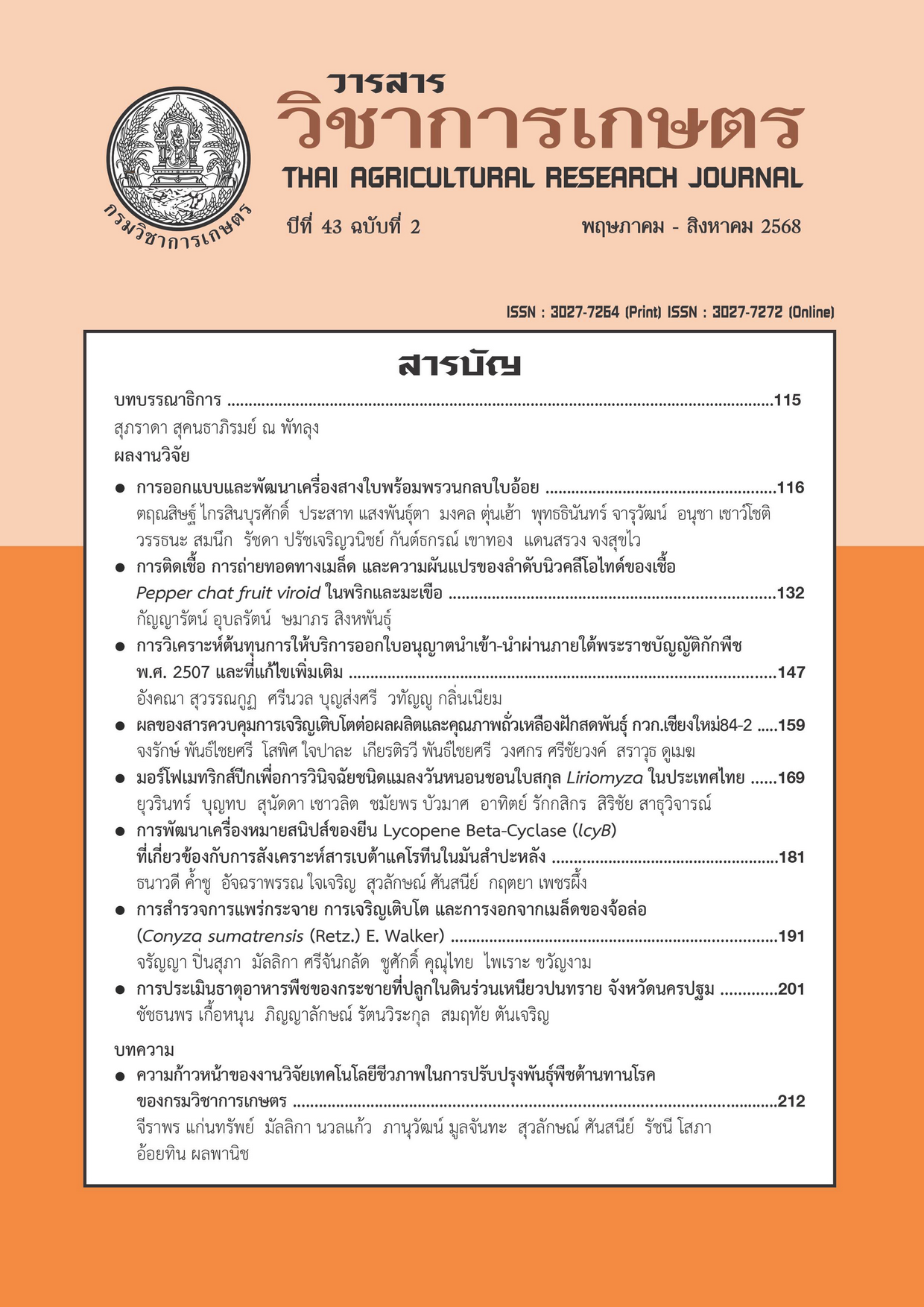
การติดเชื้อ การถ่ายทอดทางเมล็ด และความผันแปรของลำดับนิวคลีโอไทด์ ของเชื้อ Pepper chat fruit viroid ในพริกและมะเขือ
DOI:
https://doi.org/10.14456/thaidoa-agres.2025.11คำสำคัญ:
ปฏิกิริยาลูกโซ่โพลีเมอร์เรสแบบย้อนกลับ, การถ่ายทอดทางเมล็ด, ความผันแปรของลำดับนิวคลีโอไทด์, ศัตรูพืชกักกันบทคัดย่อ
เชื้อ Pepper chat fruit viroid (PCFVd) เป็นศัตรูพืชกักกันของหลายประเทศ มีผลกระทบต่อการส่งออกเมล็ดพันธุ์และการผลิตพริกและมะเขือเทศ จึงได้ศึกษาความสามารถในการก่อโรคของเชื้อ PCFVd ลักษณะอาการโรค อัตราการถ่ายทอดเชื้อผ่านทางเมล็ด และความผันแปรของลำดับนิวคลีโอไทด์ของเชื้อ PCFVd โดยการปลูกเชื้อด้วยวิธีกล บนพริกจำนวน 13 accessions และมะเขือจำนวน 16 accessions ตรวจสอบการเข้าทำลายของเชื้อไวรอยด์ด้วยเทคนิค reverse transcription-polymerase chain reaction พบว่า พริกทุก accessions ติดเชื้อ 100% และมีขนาดผลลดลงแต่ติดเมล็ดได้ ในมะเขือติดเชื้อ 10-100% โดยพบการติดเชื้อ 12 accessions และไม่ติดเชื้อ 4 accessions ใบและดอกมะเขือที่ติดเชื้อมีขนาดลดลงแต่ติดเมล็ดได้ เมื่อนำเมล็ดพริกและมะเขือ มาศึกษาการถ่ายทอดเชื้อทางเมล็ดในสภาพโรงเรือน พบอัตราการติดเชื้อในต้นกล้าที่งอกจากเมล็ดที่ได้จากต้นพริกติดเชื้อ 2 accessions ได้แก่ CA1181 และ CA1220 คิดเป็น 48.9 และ 2% ตามลำดับ และจากมะเขือ 1 accession ได้แก่ SM021B มีอัตราต้นกล้าติดเชื้อ 1.2% อาร์เอ็นเอจากเมล็ดและต้นกล้าที่ตรวจพบเชื้อ PCFVd สามารถก่อโรคบนพืชทดสอบมะเขือเทศอ่อนแอพันธุ์สีดาทิพย์ 4 การเปรียบเทียบลำดับนิวคลีโอไทด์ของดีเอ็นเอผลผลิตที่ได้กับฐานข้อมูล GenBank ยืนยันชนิดเชื้อไวรอยด์ว่าเป็น PCFVd โดยความผันแปรของลำดับนิวคลีโอไทด์ในบริเวณโดเมนฝั่งขวาของเชื้อ PCFVd มีความเหมือนกับไอโซเลต LPng20-11c1 (accession no. JF446893) 96–99% ผลการศึกษานี้ชี้ว่าเชื้อ PCFVd สามารถก่อโรคและถ่ายทอดเชื้อผ่านทางเมล็ดพันธุ์พริกและมะเขือได้
เอกสารอ้างอิง
กรมวิชาการเกษตร. 2564ก. ประกาศกรมวิชาการเกษตร เรื่องเงื่อนไขการนำเข้าเมล็ดพันธุ์พริก พ.ศ. 2563. แหล่งข้อมูล: https://www.doa.go.th/ard/wp-content/uploads/2021/01/ประกาศกรมวิชาการเกษตร-เรื่อง-เงื่อนไขการนำเข้าเมล็ดพันธุ์พริก-พ.ศ.-2563.pdf. สืบค้น: 1 ตุลาคม 2567.
กรมวิชาการเกษตร. 2564ข. ประกาศกรมวิชาการเกษตรเรื่องเงื่อนไขการนำเข้าเมล็ดพันธุ์มะเขือ พ.ศ. 2563. แหล่งข้อมูล: https://www.doa.go.th/ard/wp-content/uploads/2021/01/ประกาศกรมวิชาการเกษตร-เรื่อง-เงื่อนไขการนำเข้าเมล็ดพันธุ์มะเขือ-พ.ศ.2563-1.pdf. สืบค้น: 1 ตุลาคม 2567.
คนึงนิตย์ เหรียญวรากร. 2556. โรคพืชที่เกิดจากเชื้อไวรอยด์. ภาควิชาโรคพืช คณะเกษตรกำแพงแสน มหาวิทยาลัยเกษตรศาสตร์. 164 หน้า.
ปริเชษฐ์ ตั้งกาญจนภาสน์ คนึงนิตย์ เหรียญวรากร และวิภา เกิดพิพัฒน์. 2556. การตรวจวินิจฉัยเชื้อ Columnea latent viroid (CLVd) และ Pepper chat fruit viroid (PCFVd) ในพืชวงศ์ Solanaceae. วารสารวิชาการเกษตร. 31(2): 108-122.
ปริเชษฐ์ ตั้งกาญจนภาสน์ กาญจนา วาระวิชะนี A. Haegeman M. Höfte และ K. De Jonghe. 2567. วิวัฒนาการของเชื้อ Ccolumnea latent viroid (CLVd) ในพืชอาศัยโดยการศึกษา quasi-species population. วารสารวิชาการเกษตร. 42(3): 272-286.
ษมาภร ภูวิธกรณ์ จิราพร ปอสูงเนิน สุภาพร กลิ่นคง และคนึงนิตย์ เหรียญวรากร. 2562. การเข้าทำลายและการถ่ายทอดทางเมล็ดของ Columnea latent viroid ในพริก. วารสารเกษตร. 35(1): 101-111.
Bhuvitarkorn, S and K. Reanwarakorn. 2019. Pollen and seed transmission of Columnea latent viroid in eggplants. European Journal of Plant Pathology. 154(4): 1067-1075.
Chambers, G.A., A.M. Seyb, J. Mackie, F.E. Constable, B.C. Rodoni, D. Letham, K. Davis and M.J. Gibbs. 2013. First report of Pepper chat fruit viroid in traded tomato seed, an interception by Australian Biosecurity. Plant Disease. 97(10): 1386.
Dall, D., L. Penrose, A. Daly, F. Constable and M. Gibbs. 2019. Prevalences of pospiviroid contamination in large seed lots of tomato and capsicum, and related seed testing considerations. Viruses. 11(11): 1034.
Diener, T.O. 1987. The Viroids. Plenum Press, Inc., New York. 366 p.
Ding, B. 2009. The biology of viroid-host interactions. Annual Review of Phytopathology. 47(1): 105-131.
Flores, R., C. Hernandez, A.E. Emilio Martínez de Alba, J.A. Daros and F.D. Serio. 2005. Viroids and viroid-host interactions. Annual Review of Phytopathology. 43(1): 117-139.
Hadidi, A., R. Flores, J.W. Randles and J.S. Semancik. 2003. Viroids. CSIRO Publishing, Collingwood, Australia. 370 p.
Hadidi, A., R. Flores, J.W. Randles and P. Palukaitis, 2017. Viroids and Satellites. Academic Press. 716 p.
Kalantidis, K., M.A. Denti, S. Tzortzakaki, E. Marinou, M. Tabler and M. Tsagris. 2007. Virp1 is a host protein with a major role in Potato spindle tuber viroid infection in Nicotiana plants. Journal of Virology. 81(23): 12872–12880.
Keyata, T., S. Sinhabandhu and K. Reanwarakorn. 2024. Symptoms and disease virulence assessment in commercial pepper cultivars caused by Pepper chat fruit viroid. Journal of Plant Diseases and Protection. 131(6): 1935–1944.
Kungwon, P., C. Netwong, S. Porsoongnoen and K. Reanwarakorn. 2022. Chrysanthemum stunt viroid as a protective viroid isolate against Columnea latent viroid and Pepper chat fruit viroid in tomato plants. International Journal of Agricultural Technology. 18(4): 1601–1618.
Matsushita, Y. and S. Tsuda. 2015. Host ranges of Potato spindle tuber viroid, Tomato chlorotic dwarf viroid, Tomato apical stunt viroid, and Columnea latent viroid in horticultural plants. European Journal of Plant Pathology. 141(1): 193–197.
Matsushita, Y. and S. Tsuda. 2016. Seed transmission of Potato spindle tuber viroid, Tomato chlorotic dwarf viroid, Tomato apical stunt viroid, and Columnea latent viroid in horticultural plants. European Journal of Plant Pathology. 145(4):: 1007-1011.
Reanwarakorn, K., S. Klinkong and J. Porsoongnurn. 2011. First report of natural infection of Pepper chat fruit viroid in tomato plant in Thailand. New Disease Reports. 24(6): 2044-0588.
Steger, G., 2017. Modelling the three-dimensional structure of the right-terminal domain of pospiviroids. Scientific Reports. 7(1): 711.
Verhoeven, J.T., C.C.C, Jansen, J.W. Roenhorst, R. Flores and M. de la Peña. 2009. Pepper chat fruit viroid: biological and molecular properties of a proposed new species of the genus Pospiviroid. Virus Research. 144(1-2): 209-214.
Verhoeven, J.T.J., M. Botermans, C.C.C. Jansen and J.W. Roenhorst. 2011. First report of Pepper chat fruit viroid in capsicum pepper in Canada. New Disease Reports. 23(1): 15.
Verhoeven, J.T.J., H.M.S. Koenraadt, A. Jodlowska, L. Hüner and J.W. Roenhorst. 2020. Pospiviroid infections in Capsicum annuum: disease symptoms and lack of seed transmission. European Journal of Plant Pathology. 156(1): 21-29.
Yanagisawa, H. and Y. Matsushita. 2017. Host ranges and seed transmission of Tomato planta macho viroid and Pepper chat fruit viroid. European Journal of Plant Pathology. 149(1): 211-217.
Zhong, X., A.J. Archual, A.A. Amin and B. Ding. 2008. A genomic map of viroid RNA motifs critical for replication and systemic trafficking. The Plant Cell. 20(1): 35–47.
ดาวน์โหลด
เผยแพร่แล้ว
รูปแบบการอ้างอิง
ฉบับ
ประเภทบทความ
สัญญาอนุญาต
ลิขสิทธิ์ (c) 2025 วารสารวิชาการเกษตร

อนุญาตภายใต้เงื่อนไข Creative Commons Attribution-NonCommercial-NoDerivatives 4.0 International License.
วารสารวิชาการเกษตร

