
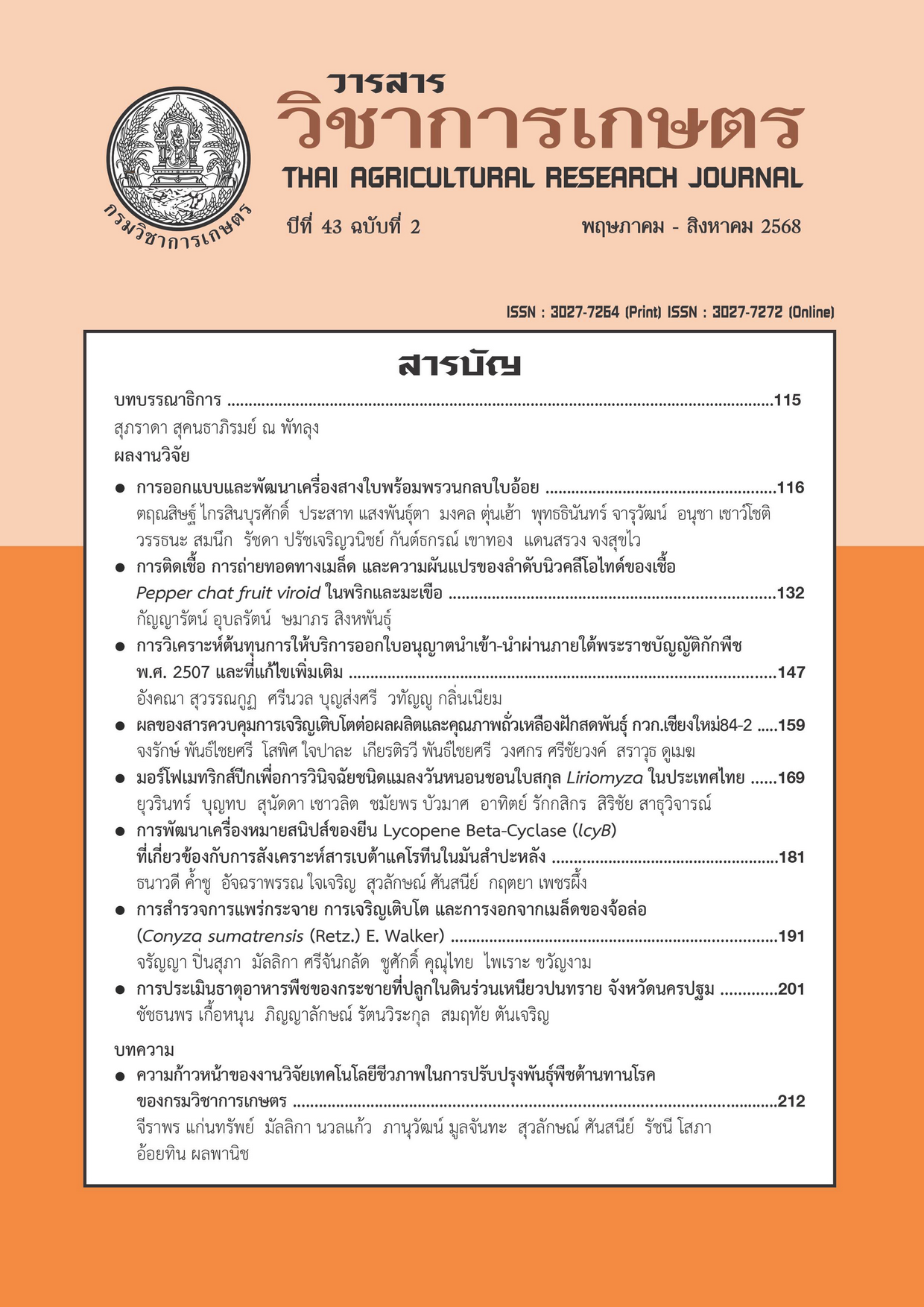
Distribution Survey, Plant Growth and Seed Germination of Sumatran Fleabane (Conyza sumatrensis (Retz.) E. Walker)
DOI:
https://doi.org/10.14456/thaidoa-agres.2025.16Keywords:
alien plant, weed, vegetative growth, seed production, biologyAbstract
Conyza sumatrensis is an invasive weed species found in Thailand and has been increasing in agricultural areas. Effective Integrated weed management requires an understanding of weed biology. Therefore, this study aimed to investigate the distribution of C. sumatrensis in agricultural areas across the country. Surveys were conducted in field crops, vegetable crops, industrial crops, and fruit orchards in all regions of Thailand during 2022–2023. Plant growth and seed germination were studied during 2023–2024. The result showed that the spread of C. sumatrensis was found in all agricultural areas, both open spaces and shaded areas. Approximately two weeks after germination (WAG), the seedlings developed true leaves, which were simple. Vegetative growth rate was low from 3–8 WAG, followed by rapid growth during 9–10 WAG. Flowering and seed maturation began at 13 and 15 WAG, respectively. Maximum seed production was observed around 18 WAG. By 29 WAG, plant growth had declined, and no additional flowering or seed set occurred. The seed germination study showed that mature seeds sown on the soil surface had an average germination rate of 44%, whereas seeds sown at depths of 5, 10, 15, 20 and 25 cm did not emerge above the soil surface. Therefore, to prevent the spread of C. sumatrensis, deep soil tillage to a depth of more than 5 cm to completely cover the seeds on the soil surface and removal of C. sumatrensis before flowering are recommended, as a single C. sumatrensis can produce more than 20,000 seeds.
References
คมสัน นครศรี จรัญญา ปิ่นสุภา และภัทร์พิชชา รุจิระพงศ์ชัย. 2553. การเฝ้าระวังการแพร่ระบาดของ Conyza canadensis (L.) Cornq.ในพืชไร่ พืชผัก และไม้ดอกเมืองหนาว. หน้า 1478-1487. ใน: รายงานผลงานวิจัยประจำปี 2553. สำนักวิจัยพัฒนาการอารักขาพืช กรมวิชาการเกษตร.
จันทร์เพ็ญ ประคองวงศ์ จรัญญา ปิ่นสุภา เบญจมาภรณ์ ลิ้มประเสริฐ และมัตติกา ทองรส. 2552. เฝ้าระวังการแพร่กระจายของ Conyza canadensis (L.) Cronq. ในประเทศไทย. หน้า 1144-1154. ใน: รายงานผลงานวิจัยประจำปี 2552. สำนักวิจัยพัฒนาการอารักขาพืช กรมวิชาการเกษตร.
จรรยา มณีโชติ. 2548. ข้าววัชพืช ปัญหาและการจัดการ. กลุ่มวิจัยวัชพืช สำนักวิจัยพัฒนาการอารักขาพืช กรมวิชาการเกษตร. 19 หน้า.
จรัญญา ปิ่นสุภา 2562. ชีววิทยาของ Asystasia gangetica (L) T. Anderson วัชพืชที่สำคัญของประเทศไทย. หน้า 321-333. ใน: การประชุมวิชาการอารักขาพืชแห่งชาติ ครั้งที่ 14. สมาคมอารักขาพืชไทย. 12-14 พฤศจิกายน 2562. จังหวัดเพชรบุรี.
โองการ วณิชาชีวะ. 2556. เปรียบเทียบปัจจัยที่มีต่อการงอกของเมล็ดวัชพืชต่างถิ่นสกุลผักเผ็ดแม้วในประเทศไทย. วารสารแก่นเกษตร. 41(3): 317-326.
Albrecht, A.J.P., V.G.C. Pereira, C.N.Z. Souza, L.H.S. Zobiole, L.P. Albrecht and F.S. Adegas. 2018. Multiple resistance of Conyza sumatrensis to three mechanisms of action of herbicides. Available at: https://www.scielo.br/j/asagr/a/S7RJGrVzc5NKZyqwywfvBFJ/?format=pdf&lang=en. Accessed: November 10, 2024.
Anastasiu, P. and D. Memedemin. 2012. Conyza sumatrensis: A new alien plant in Romania. Botanica Serbica. 36(1): 37-40.
Bewley, J.D., K.J. Bradford, H.W. Hilhorst, H. Nonogaki. 2012. Seeds: Physiology of development, germination, and dormancy. Springer Science & Business Media. New York.
CABI (Centre for Agriculture and Biosciences International). 2023. Conyza sumathensis (tall fleabane). CABI compendium. Available at: https://www.cabidigitallibrary.org/doi/10.1079
/cabicompendium.15252. Accessed: December 14, 2023.
Florentine, S., T. Humphries and B.S. Chauhan 2021. Erigeron bonariensis, Erigeron canadensis, and Erigeron sumathensis. pp. 131-149 In: Biology and Management of Problematic Crop Weed Species. Academic press.
Green, T.D. 2010. The Ecology of Fleabane (Conyza spp.). School of Environmental and Rural Science, Faculty of Arts and Sciences, University of New England.
Hao, J., S. Qiang, Q. Liu and F. Cao. 2009. Reproductive traits associated with invasiveness in Conyza sumatrensis. Journal of Systematics and Evolution. 47 (3): 245–254.
IEWF (International Environmental Weed Foundation) .2005. Common Invasive Plants of the World. Available at: https://www.iewf.org/weedid/Conyza_sumatrensis.htm. Accessed: July 12, 2023.
Loura, D., Sahil, S. Florentine and B.S. Chauhan. 2020. Germination ecology of hairy fleabane (Conyza bonariensis) and its implications for weed management. Weed Science. 68(4): 411–417.
Mahajan, G., A. Prasad and B.S. Chauhan. 2021. Seed germination ecology of Sumatran fleabane (Conyza sumatrensis) in relations to various environmental parameters. Weed Science. 69(6): 687-694.
Marambe, B., S.P. Nissanka, L. Silva, A. Anandacoomaraswamy and M.G.D.L. Priyantha. 2002. Occurrance of paraquat-resistant Erigeron sumathensis (Retz.) in upcounty tea lands of Sri Lanka. Available at: https://www.researchgate.net/publication/236160284. Accessed: December 15, 2022.
McMaugh, T. 2005. Guidelines for surveillance for plant pests in Asia and the Pacific. ACIAR Monograph.No 119, 192 p.
Ngow, Z., R.J. Chynoweth, M. Gunnarsson, P. Rolston and C.E. Buddenhagen. 2020. A herbicide resistance risk assessment for weed in wheat and barley cropping systems in New Zealand. PLoS One. 15(6): e0234771
Plantnet. 2023. Riceweeds en-Asteraceae Plantnet. Available at:http://publish.plantnet-project.org/project/riceweeds_en/collection/collection/information/details/ERIFL. Accessed: July 12, 2023.
Thebaud, C. and R.J. Abbott. 1995. Characterization of invasive Conyza species (Asteraceae) in Europe: quantitative trait and isozyme analysis. American Journal of Botany. 82(3): 360–368.
Thebaud, C., A.C. Finzi, L. Affre, M. Debussche and J. Escarre. 1996. Assessing why two introduced Conyza differ in their ability to invade Mediterranean old fields. Ecology. 77(3): 791-804.
Department of National Parks, Wildlife and Plant Conservation. 2016. The Forest Herbarium. pp. 254-255. In: Flora of Thailand. Volume 13 Part 2 Composite (Asteraceae).
Wu, H., S. Walker, M.J. Rollin, D.K.Y. Tan, G. Robinson and J. Werth. 2007. Germination, persistence, and emergence of flaxleaf fleabane (Conyza bonariensis [L.] Cronquist). Weed Biology and Management. 7(3): 192-199.
Xu, Y., J. Ye, A. Khalofah, A.T.K. Zuan, R. Ullah and A.M. El-Shehawi. 2021.Seed germination ecology of Conyza sumatrensis populations stemming from different habitats and implications for management. PLoS One. 16(12): e0260674.
Downloads
Published
How to Cite
Issue
Section
License
Copyright (c) 2025 Thai Agricultural Research Journal

This work is licensed under a Creative Commons Attribution-NonCommercial-NoDerivatives 4.0 International License.
Thai Agricultural Research Journal

