
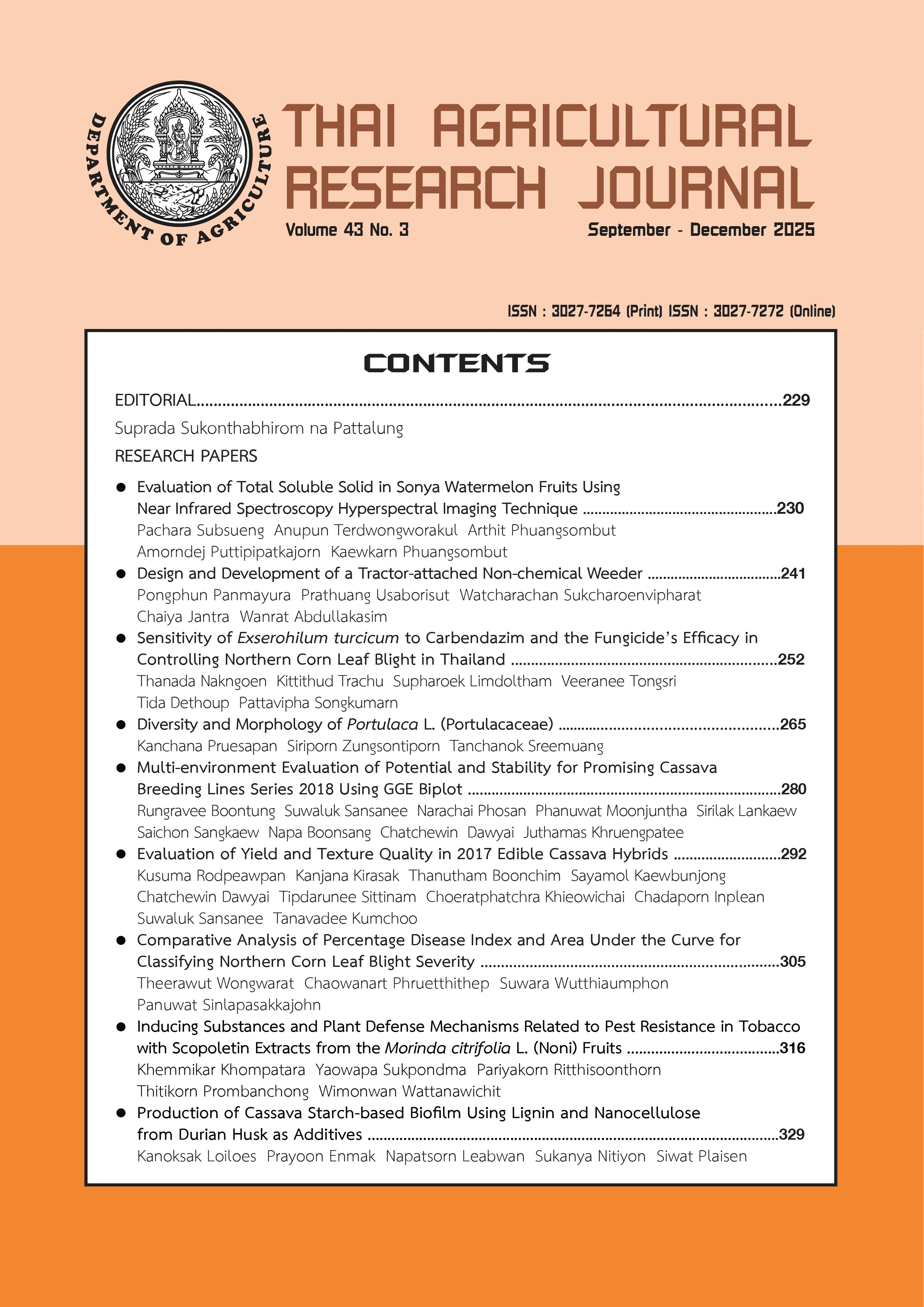
Diversity and Morphology of Portulaca L. (Portulacaceae)
DOI:
https://doi.org/10.14456/thaidoa-agres.2025.21Keywords:
botanical name, ornamental plant, purslane, weedAbstract
Many species of Portulaca L. (Portulacaceae) pose a significant risk of spreading in agroecosystems as weeds. Contamination of agricultural products by these plants may significantly impact international trade. Effective prevention should be based on the knowledge of their botanical names. This research aimed to study the diversity and morphology of the genus Portulaca by surveying plants in agroecosystems and related distribution areas, collecting samples, recording morphological data, and identifying the collected specimens. A total of
25 plant samples were collected, and 7 species were identified based on morphological characteristics: P. amilis Speg., P. grandiflora Hook., P. oleracea L., P. pilosa L., P. quadrifida L., P. umbraticola Kunth, and Portulaca sp. The study found that P. amilis and P. umbraticola have never been previously reported in Thailand. The distribution of P. oleracea, P. pilosa, P. quadrifida and Portulaca sp. showed their status as weeds in agricultural areas that should be monitored. Meanwhile, P. amilis, P. grandiflora and P. umbraticola were mostly found as ornamental plants in community areas. All plants found can serve as a reference database for plant protection and development in the future.
References
กองพฤกษศาสตร์และวัชพืช. 2544. ที่ระลึกในวโรกาสสมเด็จพระเทพรัตนราชสุดาฯ สยามบรมราชกุมารี เสด็จพระราชดำเนิน ทรงเปิดอาคารพิพิธภัณฑ์พืชสิริธร. โรงพิมพ์ชุมนุมสหกรณ์การเกษตรแห่งประเทศไทย, กรุงเทพฯ. 129 หน้า.
ธวัชชัย รัตน์ชเลศ และเจมส์ เอฟ แมกซ์เวล. 2540. รายชื่อวัชพืชที่มีรายงานพบในประเทศไทย. เวิร์คเพรส, กรุงเทพฯ. 286 หน้า.
สมาคมวิทยาการวัชพืชแห่งประเทศไทย. 2545. วัชพืชสามัญภาคกลาง. สมาคมวิทยาการวัชพืชแห่งประเทศไทย, กรุงเทพฯ. 135 หน้า.
Aisyah, S.I., R.A.M. Saraswati, Y.S. Yudha and W. Nurcholis. 2022. The diversity of agromorphological characters of Portulaca grandiflora in the MV8 population deriving from recurrent irradiation. Biodiversitas. 23(9): 4432-4439.
Benoit, A.D., M.G. Oliver, R.J. Vichich and J.M. Budke. 2020. Noteworthy collections: first record of the non-native plant Portulaca amilis (Portulacaceae) in Tennessee. Castanea. 85(2): 343-347.
Bridson, D. and L. Forman. 1998. The Herbarium Handbook. Royal Botanic Gardens, Kew. 346 p.
Bulakh, E.V., M.V. Shevera, P. Szkudlarz, P.Y. Bulakh and Z. Celka. 2022. Identification of new taxa of Portulaca oleracea L. aggregate from Poland based on seed coat micromorphological characteristics. Acta Societatis Botanicorum Poloniae. 91: 9118.
Coleman, M., P. Kristiansen, B. Sindel and C. Fyfe. 2018. Pigweed (Portulaca oleracea): Weed Management Guide for Australian Vegetable Production, University of New England, Armidale. 12 p.
Danin, A., F. Buldrini, M.B. Mazzanti, G. Bosi, M.C. Caria, D. Dandria, E. Lanfranco, S. Mifsud and S. Bagella. 2016. Diversification of Portulaca oleracea L. complex in the Italian peninsula and adjacent islands. Botany Letters. 163(3): 261-272.
Dhande, S.R. and V.R. Patil. 2020. An overview of Protulaca quadrifida. International Journal of Vegetable Science. 26(5): 450-456.
Garba, Y. 2021. Response of onion (Allium cepa L.) to plant population and weed control methods in a chicken weed (Portulaca quadrifida L.) infested field in Sudan Savanna, Nigeria. Global Journal of Agricultural Sciences. 20(1): 19-27.
Geesink, R. 1969. Portulaca in Indo-Australia and the Pacific. Blumea. 17(2): 297.
Geesink, R. 1971. Portulacaceae. pp. 121-133. In: Flora Malesiana. Ser. 1 Vol. 7, C.G.G.J. van Steenis (ed.). Wolters-Noordhoff Publishing, Groningen.
Geesink, R. 1975. Portulacaceae. pp. 268-273. In: Flora of Thailand. T. Smitinand and K. Larsen (eds.), Applied Scientific Research Corporation of Thailand, Bangkok.
Ghafoor, A. 2018. Portulacaceae in Flora of Pakistan. Available at: http://www.efloras.org/florataxon.aspx? flora_id=5&taxon_id=10724. Accessed: March 1, 2025.
Harada, J., Y. Paisooksantivatana and S. Zungsontiporn. 1987. Weeds in the Highlands of Northern Thailand: Color Illustrated. Project manual No.3. Japan International Cooperation Agency and Department of Agriculture, Ministry of Agriculture and Cooperatives, Bangkok. 126 p.
Hassler, M. 1994 – 2025. World Plants. Synonymic Checklist and Distribution of the World Flora. Version 25.03; last update March 6th, 2025. Available at: https://www.worldplants.de/worldplants- complete-list/complete-plant-list. Accessed: March 1, 2025.
Holm, L.G., D.L. Plucknett, J.V. Pancho and J.P. Herberger. 1977. The World’s Worst Weeds: Distribution and Biology. The University Press of Hawaii, Honolulu. 610 p.
Jia, S., Z. Yan, Y. Wang, Y. Wei, Z. Xie and F. Zhang. 2017. Genetic diversity and relatedness among ornamental purslane (Portulaca L.) accessions unraveled by SRAP markers. 3 Biotech. 7(4): 241.
Judd, W.S., C.S. Campbell, E.A. Kellogg, P.F. Stevens and M.J. Donoghue. 2002. Aizoaceae, Euphorbiaceae and Portulacaceae, in Phylogenetic relationships of Angiosperms. pp. 316-317, 343-347. In: Plant Systematics: A Phylogenetic Approach. Sinauer Associates, Inc., Sunderland, Massachusetts.
Li, Y., L. Xiao, H. Yan, M. Wu, X. Hao and H. Liu. 2023. Nutritional values, bioactive compounds and health benefits of purslane (Portulaca oleracea L.): A comprehensive review. Food Science and Human Wellness. 13(5): 2480-2501.
Lu, D. and M.G. Gilbert. 2004. Portulaca Linnaeus in Flora of China. Available at: http://www.efloras. org/florataxon.aspx?flora_id=2&taxon_id=126612. Accessed: March 1, 2025.
Marsh, S.T., N.A. Brummitt, R.P.J. de Kok and T.M.A. Utteridge. 2009. Large–scale patterns of plant diversity and conservation priorities in South East Asia. Blumea. 54: 103-108.
Matthews, J.F. 2004. Portulaca Linnaeus in Flora of North America. Available at: https://www.efloras.org/ florataxon.aspx?flora_id=1&taxon_id=126612. Accessed: March 1, 2025.
Mokni, R.E. 2025. Portulaca umbraticola (Portulacaceae), new to the succulent flora of North Africa and an updated key to Tunisian species and forms of the genus. Bradleya. 2025(43): 252-257.
Phillips, S.M. 2002. Portulacaceae. pp. 1-40. In: Flora of Tropical East Africa. H.J. Beentje and S.A.L. Smith (eds.). Balkema, Rotterdam.
Rafidah, A.R. 2010. Portulacaceae. pp. 203-209. In: Flora of Peninsular Malaysia Ser. 2: Seed Plants. Vol. 1, R. Kiew, R.C.K. Chung, L.G. Saw, E. Soepadmo and P.C. Boyce (eds.). Straits Digital Sdn. Bhd., Subang Jaya, Selangor Darul Ehsan.
Shay, N.J. and E. Prostko. 2024. Pink purslane (Portulaca pilosa) control with postemergence herbicides. Weed Technology. 38: 1-19.
Smitinand, T. 1958. The genus Dipterocarpus Gaertn.f. in Thailand. Thai Forest Bulletin (Botany). 4: 1-64.
Tahir, M.A. and M.S.A. Abbasi. 2020. Phytochemical analysis of Portulaca pilosa & Portulaca quadrifida Linn through FTIR. South Asian Research Journal of Natural Products. 3(3): 1-6.
Downloads
Published
How to Cite
Issue
Section
License
Copyright (c) 2025 Thai Agricultural Research Journal

This work is licensed under a Creative Commons Attribution-NonCommercial-NoDerivatives 4.0 International License.
Thai Agricultural Research Journal

