
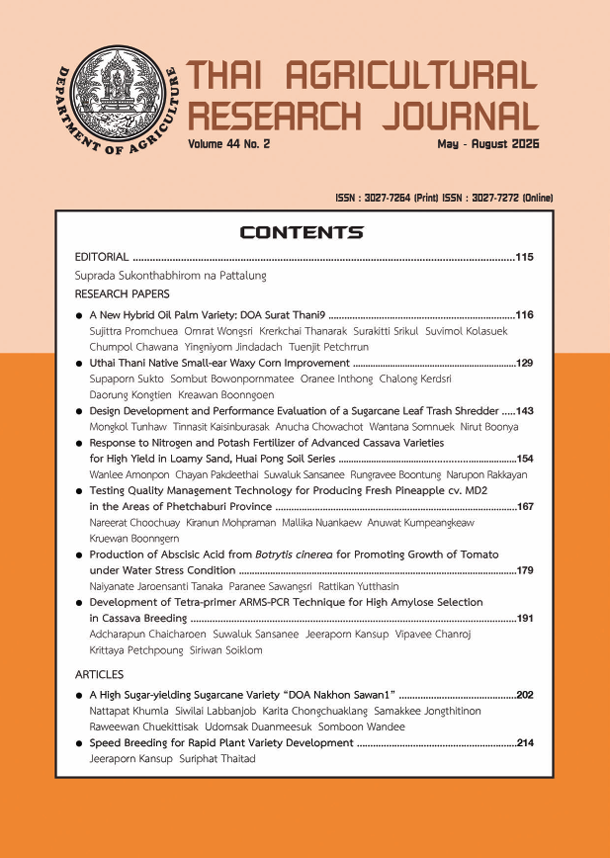
Development of Tetra-primer ARMS-PCR Technique for High Amylose Selection in Cassava Breeding
DOI:
https://doi.org/10.14456/thaidoa-agres.2026.16Keywords:
amylose content, molecular marker, SNP, Tetra-primer ARMS-PCR, plant breedingAbstract
Amylose starch in cassava (Manihot esculenta Crantz) can be widely used in many industries. Rapid selection of cassava varieties with high amylose starch content can be done using advanced techniques. This study aimed to develop molecular markers associated with high amylose content by designing primers for single nucleotide polymorphism (SNP) markers. The results revealed that the SNP marker S2_25293441 on chromosome 2 was significantly associated with high amylose content. Optimal conditions for tetra-primer amplification refractory mutation system polymerase chain reaction (tetra-primer ARMS-PCR) were achieved at an annealing temperature of 60°C. In heterozygous (CT) genotypes, DNA bands of 339, 229, and 166 bp were observed, while homozygous (CC) genotypes produced bands of 339 and 229 bp. Genotypes exhibiting the CT genotype demonstrated phenotypes with high amylose content. In testing with cassava varieties containing amylose content exceeding 18%, the developed SNP marker achieved an accuracy rate of 75.90% in selecting high amylose varieties. The use of this molecular marker reduced the number of plants required for field selection, enabled screening with fairly high accuracy, and shortened the time for selecting cassava varieties with high amylose content.
References
จิณณจาร์ หาญเศรษฐสุข ประพิศ วองเทียม อุมาพร รักษาพราหมณ์ จิตติลักษณ์ พลพวก จารุวรรณ บางแวก และจินดา จิตจักร. 2559. การจำแนกและประเมินลักษณะทางคุณภาพของหัวคุณสมบัติทางเคมีฟิสิกส์ของแป้งและคุณภาพของท่อนพันธุ์ในเชื้อพันธุ์มันสำปะหลัง. รายงานผลงานเรื่องเต็มการทดลองที่สิ้นสุดโครงการวิจัยและพัฒนาพันธุ์มันสำปะหลัง, ศูนย์วิจัยพืชไร่ระยอง. 163 หน้า.
Chaicharoen, A., S. Amawan, J. Kansup, A. Sawwa and K. Petchpoung. 2023. Novel SNP markers and their application in low-cyanide cassava (Manihot esculenta crantz) breeding program. Trends in Sciences. 20(4): 6456.
Codjia, E.D., B. Olasanmi, C.E. Ugoji and I.Y. Rabbi. 2023. SNP-based marker-assisted selection for high provitamin A content in African cassava genetic background. South African Journal of Science. 119(11-12): 15115.
Das, S., M.K. Das, T. Jamatia, B. Bhattacharya, R. Mazumder, P.K. Yadav, N.R. Ghose Bishwas, T. Deka, D. Roy, B. Sinha, B. Das, I. Daule, K. Paul, A. Roy, A. Choudhury, P. Sadhukhan, D. Sarmah, D. Bhargab, B.K. Jana, D. Tayeng, N. Guha, B. Kalita and S. Mandal. 2024. Advances of cassava starch-based composites in novel and conventional drug delivery systems: a state-of-the-art review. RSC Pharmaceutics. 1(2):182-203.
Devi, K.D., K. Punyarani, N.S. Singh and H.S. Devi. 2013. An efficient protocol for total DNA extraction from the members of order Zingiberales-suitable for diverse PCR based downstream applications. SpringerPlus. 2(1): 669.
do Carmo, C.D., M.B.E. Sousa, P.P. dos Santos Silva, G.A.F. Oliveira, H. Ceballos and E.J. de Oliveira. 2020. Identification and validation of mutation points associated with waxy phenotype in cassava. BMC Plant Biology. 20(1):164.
Flint-Garcia, S.A., J.M. Thornsberry and E.S. Buckler. 2003. Structure of linkage disequilibrium in plants. Annual Review of Plant Biology. 54(1): 357–374.
Gawłowska, M., L. Lahuta, L. Boros, A. Sawikowska, P. Kumar, M. Knopkiewicz, Z. Kaczmarek and W. Święcicki. 2022. Validation of molecular markers significant for flowering time, plant lodging, stem geometry properties, and raffinose family Oligosaccharides in pea (Pisum sativum L.). Agriculture. 12(8):1125.
Gomez, G.G. 1979. Use of cassava products in pig feeding. Available at: https://www.fao.org/4/t0554e/t0554e11.htm. Accessed: October 14, 2025.
Grand View Research. 2023. Cassava starch market size and share: applications as thickening, binding, stabilizing agent in processed foods. Available at: https://www.grandviewresearch.com/industry-analysis/cassava-starch-market-report. Accessed: October 14, 2025.
Hasan, M.M., M.Y. Rafii, M.R. Ismail, M. Mahmood, H.A. Rahim, M.A. Alam, S. Ashkani, M.A. Malek and M.A. Latif. 2015. Marker-assisted backcrossing: a useful method for rice improvement. Biotechnology and Biotechnological Equipment. 29(2): 237–254.
Hasan, N., S. Choudhary, N. Naaz, N. Sharma and R.A. Laskar. 2021. Recent advancements in molecular marker-assisted selection and applications in plant breeding programmes. Journal of Genetic Engineering and Biotechnology. 19(1): 128.
Ige, A.D., B. Olasanmi, E.G.N. Mbanjo, I.S. Kayondo, E.Y. Parkes, P. Kulakow, C. Egesi, G.J. Bauchet, E. Ng, L.A.B. Lopez-Lavalle, H. Ceballos and I.Y. Rabbi. 2021. Conversion and validation of uniplex SNP markers for selection of resistance to cassava mosaic disease in cassava breeding programs. Agronomy. 11(3): 420.
Ige, A.D., B. Olasanmi, G.J. Bauchet, I.S. Kayondo, E.G.N. Mbanjo, R. Uwugiaren, S. Motomura-Wages, J. Norton, C. Egesi, E.Y. Parkes, P. Kulakow, H. Ceballos, I. Dieng and I.Y. Rabbi. 2022. Validation of KASP-SNP markers in cassava germplasm for marker-assisted selection of increased carotenoid content and dry matter content. Frontiers in Plant Science. 13: 1016170.
Jacoby, R.P., L. Li, S. Huang, C.P. Lee, A.H. Millar and N.L. Taylor. 2012. Mitochondrial composition, function and stress response in plants. Journal of Integrative Plant Biology. 54(11): 887-906.
Janket, A., N. Vorasoot, B. Toomsan, W. Kaewpradit, S. Jogloy, P. Theerakulpisut, C.C. Holbrook, C.K. Kvien and P. Banterng. 2020. Starch accumulation and granule size distribution of cassava cv. Rayong9 grown under irrigated and rainfed conditions using different growing seasons. Agronomy. 10(3): 412.
Juliano, B.O. 1971. A simplified assay for milled-rice amylose. Cereal Science Today. 16(11): 334-340.
Kumar, S., T.W. Banks and S. Cloutier. 2012. SNP discovery through next-generation sequencing and its applications. International Journal of Plant Genomics. 2012: 831460.
Kumar, R., S.P. Das, B.U. Choudhury, A. Kumar, N.R. Prakash, R. Verma, M. Chakraborti, A.G. Devi, B. Bhattacharjee, R. Das, B. Das, H.L. Devi, B. Das, S. Rawat and V.K. Mishra. 2024. Advances in genomic tools for plant breeding: harnessing DNA molecular markers, genomic selection, and genome editing. Biological Research. 57(1): 80.
Mohidin, S.R.N.S.P., S. Moshawih, A. Hermansyah, M.I. Asmuni, N. Shafqat and L.C. Ming. 2023. Cassava (Manihot esculenta Crantz): a systematic review for the pharmacological activities, traditional uses, nutritional values, and phytochemistry. Journal of Evidence-Based Integrative Medicine. 28: 2515690X231206227.
Rychlik, W., W.J. Spencer and R.E. Rhoads. 1990. Optimization of the annealing temperature for DNA amplification in vitro. Nucleic Acids Research. 18(21): 6409.
Santos, C.S.D., M.B. Sousa, A.C. Brito, L.A. de Oliveira, C.W.P. Carvalho and E.J. de Oliveira. 2022. Genome-wide association study of cassava starch paste properties. PLoS ONE. 17(1): e0262888.
Schaedler, T.A., B. Faust, C.A. Shintre, E.P. Carpenter, V. Srinivasan, H.W. van Veen and J. Balk. 2015. Structures and functions of mitochondrial ABC transporters. Biochemical Society Transactions. 43(5): 943-951.
Silveira, Y.D., A.S. Franca and L.S. Oliveira. 2025. Cassava waste starch as a source of bioplastics: development of a polymeric film with antimicrobial properties. Foods. 14(1): 113.
Sinha, D., A.K. Maurya, G. Abdi, M. Majeed, R. Agarwal, R. Mukherjee, S. Ganguly, R. Aziz, M. Bhatia, A. Majgaonkar, S. Seal, M. Das, S. Banerjee, S. Chowdhury, S.B. Adeyemi and J.T. Chen. 2023. Integrated genomic selection for accelerating breeding programs of climate-smart cereals. Genes. 14(7): 1484.
Xu, Y. and J.H. Crouch. 2008. Marker-assisted selection in plant breeding: from publications to practice. Crop Science. 48(2): 391–407.
Yu, J., G. Pressoir, W.H. Briggs, I. Vroh Bi, M. Yamasaki, J.F. Doebley, M.D. McMullen, B.S. Gaut, D.M. Nielsen, J.B. Holland, S. Kresovich and E.S. Buckler. 2006. A unified mixed-model method for association mapping that accounts for multiple levels of relatedness. Nature Genetics. 38(2): 203–208.
Downloads
Published
How to Cite
Issue
Section
License
Copyright (c) 2026 Thai Agricultural Research Journal

This work is licensed under a Creative Commons Attribution-NonCommercial-NoDerivatives 4.0 International License.
Thai Agricultural Research Journal

