
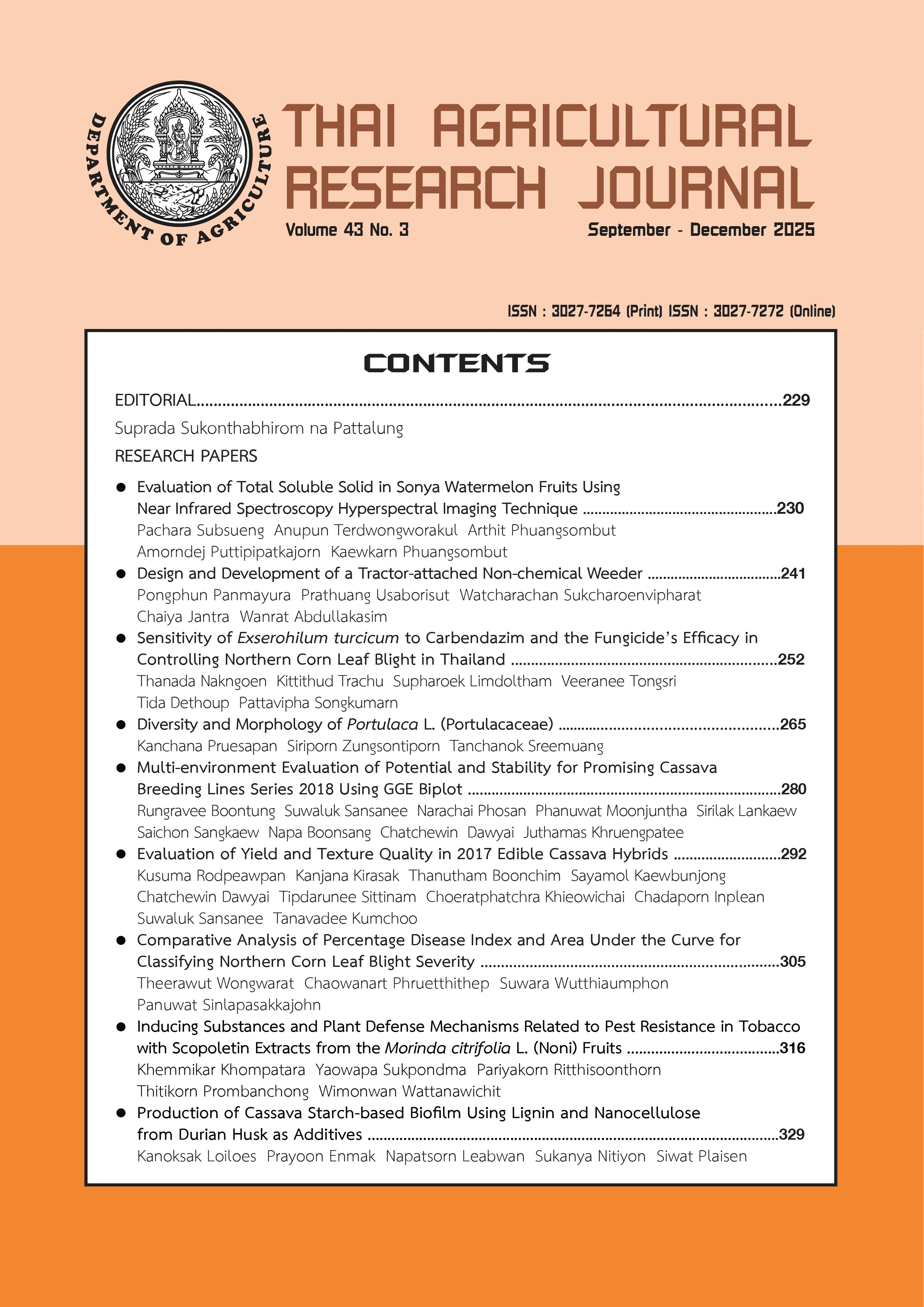
Evaluation of Total Soluble Solid in Sonya Watermelon Fruits Using Near Infrared Spectroscopy Hyperspectral Imaging Technique
DOI:
https://doi.org/10.14456/thaidoa-agres.2025.19Keywords:
total soluble solid, watermelon fruits, near infrared spectroscopy, hyperspectral imaging techniqueAbstract
Near-infrared hyperspectral imaging (NIR-HSI) is a rapid accurate, and non-destructive technique for analyzing the composition and internal quality of agricultural products. This study aimed to develop a method for assessing the internal quality of the 'Sonya' watermelon cultivar using NIR-HSI by constructing a predictive model for total soluble solids (TSS) content based on 100 watermelon samples. The reflectance spectra were measured in the wavelength range of 900–1700 nm. The obtained data were in the form of hypercube spectral data, and an equation was created to predict the total soluble solids content using the partial least squares regression technique. The best prediction equation had a correlation coefficient of 0.977, a root mean square error of 0.231°Bx and a bias of 0.047, indicating that it was effective for quality assessment. Additionally, the absorbance values from each pixel of the hypercube data were used to create a map showing the distribution of TSS in the watermelon samples. The findings of this study demonstrate that NIR-HSI can effectively predict TSS content and visualize its spatial distribution within whole watermelons, highlighting its potential application in future automated systems for watermelon quality grading.
References
แก้วกานต์ พวงสมบัติ อนุพันธ์ เทอดวงศ์วรกุล ณัฐภรณ์
สุทธิวิจิตรภักดี อาทิตย์ พวงสมบัติ Satoru Tsuchikawa Tetsuya Inagaki และ Te Ma. 2560. การจำแนกเมล็ดถั่วเขียวสำหรับการเพาะงอกด้วยเทคนิคสเปกโทรสโกปี
และการวิเคราะห์ภาพสเปกตรัมอินฟราเรดย่านใกล้. วารสารสมาคมวิศวกรรมเกษตรแห่งประเทศไทย. 23(1): 23-29.
ธวัช ลวะเปารยะ. 2520. การปลูกแตงโม. วารสารพืชสวน. 13(1): 1–14.
สำนักงานมาตรฐานสินค้าเกษตรและอาหารแห่งชาติ. 2555. มาตรฐานสินค้าเกษตร มกษ. 20-2555: แตงโม (Watermelon). กระทรวงเกษตรและสหกรณ์. แหล่งข้อมูล: https://www.acfs.go.th/standard /detail/231. สืบค้น: 20 พฤษภาคม 2568.
Bonifazi, G., S. Serranti and R. Gasbarrone. 2022. Watermelon seeds germination study by shortwave infrared-based hyperspectral imaging techniques. 9-35. In: Proceedings of the 11th UBT Annual International Conference on Mechatronics, System Engineering and Robotics; 2022 Oct 29–30; Pristina.
Büning Pfaue, H. 2003. Analysis of water in food by near infrared spectroscopy. Food Chemistry. 82(1): 107–115.
Burns, D.A. and E.W. Ciurczak, eds. 2008. Handbook of Near-Infrared Analysis. 3nd ed. Boca Raton, FL: CRC Press. 834 p.
Chiatrakul, J., K. Phuangsombut, A. Terdwongworakul and A. Phuangsombut. 2022. The evaluation of total soluble solid on sugar cane stalk using near infrared spectroscopy hyperspectral imaging technique. Thai Agricultural Research Journal. 40(3): 276–287.
Golic, M., K. Walsh and P. Lawson. 2003. Short-wavelength near-infrared spectra of sucrose, glucose, and fructose with respect to sugar concentration and temperature. Applied Spectroscopy. 57(2): 139–145.
Jie, D., L. Xie, X. Rao and Y. Ying. 2014. Using visible and near infrared diffuse transmittance techniqueto predict soluble solids content of watermelon in an on-line detection system. Postharvest Biologyand Technology. 90: 1–6.
Maheshwari S., V. Kumar, G. Bhadauria, and A. Mishra. 2022. Immunomodulatory potential of phytochemicals and other bioactive compounds of fruits: A review. Food Frontiers. 3(2): 221–238
Manley, M. 2014. Near-infrared spectroscopy and hyperspectral imaging: non-destructive analysis of biological materials. Chemical Society Reviews. 43(24): 8200–8214.
Martinsen, P. and P. Schaare. 1998. Measuring soluble solids distribution in kiwifruit using near-infrared imaging spectroscopy. Postharvest Biology and Technology. 14(3): 271–281.
Muncan, J., M. Yamaguchi, I. Kashiwakura and R. Tsenkova.
Non-invasive estimation of absorbed ionizing radiation dose in mice using near-infrared spectroscopy (NIRS) and aquaphotomics. Radiation Physics and Chemistry. 229: 112554.
Qi H., M. He, Z. huang, and J. Yan.2024. Application of hyperspectral imaging for watermelon seed classification using deep learning and scoring mechanism. Journal of Food Quality. 2024:1-13.
Rungpichayapichet, P., M. Nagle, P. Yuwanbun, P. Khuwijitjaru, B. Mahayothee and J. Müller. 2017. Prediction mapping of physicochemical properties in mango by hyperspectral imaging. Biosystems Engineering.159: 109–120.
Simón-Portillo, F.J., D. Abellán-López, M. Fabra-Rodriguez, R. Peral-Orts and M. Sánchez-Lozano. 2023. Detection of hollow heart disorder in watermelons using vibrational test and machine learning. Journal of Agriculture and Food Research. 14: 100779. 10 p.
Sun, J., A. Nirere, K.D. Dusabe, Z. Yuhao and G. Adrien. 2024. Rapid and nondestructive watermelon (Citrullus lanatus) seed viability detection based on visible near-infrared hyperspectral imaging technology and machine learning algorithms. Journal of Food Science. 89(7): 4403–4418.
Tian, H.Q., Y.B. Ying, H.S. Lu, X.P. Fu and H.Y. Yu. 2007. Measurement of soluble solids content in watermelon by Vis/NIR diffuse transmittance technique. Journal of Zhejiang University Science B. 8(2): 105–110.
Torge, R., E. Morgenbrod and T. Thomas. 1994. High precision interference refractometer for length measurements. pp. 1–6. In: Proceedings of SPIE, Conference on Interference Refractometry, April 11–12, 1994, Bellingham, WA, USA. Bellingham, WA: SPIE.
Vega-Castellote, M., M.T. Sánchez, I. Torres, M.J. de la Haba and D. Pérez-Marín. 2022. Assessment of watermelon maturity using portable new generation NIR spectrophotometers. Scientia Horticulturae. 304: 111328.
Vega-Castellote, M., M.T. Sánchez, J.P. Wold, N.K. Afseth and D. Pérez-Marín. 2023. Near infrared light penetration in watermelon related to internal quality evaluation. Postharvest Biology and Technology. 204(5): 112477.
Workman, Jr., J. and L. Weyer. 2012. Practical Guide and Spectral Atlas for Interpretive Near-Infrared Spectroscopy. 2nd ed. CRC Press, Boca Raton, FL, USA. 326 p.
Downloads
Published
How to Cite
Issue
Section
License
Copyright (c) 2025 Thai Agricultural Research Journal

This work is licensed under a Creative Commons Attribution-NonCommercial-NoDerivatives 4.0 International License.
Thai Agricultural Research Journal

