
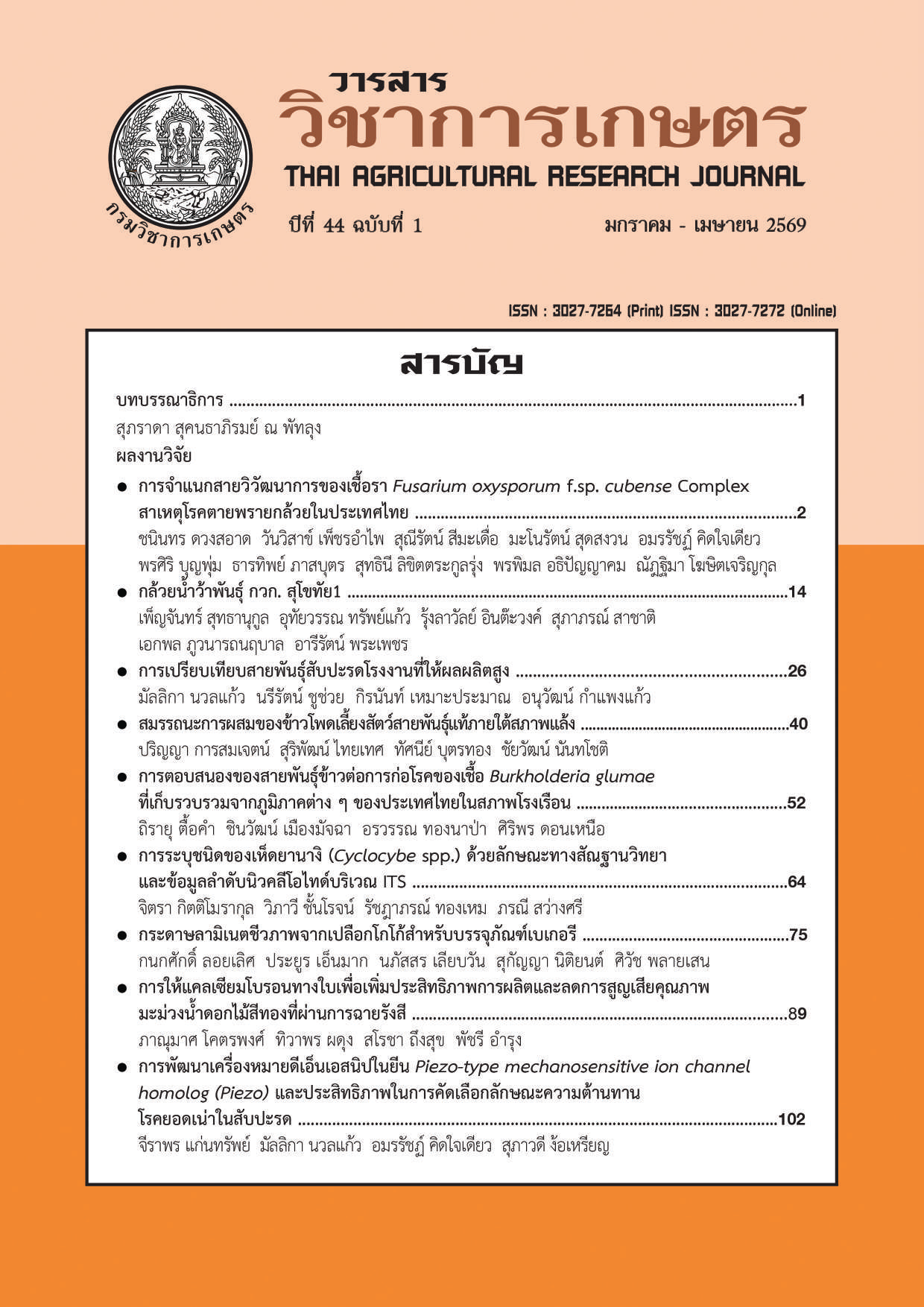
การพัฒนาเครื่องหมายดีเอ็นเอสนิปในยีน Piezo-type mechanosensitive ion channel homolog (Piezo) และประสิทธิภาพในการคัดเลือกลักษณะความต้านทานโรคยอดเน่าในสับปะรด
DOI:
https://doi.org/10.14456/thaidoa-agres.2026.9คำสำคัญ:
เครื่องหมายดีเอ็นเอ, สนิป, โรคยอดเน่า, สับปะรด, เตตระไพรเมอร์ เออาร์เอ็มเอส พีซีอาร์บทคัดย่อ
โรคยอดเน่าจากเชื้อรา Phytophthora spp. เป็นปัญหาสำคัญในการผลิตสับปะรด เครื่องหมายดีเอ็นเอสนิปที่มีประสิทธิภาพสามารถใช้ในการคัดเลือกพันธุ์ต้านทานต่อโรคยอดเน่าอย่างรวดเร็วและแม่นยำ งานวิจัยนี้ได้ดำเนินการพัฒนาชุดไพรเมอร์ที่จำเพาะต่อเครื่องหมายดีเอ็นเอชนิดสนิปแบบ nonsynonymous ในยีน Piezo-type mechanosensitive ion channel homolog (Piezo) ของสับปะรด ตำแหน่ง S13_8307911 ที่พบว่ามีความแตกต่างของลำดับนิวคลีโอไทด์ระหว่างพันธุ์ต้านทานและพันธุ์อ่อนแอต่อโรคยอดเน่า และได้หาสภาวะที่เหมาะสมสำหรับการตรวจสอบเครื่องหมายดีเอ็นเอสนิปด้วยเทคนิค tetra-primer ARMS–PCR ผลการทดสอบประสิทธิภาพขอเครื่องหมายในการคัดเลือกลักษณะความต้านทานต่อโรคยอดเน่าในกลุ่มตัวอย่างสับปะรดลูกผสม จำนวน 22 สายต้นที่แสดงลักษณะต้านทานโรคภายใต้สภาพแวดล้อมธรรมชาติ โดยประเมินจากความสอดคล้องระหว่างจีโนไทป์และฟีโนไทป์ หรือความแม่นยำ พบว่า เครื่องหมายดีเอ็นเอสนิป S13_8307911 เมื่อเปรียบเทียบกับเครื่องหมายดีเอ็นเอสนิป S6_3252739 ในยีน E3ubiquitin-protein ligase MED25 binding RING-H2 protein 1 และ S15_644992 ในยีน Pathogenesis-related protein-4-like มีความแม่นยำของเครื่องหมาย 95.5 100 และ 81.8% ตามลำดับ ผลการศึกษาชี้ให้เห็นว่าเครื่องหมายสนิป ดังกล่าวมีศักยภาพสำหรับประยุกต์ใช้เพื่อการคัดเลือกพันธุ์สับปะรดต้านทานโรคยอดเน่า อย่างไรก็ตาม ควรมีการประเมินเพิ่มเติมในประชากรขนาดใหญ่และมีพื้นฐานพันธุกรรมที่หลากหลายเพื่อยืนยันความเสถียรและความแม่นยำก่อนนำไปใช้ในโปรแกรมปรับปรุงพันธุ์
เอกสารอ้างอิง
จารุพันธ์ ทองแถม. 2526. สับปะรดและอุตสาหกรรมสับปะรดในประเทศไทย. กรุงเทพฯ: ภาควิชาพืชสวน คณะเกษตร มหาวิทยาลัยเกษตรศาสตร์. 158 หน้า.
จีราพร แก่นทรัพย์ มัลลิกา นวลแก้ว อมรรัชฏ์ คิดใจเดียว สุภาวดี ง้อเหรียญ รังสิมันตุ์ ธีระวงศ์ภิญโญ และ ภรณี สว่างศรี. 2566. การพัฒนาเครื่องหมายดีเอ็นเอสนิปในยีน E3 ubiquitin- protein ligase MBR1 และยีน pathogenesis-related protein PR-4-like ที่เกี่ยวข้องกับความต้านทานโรคเน่าในสับปะรด, หน้า 1-9. ใน: การประชุมวิชาการระดับชาติ ครั้งที่ 20, มหาวิทยาลัยเกษตรศาสตร์ วิทยาเขตกำแพงแสน.
สำนักวิจัยเศรษฐกิจการเกษตร. 2566. สถานการณ์สินค้าเกษตรที่สำคัญและแนวโน้ม ปี 2567. สำนักงานเศรษฐกิจการเกษตร, กรุงเทพฯ. 238 หน้า.
Ali, S., B.A. Ganai, A.N. Kamili, A.A. Bhat, Z.A. Mir, J.A. Bhat, A. Tyagi, S.T. Islam, M. Mushtaq, P. Yadav, S. Rawat and A. Grover. 2018. Pathogenesis-related proteins and peptides as promising tools for engineering plants with multiple stress tolerance. Microbiological Research. 212-213: 29-37.
Clark, J.R. and C.E. Finn. 2010. Register of new fruit and nut cultivars list 45. HortScience. 45(5): 716–756.
Codjia, E.D., B. Olasanmi, P.A. Agre, R. Uwugiaren, A.D. Ige and I.Y. Rabbi. 2022. Selection for resistance to cassava mosaic disease in African cassava germplasm using single nucleotide polymorphism markers. South African Journal of Science. 118: 11607.
Collard, B.C.Y. and D.J. Mackill. 2008. Marker-assisted selection: An approach for precision plant breeding in the twenty-first century. Philosophical Transactions of the Royal Society B: Biological Sciences. 363(1491): 557–572.
Devi, K.D., K. Punyarani, N.S. Singh and H.S. Devi. 2013. An efficient protocol for total DNA extraction from the members of order Zingiberales-suitable for diverse PCR based downstream applications. SpringerPlus. 2(1): 669.
Duplan, V. and S. Rivas. 2014. E3 ubiquitin-ligases and their target proteins during the regulation of plant innate immunity. Frontiers in Plant Science. 5: 42.
Heng, H., H. Guoqiang, S. Jin, Z. Fengli and Z. Dabing. 2021. Bioinformatics analysis for Piezo in rice. Reproduction and Breeding. 1(2): 108-113.
Ige, A.D., B. Olasanmi, E.G.N. Mbanjo, I.S. Kayondo, E.Y. Parkes, P. Kulakow, C. Egesi, G.J. Bauchet, E. Ng, L.A.B. Lopez-Lavalle, H. Ceballos and I.Y. Rabbi. 2021. Conversion and validation of uniplex SNP markers for selection of resistance to cassava mosaic disease in cassava breeding programs. Agronomy. 11: 420.
Kunzelmann, K. 2016. Ion channels in regulated cell death. Cellular and Molecular Life Sciences. 73(11): 2387–2403.
Kim, Y.J. and J. Hyun. 2023. Mechanosensitive ion channels in apoptosis and ferroptosis: Focusing on the role of Piezo1. BMB Reports. 56(3): 145-152.
Leelasetthakul, K. 1972. Pineapple Disease. Office of Agriculture Thailand, Bangkok.
Ratti, M.F., M.S. Ascunce, J.J. Landivar and E.M. Goss. 2018. Pineapple heart rot isolates from Ecuador reveal a new genotype of Phytophthora nicotianae. Plant Pathology. 67(8): 1803-1813.
Sanewski, G., L. Ko, J. DeFaveri and A. Kilian. 2016. Genetic resistance to the root rot pathogen Phytophthora cinnamomi in Ananas. pp. 281-286. In: XXIX International Horticultural Congress on Horticulture: Sustaining Lives, Livelihoods and Landscapes (IHC2014): IV 1111.
Serrato-Diaz, L., L. Simbana, Y. Vélez-Negrón and L. Vargas. 2022. Detection and incidence of pineapple heart rot disease caused by Phytophthora nicotianae in commercial farms of Puerto Rico. The Journal of Agriculture of the University of Puerto Rico. 106(2): 233-246.
Yu, J.L. and H.Y. Liao. 2021. Piezo-type mechanosensitive ion channel component 1 (Piezo1) in human cancer. Biomedicine and Pharmacotherapy. 140: 111692.
Zhang, Z., X. Tong, S.Y. Liu, L.X. Chai, F.F. Zhu, X.P. Zhang, J.Z. Zou and X.B. Wang. 2019. Genetic analysis of a Piezo-like protein suppressing systemic movement of plant viruses in Arabidopsis thaliana. Scientific Reports. 9(1): 3187.
ดาวน์โหลด
เผยแพร่แล้ว
รูปแบบการอ้างอิง
ฉบับ
ประเภทบทความ
สัญญาอนุญาต
ลิขสิทธิ์ (c) 2026 วารสารวิชาการเกษตร

อนุญาตภายใต้เงื่อนไข Creative Commons Attribution-NonCommercial-NoDerivatives 4.0 International License.
วารสารวิชาการเกษตร

