
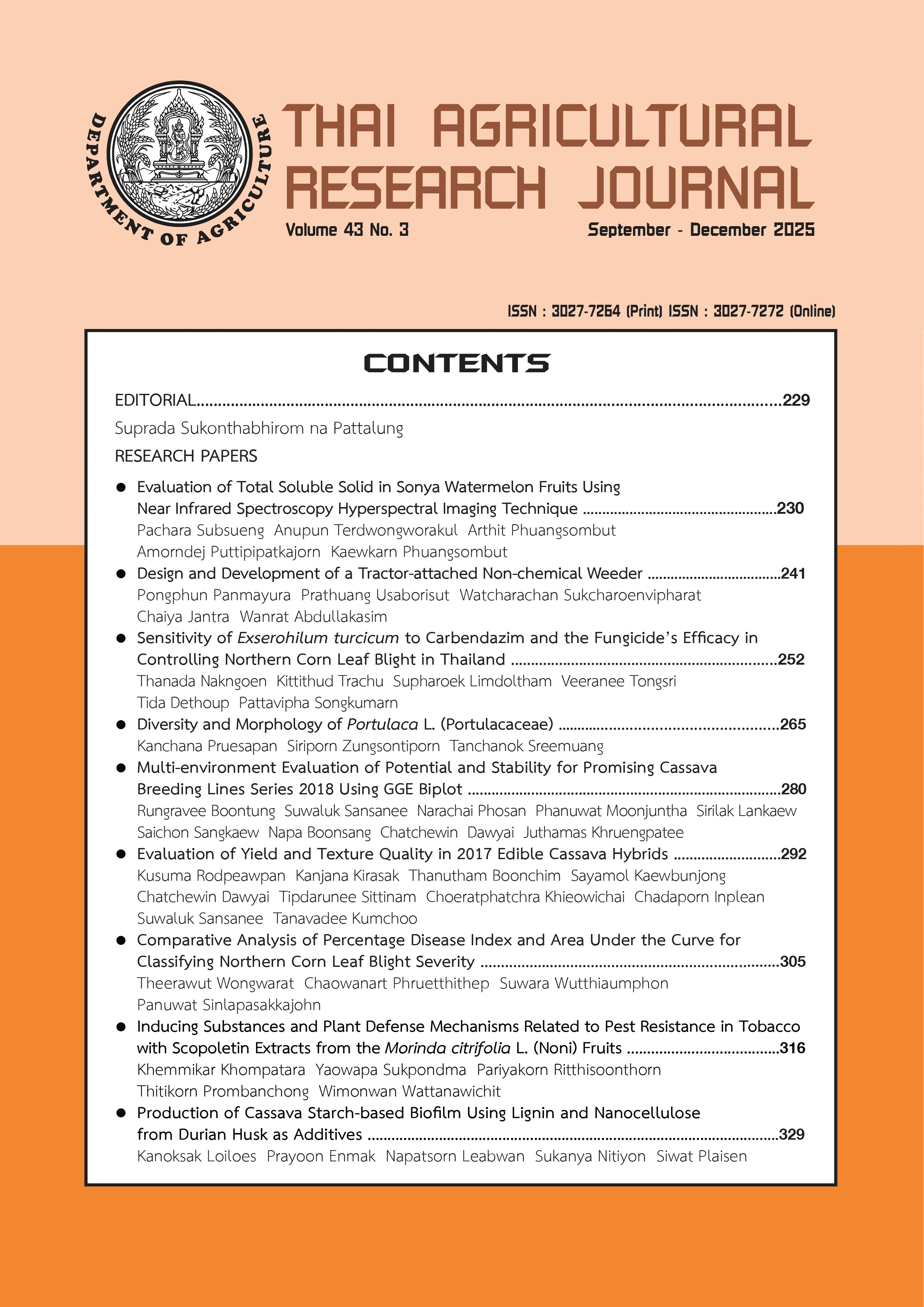
Design and Development of a Tractor-attached Non-chemical Weeder
DOI:
https://doi.org/10.14456/thaidoa-agres.2025.20Keywords:
agricultural machinery, thermal weed control, flame weeder, hot water weederAbstract
Sugarcane is an important economic crop in Thailand. Farmers face challenges in weed control due to the limitations of chemical herbicides, which pose health and environmental risks, as well as mechanical methods that are constrained by field conditions and timing. This research aimed to design and develop a tractor-mounted weed control machine utilizing flame and hot water, and to evaluate its performance in sugarcane fields. Two factors were tested: three levels of forward speed and three nozzle heights (10, 20, and 30 cm). Results indicated that the flame-based system, with a nozzle height of 10 cm and a forward speed of 8.89 km/h, achieved the highest weed control efficiency at 100% within 7 days after treatment. The maximum temperature at the sugarcane base reached 48.75°C, while soil moisture decreased by 0.14%. The field capacity was 0.40 rai/h, and the field efficiency was 66.77%. LPG consumption was 10.29 kg/rai, with a break-even point of 12.19 rai/year and a payback point of 67.19 rai. Meanwhile, the hot water system, with a nozzle height of 10 cm and a speed of 8.41 km/h, achieved a maximum weed control efficiency of 93.40% within 7 days. The maximum temperature at the sugarcane base was 33.5°C, while soil moisture increased by 0.35%. The field capacity was 0.40 rai/h, and the field efficiency was 71.27%. LPG consumption was 15.14 kg/rai, with a break-even point of 30.48 rai/year and a payback point of 167.95 rai. These findings suggest that the flame-based weed control machine provides greater efficiency and economic feasibility, making it more suitable for weed management in sugarcane fields.
References
กรมวิชาการเกษตร. 2563. การดำเนินการเกี่ยวกับวัตถุอันตราย ชนิดที่ ๔ ที่กรมวิชาการเกษตรเป็นผู้รับผิดชอบ. น. 28-29. ใน: รายงานราชกิจจานุเบกษา 2563. สำนักเลขาธิการคณะรัฐมนตรี.
กรมส่งเสริมการเกษตร. 2564. เทคโนโลยีการผลิตอ้อย. กลุ่ม โรงพิมพ์ สำนักงานพัฒนาการถ่ายทอดเทคโนโลยี กรมส่งเสริมการเกษตร กระทรวงเกษตรและสหกรณ์ กรุงเทพฯ. แหล่งข้อมูล: https://esc.doae.go.th/wp-content/uploads/2022/01/A2.pdf. สืบค้น: 16 มิถุนายน 2568.
ชลธิชา เบิกใจ และ ธนัชสัณห์ พูนไพบูลย์พิพัฒน์. 2566. ผลของใบอ้อยคลุมดินต่อการจัดการวัชพืชเพื่อประยุกต์ใช้ในอ้อยอินทรีย์. วารสารเกษตรนเรศวร. 20(1): e0200104.
ธนาคารแห่งประเทศไทย. 2568. อัตราดอกเบี้ยประจำวันของธนาคารพาณิชย์. อัตราดอกเบี้ยเงินฝากสำหรับบุคคลธรรมดาของธนาคารพาณิชย์ ประจำวันที่ 30 มิถุนายน 2568. แหล่งข้อมูล: https://www.bot. or.th/th/statistics/ interest-rate.html. สืบค้น: 16 มิถุนายน 2568.
สำนักงานคณะกรรมการอ้อยและน้ำตาลทราย. 2567. รายงานสถานการณ์การปลูกอ้อยประจำปีการผลิต 2566/2567. กลุ่มเทคโนโลยีสารสนเทศและการสื่อสาร กองยุทธศาสตร์และแผนงาน สำนักงานคณะกรรมการอ้อยและน้ำตาลทราย. 78 หน้า.
Aekrathok, P., P. Songsri, N. Jongrungklang and S. Gonkhamdee. 2021. Efficacy of post-emergence herbicides against Important weeds of sugarcane in North-East Thailand. Agronomy. 11(3): 429.
ESCAP and RNAM (Economic and Social Commission for Asia and the Pacific, Regional Network for Agricultural Machinery). 1983. RNAM Test codes and procedures for farm machinery (12): 297. 297 p.
Gravois K., H. Viator, G. Reagan, J. Beuzelin, J. Griffin, B. Tubana, J. Hoy. 2014. Sugarcane production Handbook. Louisiana State University Agricultural Center Pub. 2859. 84 p.
Inman-Bamber, N. and D. M. Smith. 2005. Water relations in sugarcane and response to water deficits. Field crops research. 92(2-3): 185-202.
Khaliq, A., N. Ahmad, M. S. Afzal, M. Yasin, H. Abdulrauf and S. Rahseed. 2018. Impact of weed control methods on yield and quality of sugarcane crop. Global Scientific Journal. 6(11): 464-472.
Kristoffersen, P., A. M. Rask and S. U. Larsen. 2008. Non-chemical weed control on traffic islands: a comparison of the efficacy of five weed control techniques. Weed Research. 48(2): 124-130.
Martelloni, L., C. Frasconi, M. Sportelli, M. Fontanelli, M. Raffaelli and A. Peruzzi. 2021. Hot foam and hot water for weed control: A comparison. Journal of Agricultural Engineering. 52(3): 1-10.
Merfield, C. N., J. G. Hampton and S. D. Wratten. 2017. Efficacy of heat for weed control varies with heat source, tractor speed, weed species and size. New Zealand Journal of Agricultural Research. 60(4): 437-448.
Randell, T. M., L. C. Hand, J. C. Vance and A. S. Culpepper. 2020. Interval between sequential glufosinate applications influences weed control in cotton. Weed Technology. 34(4): 528–533.
Upadhyay, A., K. P. Singh, K. B. Jhala, M. Kumar and A. Salem. 2024. Non-chemical weed management: Harnessing flame weeding for effective weed control. Heliyon. 10(12): e3277
Downloads
Published
How to Cite
Issue
Section
License
Copyright (c) 2025 Thai Agricultural Research Journal

This work is licensed under a Creative Commons Attribution-NonCommercial-NoDerivatives 4.0 International License.
Thai Agricultural Research Journal

