
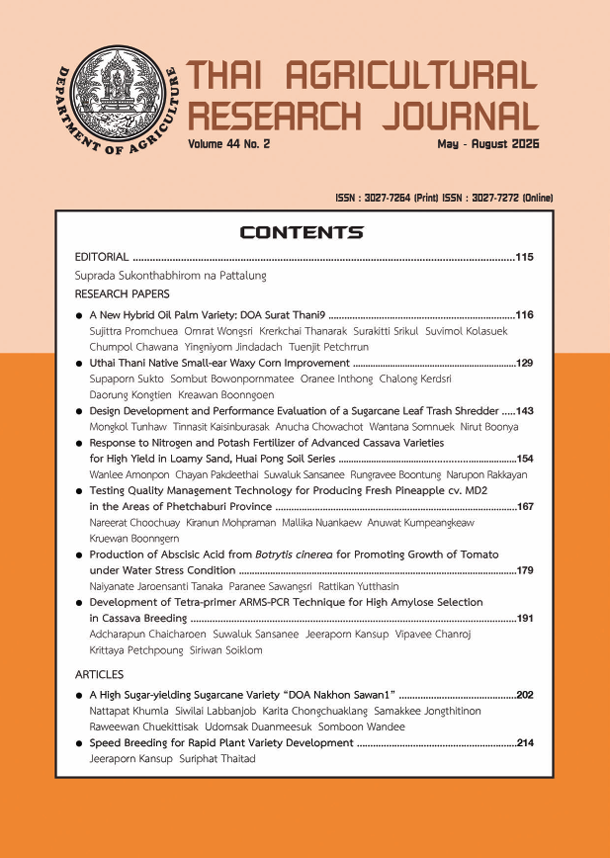
Design Development and Performance Evaluation of a Sugarcane Leaf Trash Shredder
DOI:
https://doi.org/10.14456/thaidoa-agres.2026.12Keywords:
sugarcane leaf trash shredder, Y-shaped blade, PM2.5 reductionAbstract
Sugarcane leaf trash management is a critical challenge in mechanized farming, often leading to open burning and environmental pollution. This study aimed to develop a prototype sugarcane shredder designed to improve shredding efficiency, evaluated by the reduction in residue size and field-tested for engineering economic viability. The machine utilizes a dual-shaft mechanism: shaft A employs C-shape 24 blades for initial cutting, while shaft B features 12 sets of Y-shape flail blades operating at high linear speed of 16.7 m/s (800 rpm) for fine shredding. The performance was evaluated under varying blade linear speeds for shaft A (7.4, 9.6, and 11.7 m/s) and forward speeds (0.5 and 1.2 km/h). Statistical analysis indicated that the optimal condition was a blade linear speed of 11.7 m/s combined with a forward speed of 1.2 km/h. This configuration significantly reduced residue size, with the average width decreasing by 78.6% (to 0.7 cm) and the average length by 77.7% (to 28 cm). Economic analysis revealed a field capacity of 1.1 rai/h, with a break-even point of approximately 114.6 rai/year. This developed sugarcane shredder offers an efficient mechanical solution to support zero burn policies, enhancing biomass incorporation into the soil while remaining commercially viable for farmers.
References
วรรณวิภา แก้วประดิษฐ์. 2564. การจัดการใบอ้อยเพื่อลดฝุ่นละอองขนาดเล็กและส่งเสริมการผลิตอ้อยอย่างยั่งยืน. วารสารแก่นเกษตร. 49(1): 76–86.
วิมล ภูกองไชย และวรรณวิภา แก้วประดิษฐ์. 2561. การจัดการเศษซากใบอ้อยที่ส่งผลต่อการย่อยสลายและปลดปล่อยไนโตรเจน. วารสารแก่นเกษตร. 46(1): 25–29.
สุภาษิต เสงี่ยมพงศ์ อัคคพล เสนาณรงค์ ยุทธนา เครือหาญชาญพงค์ และขนิษฐ์ หว่านณรงค์. 2548. วิจัยและพัฒนาจอบหมุนแบบแถวเดี่ยวเพื่อพรวนดินและสับใบอ้อยในระหว่างแถวสำหรับไร่อ้อย. หน้า 124-138. ใน: รายงานผลงานวิจัยประจำปี 2548 กรมวิชาการเกษตร.
สำนักงานคณะกรรมการอ้อยและน้ำตาลทราย. 2566. รายงานประจำปี 2566 สำนักงานคณะกรรมการอ้อยและน้ำตาลทราย. แหล่งข้อมูล: https://e-library.moc.go.th/book-detail/22756. สืบค้น: 5 พฤษภาคม 2567.
อรรถสิทธิ์ บุญธรรม ชุมพล คำสิงห์ และสนิท สมเหมาะ. 2547. เครื่องสับใบอ้อยระหว่างแถวอ้อยตอ. หน้า 52-61. ใน: รายงานผลงานวิจัยประจำปี 2547 ศูนย์วิจัยพืชไร่สุพรรณบุรี. กรมวิชาการเกษตร.
อรรถสิทธิ์ บุญธรรม ชุมพล คำสิงห์ นริศร ขจรผล สุกรี นันตะสุคนธ์ และสนิท สมเหมาะ. 2551. การแก้ปัญหาการเผาใบอ้อยก่อนการเก็บเกี่ยวโดยใช้เครื่องสางใบอ้อย. หน้า 211-225. ใน: รายงานผลการวิจัยประจำปี 2551 ศูนย์วิจัยพืชไร่สุพรรณบุรี. กรมวิชาการเกษตร.
Dong, X., J. Zhang and M. Li. 2013. Structural design of key components of 1GYF-240 sugarcane leaf crushing and returning machine. China Tropical Agriculture. 6: 39-41.
ESCAP and RNAM (Economic and Social Commission for Asia and the Pacific, Regional Network for Agricultural Machinery). 1983. RNAM Test Codes and Procedures for Farm Machinery. No.12. 297 p.
Hemwong, S., B. Toomsan, G. Cadisch, V. Limpinuntana, P. Vityakon and A. Patanothai. 2009. Sugarcane residue management and grain legume crop effect on N dynamic, N losses and growth of sugarcane. Nutrient Cycling in Agroecosystems. 83(2): 135-151.
Khaehanchanpong, Y., T. Ahamed and T. Takigawa. 2017. Design, fabrication and performance evaluation of an inter-row cultivator for sugarcane fields. Inventions. 2(3): 25.
Lin, Y., F. Wen, M. Yu, Y. Tang, K. Hu and Y. Wang. 2020. Simulation analysis of the sugarcane leaves cutting process of the electric returning machine. IOP Conference Series: Earth and Environmental Science. 453(1): 012047.
Singrun, C., S. Sudajan, C. Junsiri, K. Laloon and C. Oupathum, 2021. Effects of moisture content and blade cutting speed on the chopping and size distribution of sugarcane leaves for the production of fuel biomass. Agricultural Engineering International: CIGR Journal. 23(2): 152-161.
Zhang, B., C. Gao, W. Shen and B. Chen. 2024. Design and experiment of profiling furrow-ridge terrain by cane leaf-chopping and returning machine. Agriculture. 14(3): 413.
Downloads
Published
How to Cite
Issue
Section
License
Copyright (c) 2026 Thai Agricultural Research Journal

This work is licensed under a Creative Commons Attribution-NonCommercial-NoDerivatives 4.0 International License.
Thai Agricultural Research Journal

