
Distribution and Population Status of Pteropus medius and Pteropus hypomelanus Flying Foxes (Mammalia: Chiroptera: Pteropodidae) in Myanmar
DOI:
https://doi.org/10.58837/tnh.25.1.263387Keywords:
distribution, population, Pteropus medius, Pteropus hypomelanus, conservation status, MyanmarAbstract
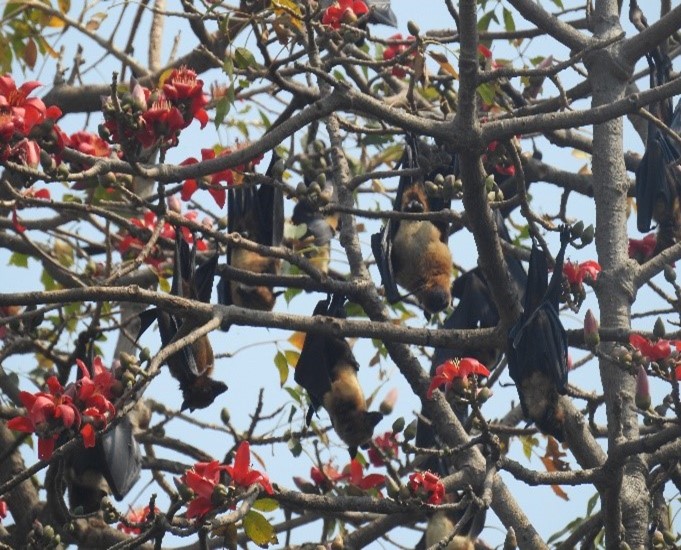
Populations of large fruit bats such as flying foxes are declining globally, particularly due to hunting. Monitoring population changes as well as roost characteristics are vital for conservation planning. The distribution and population size of flying foxes (Pteropus spp.) in Myanmar were assessed in the Mandalay Region, Sagaing Region, Mon State (Mawlamyine Township and Kyaikami Township), and Tanintharyi Region (Myeik Township, Thayetchaung Township, Thae Phyu Island) from February 2020 to January 2021. The survey found 12 colonies of P. medius and 3 colonies of P. hypomelanus roosting in 17 tree species. Direct roost counts were used to estimate the population size of these species. The total number of individuals across all study sites was 73,876 for P. medius and 20,458 for P. hypomelanus. The roosting sites of P. medius and P. hypomelanus were at an average elevation of 59.25 m and 25 m, respectively, and close to bodies of water. In total, 66% of P. medius and 61% of P. hypomelanus populations were located within Buddhist temples and public land, respectively. In addition, one-third of their populations occupied private land. Approximately 56% of the total flying fox population was found in areas classified as well-protected and 44% as disturbed. Temples play a crucial role in providing safe roosting habitats for flying foxes in Myanmar as hunting is prohibited in temples. Tall, large canopy trees offer optimum roost sites for flying foxes as they provide more heat dissipation on hot days when flying foxes often experience hyperthermia in full sunlight. Some colonies were found to suffer from hunting or roost tree cutting. Private land is also vital for flying fox survival and conservation efforts need to involve collaboration with private landowners to ensure their protection and survival. This study identifies ecologically important roost characteristics and provides an update on the distribution and population status of Pteropus species in Myanmar.
References
Aung L.L., Zin, E.E., Theingi, P., Elvera, N., Aung, P.P., Han, T.T., Oo, Y. and Skaland, R.G. 2017. Myanmar Climate Report, Department of Meteorology and Hydrology Myanmar, Ministry of Transport and Communications, Government of the Republic of the Union of Myanmar. Yangon, 105 pp.
Aung, M.M. 2006. Autecology of Indian Flying Fox, Pteropus giganteus Brunnich, 1782 within Shwe Sedi Pagoda Precinct, Hpa Yar Pyan Village, Wetlet Township. PhD. Thesis. Department of Zoology, Mandalay University.
Aung, M.M. 2013. Autecology of Pteropus giganteus from Myanmar- Feeding, Reproductive and Roosting Ecology. LAP Lambert Academic Publishing House, Germany, 84 pp.
Aye, N.N., Lin, T.T. and Htwe, M. M. 2007. Study on some bat species in Myeik Environs. Departmental Research, Department of Zoology, Myeik University.
Aziz, S. A., Olival, K. J., Bumrungsri, S., Richards, G. C., Racey, P. A. 2016. The Conflict Between Pteropodid Bats and Fruit Growers: Species, Legislation and Mitigation. In: Voigt, C., Kingston, T. (eds) Bats in the Anthropocene: Conservation of Bats in a Changing World.
Aziz, S. A., Clements, G. R., Giam, X., Forget, P. M. and Campos-Arceiz, A. 2017. Coexistence and conflict between the island flying fox (Pteropus hypomelanus) and humans on Tioman Island, Peninsular Malaysia. Human Ecology, 45 (3), 377–389. https://doi.org/10.1007/s10745-017-9905-6.
Aziz, S. A., Clements, G. R., Peng, L. Y., Campos-Arceiz, A., McConkey, K. R., Forget, P., Gan, H. M. 2017. Elucidating the diet of the island flying fox (Pteropus hypomelanus) in Peninsular Malaysia through Illumina Next-Generation Sequencing. PeerJ5: e3176.
Aziz, S. A., McConkey, K. R., Tanalgo, K., Sritongchuay, T., Low, M. R., Yong, J. Y., Mildenstein, T. L., Nuevo-Diego, C. E., Lim, V. C. and Racey, P. A. 2021. The critical importance of old world fruit bats for healthy ecosystems and economies. Frontiers in Ecology and Evolution, 9, Article 641411.
Bates, P.J.J. and Harrison, D.L. 1997. Bats of the Indian Subcontinent. Harrison Zoological Museum. Kent, 258 pp.
Bates, P.J.J., New, T., Pearch, M.J., Swe, K.M., Bu, S.S.H. and Tun, T. 2000. A review of bat research in Myanmar (Burma) and results of a recent survey. Acta Chiropterologica, 2: 53–82.
Bates, P., Francis, C., Gumal, M., Bumrungsri, S., Walston, J., Heaney, L. and Mildenstein, T. 2008. Pteropus vampyrus. The IUCN Red List of Threatened Species. Available from: http://doi.org/10.2305/IUCN.UK.2008.RLTS, (31 December 2023).
Bell, S.S, McCoy, E.D. and Mushinski, H.R. 1994. Habitat Structure: The Physical Arrangement of Object in Space. Chapman and Hall. London, 100 pp.
Betts, B.J. 1998. Roosts used by maternity colonies of Silver-Haired Bats in Northeastern Oregon. Journal of Mammalogy, 79: 643–650.
Boonkird, K., Wanghongsa, S., Wacharapluesadee, S. and Hemachudha, T. 2006. On the roost selection of Lyle’s Flying Fox, Pteropus lylei at Wat Luang Pormmawas, Chon Buri province. Wildlife Yearbook, 7: 120–131.
Chaiyes, A., Duengkae, P., Wacharapluesadee, S., Pongpattananurak, N., Olival, K.J. and Hemachudha, T. 2017. Assessing the distribution, roosting site characteristics, and population of Pteropus lylei in Thailand. Raffles Bulletin of Zoology, 65: 670–680.
Clunie, F. 1972. A contribution to the natural history of the Fiji peregrine. Notornis 19: 302–321.
Donald, P.F., Round, P.D., Dai We Aung, T., Grindley, M., Steinmetz, R., Shwe, N. M. and Buchanan, G.M. 2015. Social reform and a growing crisis for southern Myanmar’s unique forests. Conservation Biology, 29: 1485–1488.
Duengkae, P., Srikhunmuang, P., Chaiyes, A., Suksavate, W., Pongpattananurak, N., Wacharapluesadee, S., Hemachudha, T., 2019. Patch metrics of roosting site selection by Lyle’s flying fox (Pteropus lylei Andersen, 1908) in a human-dominated landscape in Thailand. Folia Oecologica, 46: 63- 73.
Eby, P. 1991. Seasonal movements of Grey-headed Flying-foxes, Pteropus poliocephalus (Chiroptera: Pteropodidae), from two maternity roosts in Northern New South Wales. Wildlife Research, 18: 547–559.
Eby, P. and Lunney, D. 2002. Managing the Grey-headed Flying Fox Pteropus poliocephalus as a threatened species in NSW: adjusting to a long-term vision, pp. 273–284. In: Eby, P and Lunney, D. (Eds.). Managing the grey-headed Flying Fox as a threatened species in NSW. Mosman, NSW: Royal Zoological Society of New South Wales. New South Wales, 286 pp.
Fam, S. D. and Nijman, V. 2011. Spizaetus hawk- eagles as predators of arboreal colobines. Primates 52: 105–110.
Francis, C. 2008. A Guide to the Mammals of South-East Asia. Princeton University Press. United Kingdom, 392 pp.
Francis, C. 2019. Field guide to the mammals of Southeast Asia (2nd edition). Bloomsbury Publishing. London, 416 pp.
Fretwell, S.D. and Lucas, H.L. 1970. On territorial behaviour and other factors influencing habitat distribution in birds. Acta Biotheoretica, 19: 16–36.
Giannini, N.P. 2019. Pteropodidae (Old World Fruit Bat). In: Wilson, D.E. and Mittermeier, R.A. (Eds). Handbook of the Mammals of the World - Volume 9. Lynx Edicions in association with Conservation International and IUCN. Barcelona, 16–61.
Granek, E. 2002. Conservation of Pteropus livingstonii based on roost site habitat characteristics on Anjouan and Moheli, Comoros Islands. Biological Conservation, 108(1): 93–100.
Gulraiz, T.L., Javid, A., Mahmood-Ul-Hassan, M., Maqbool, A., Ashraf, S., Hussain, M. and Daud, S. 2015. Roost characteristics and habitat preferences of Indian Flying Fox (Pteropus giganteus) in urban areas of Lahore, Pakistan. Turkish Journal of Zoology, 39: 388–394.
Hondo, E., Inoue, N., Maeda, K., Rerkamnuaychoke, W. and Duengkae, P. 2010. Movement of Lyle’s Flying Fox (Pteropus lylei) in Central Thailand. Journal of Wildlife in Thailand, 17: 55–63.
IUCN. 2023. The IUCN Red List of Threatened Species. Version 2023-1. Available from: https://www.iucnredlist.org/en, (31 December 2023).
Koopman, K. 1994. Handbook of Zoology, Band/Volume VIII Mammalia. Chiroptera: Systematics Teilband/Part 60. Walter de Gruyter Press. New York, 217 pp.
Kress, W.J., Defilipps, R.A., Farr, E. and Kyi, Y.Y. 2003. A Checklist of the Trees, Shrubs, Herbs and Climbers of Myanmar. Contributions from the United States National Herbarium, Vol. 45. Smithsonian Institution. Washington, D.C., 590 pp.
Kumar, R., Prasad, D. N. and Elangovan, V. 2017. An update on distribution of the Indian Flying Fox, Pteropus giganteus in Uttar Pradesh, India. Trends in Biosciences, 10(37): 7794–7801.
Kunz, T. H., Thomas, D. W., Richards, G. C., Tidemann, C. R., Pierson, E. D. and Racey, P. A. 1996. Observational techniques for bats, pp. 105-114. In: Wilson D.E., F. R. Cole, J. D. Nichols, R. Rudran & M. S. Foster (eds.). Measuring and Monitoring Biological Diversity: Standard Methods for Manuals. Smithsonian Institution Press, Washington D. C., USA, 440 pp.
Lane, D.J.W., Kingston, T. and Lee, B.P.Y.H. 2006. Dramatic decline in bat species richness in Singapore, with implications for Southeast Asia. Biological Conservation, 131: 584–593.
Low, M. R., Hoong, W. Z., Shen, Z., Murugavel, B., Mariner, N., Paguntalan, L. M., Tanalgo, K., Aung, M. M., Sheherazade, Bansa, L. A., Sritongchuay, T., Preble, J. H., and Azia, S. A. 2023. Bane or Blessing? Reviewing Cultural Values of Bats across the Asia-Pacific Region. Journal of Ethnobiology, 41 (1), 18- 34. https://doi.org/10.2993/0278-0771-41.1.18 (Original work published 2021).
Lyon, M.W., Jr. 1911. Mammals collected by Dr W. L. Abbott on Borneo and some of the small adjacent islands. Proceeding of US National Museum, 40 (1809): 53–146.
Marshall, A. G. 1983. Bats, flowers and fruit: evolutionary relationships in the Old World. Biological Journal of the Linnean Society, 20 (1), 115- 135.
Marshall, A. G. 1985. Old World phytophagous bats (Megachiroptera) and their food plants: A survey. Zoological Journal of the Linnean Society, 83 (4), 351- 369.
Meade, J., Martin, J. M. and Welbergen, J. A. 2021. Fast food in the city? Nomadic Flying Foxes commute less and hang around for longer in urban areas. Behaviour Ecology, 32: 1151–1162.
Mickleburgh, S.P., Hutson, A.M. and Racey, P.A. 1992. Old World Fruit Bats. An Action Plan for their Conservation. IUCN/SSC Chiroptera Specialist Group. Gland, 263 pp.
Mikula, P., Morelli, F., Lucan, R. K., Jones, D. N. and Tryjanowski, P. 2016. Bats as prey of diurnal birds: A global perspective. Mammal Review, 46 (3), 160–172.
Mildenstein, T. L., Stier, S. C., Nuevo-Diego, C. E. and Mills, L. S. 2005. Habitat selection of endangered and endemic large Flying Foxes in Subic Bay, Philippines. Biology Conservation, 126: 93–102.
Mildenstein, T., Tanshi, I., Racey, P. A. 2016. Exploitation of Bats for Bushmeat and Medicine, In: Voigt, C., Kingston, T. (eds) Bats in the Anthropocene: Conservation of Bats in a Changing World. Springer, Cham.
Mildenstein, T., Abdul Aziz, S., Paguntalan, L., Jakosalem, P. G., Mohd-Azlan J., Tagtag, A., Bansa, L., Reintar, A. R., Struebig, M., Fredriksson, G., Lee, B., Thong, V. D. and Sheherazade. 2022. Pteropus vampyrus. The IUCN Red List of Threatened Species 2022: e.T18766A22088824.
Mohd-Azlan, J., Zubaid, A. and Kunz, T.H. 2001. Distribution, Relative Abundance, and Conservation Status of the Large Flying Fox, Pteropus vampyrus, in Peninsular Malaysia. Acta Chiropterologica, 3(2): 149–162.
Mohd-Azlan, J., Yong, J. Y., Hazzrol, N. N. M., Pengiran, P., Atong, A. and Aziz, S. A. 2022. Local hunting practices and perceptions regarding the distribution and ecological role of the Large Flying Fox (Chiroptera: Pteropodidae: Pteropus vampyrus) in western Sarawak, Malaysian Borneo, Journal of Threatened Taxa 14 (1): 20387- 20399.
Molur, S., Srinivasulu, C., Bates, P. and Francis, C. 2008. Pteropus medius. The IUCN Red List of Threatened Species 2008: e.T18725A8511108. Available from: https://www.iucnredlist.org/, (31 December 2023).
Nowak, R. 1994. Walker’s Bats of the World. The Johns Hopkins University Press. Baltimore, 287 pp.
Nyunt, M.M. 2007. Ecology and Seasonal Abundance of Indian Flying Fox Pteropus giganteus, (Brunnich, 1782) in Nyaung Hla Village, Nyaung Oo Township. PhD. Thesis. Mandalay University.
Oo, K.T. 2009. Distribution, Seasonal Occurrence and Roosting of Indian Flying Fox Pteropus giganteus Brunnich, 1782 in Monywa Township and its Environs. PhD. Thesis. Mandalay University.
Oo, K.S., Win, H.L., Bates, P.J.J. and Pearch, M. 2017. The ecology and distribution of Flying Foxes (Chiroptera: Pteropodidae: Pteropus) in Tanintharyi Region, Myanmar with a first mainland record of Pteropus hypomelanus geminorum from Myeik. Journal of Threatened Taxa, 9(8): 10528–10537.
Palmer, C. and Woinarski, J.C.Z. 1999. Seasonal roosts and foraging movements of the Black Flying Fox (Pteropus alecto) in the Northern Territory: resource tracking in a landscape mosaic. Wildlife Research, 26(6): 823–838.
Parry-Jones, K.A. and Augee, M.L. 1992. Movements of Grey-headed flying foxes (Pteropus poliocephalus) to and from a colony site on the central coast of New South Wales. Wildlife Research, 19: 331–340.
Parry-Jones, K.A. and Augee, M.L. 2001. Factors affecting the occupation of a colony site in Sydney, New South Wales by the Grey-headed Flying Fox Pteropus poliocephalus (Pteropodidae). Australian Ecology, 26:47–55.
Pierson, E. D. and Rainey, W. E. 1992. The Biology of Flying Foxes of the Genus Pteropus: a review. In: Wilson, D.E. and Graham, G.L. (Eds.). Pacific Island Flying-foxes: Proceedings of an International Conservation Conference, US Department of the Interior, Fish and Wildlife Service. Washington, DC, 90 (23): 111–121.
Ravon, S., Furey, N.M., Hul, V. and Cappelle, J. 2014. A rapid assessment of Flying Fox (Pteropus spp) colonies in Cambodia. Cambodian Journal of Natural History, 1: 14–18.
Sewall, B. J., Granek, E. F., Carroll, J. B., Feistner, A. T. C., Masfeiled, W., Moutui, M. F. E., Trewhella, W. J., Young, R. J., and Said, I. 2007. Conservation Action Plan for Livingstone’s Flying Fox Pteropus livingstonii. Mutsamudu, Anjouan, Union of the Comores: Action Comores (antenne Anjouan).
Sheherazade and Tsang, S.M. 2018. Roost of Gray Flying Foxes (Pteropus griseus) in Indonesia and records of a new hunting threat. Diversity, 10(3): 102.
Sheherazade, Ober, H. K., Tsang, S. M. 2019. Contributions of bats to the local economy through durian pollination in Sulawesi, Indonesia. Biotropica. 2019; 00:1-10.
Stewart, A.B., Srilopan, S., Wayo, K., Hassa, P., Dudash, M. R., Bumrungsri, S. 2024. Bat pollinators: a decade of monitoring reveals declining visitation rates for some species in Thailand. Zoological Letters, 10(1): 5.
Tait, J., Perotto-Baldivieso, H.L., McKeown, A. and Westcott, D.A. 2014. Are Flying Foxes coming to town? Urbanisation of the Spectacled Flying Fox (Pteropus conspicillatus) in Australia. PLoS ONE, 9: e109810.
Tsang, S. M. 2020. Pteropus hypomelanus. The IUCN Red List of Threatened Species 2020: e.T18729A22081642.
Vonhof, M.J. and Barclay, R.M.R. 1996. Roost-site selection and roosting ecology of forest- dwelling bats in Southern British Columbia. Canadian Journal of Zoology, 74: 1797–1805.
Weber, N., Duengkae, P., Fahr, J., Dechmann, D.K.N., Phengsakul, P., Khumbucha, W., Siriaroonrat, B., Wacharapluesadee, S., Maneeorn, P., Wikelskiand, M. and Newman, S. 2015. High-resolution GPS tracking of Lyle’s Flying Fox between temples and orchards in central Thailand. The Journal of Wildlife Management, 79(6): 957–968.
Welbergen, J. A. 2006. Timing of the evening emergence from day roosts of the grey-headed flying fox, Pteropus poliocephalus: the effects of predation risk, foraging needs, and social context. Behavioral Ecology and Sociobiology 60: 311–322.
Welbergen, J. A., Booth, C. and Martin, J. 2014. Killer climate: Tens of thousands of Flying Foxes dead in a day, The conversation. Australia, 5. Available from: https://www.iucnredlist.org/, (31 December 2023).
Win, H.L. 2016. Population and Roosting Preference of Small Island Flying Fox Pteropus hypomelanus geminorum (Miller, 1903) in Myeik, Tanintharyi Region. M. Res. Thesis, Department of Zoology, Myeik University.
Worthy, T. H. and Anderson, A. 2009. Results of palaeofaunal research. In: Clark G, Anderson A (eds) The Prehistory of Early Fiji, Terra Australis 31, 41–62. Australian National University, Canberra, Australia.
Yee, M. S. and Nawata, E. 2014. Land use and farming systems in Dry Zone, Myanmar. Tropical Agriculature Development, 58(4): 169–179.
Downloads
Additional Files
Published
How to Cite
Issue
Section
Categories
License
Chulalongkorn University. All rights reserved. No part of this publication may be reproduced, translated, stored in a retrieval system, or transmitted in any form or by any means, electronic, mechanical, photocopying, recording or otherwise, without prior written permission of the publisher