Anatomical Characteristics and Genetic Relationship of Curcuma gracillima (Zingiberaceae)
DOI:
https://doi.org/10.58837/tnh.26.1.266552Keywords:
Curcuma gracillima, anatomy, ITS, trnL, ZingiberaceaeAbstract
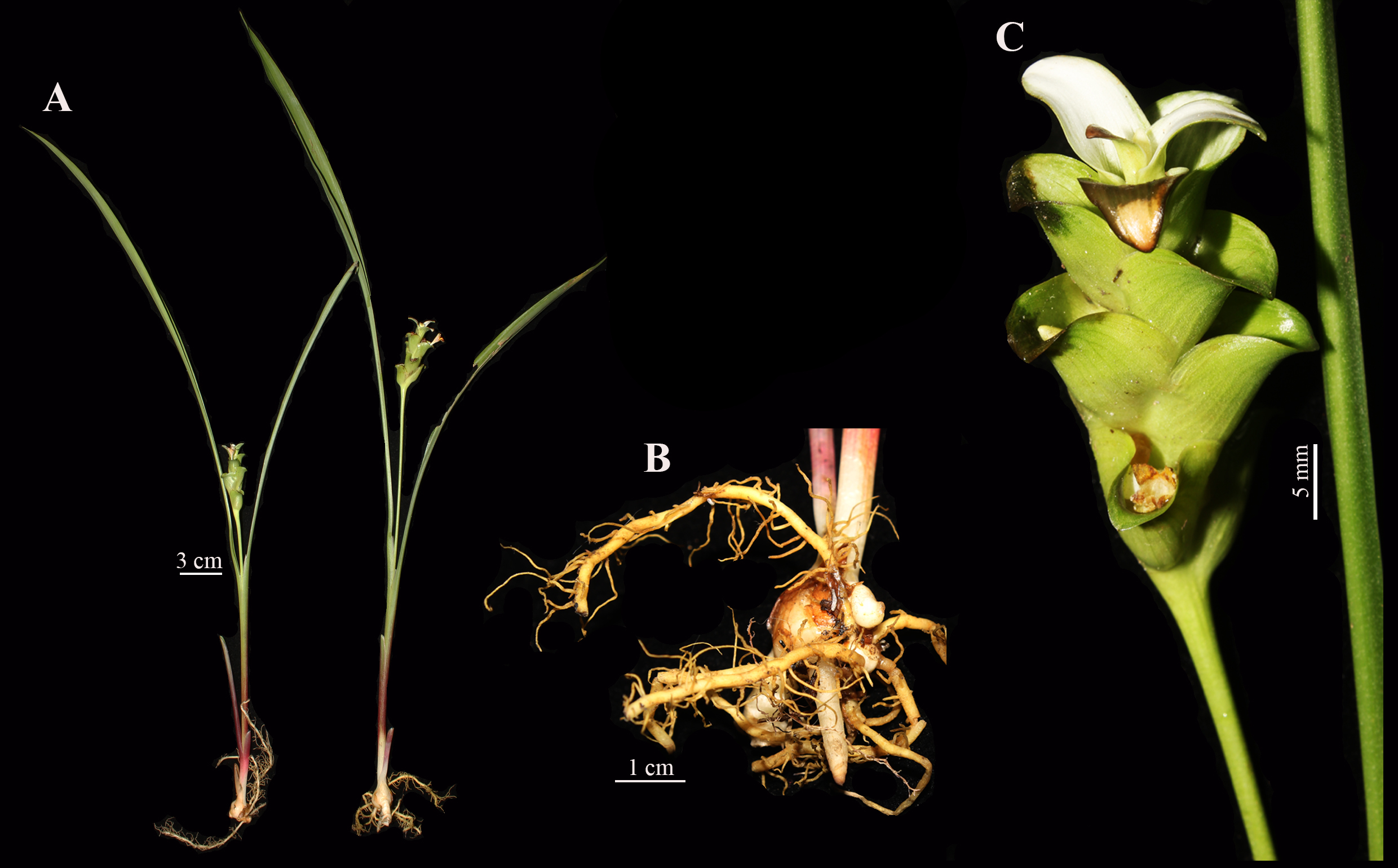
Curcuma gracillima Gagnep. is a rare species and it has been found in Cambodia, Laos, Thailand, and some regions of southern Vietnam. This study provided the micro-morphological and molecular data of this species collected from Xuyen Moc Commune, Ho Chi Minh City, Vietnam for the first time. As a result, the Internal Transcribe Spacer (ITS) and trnL intron of C. gracillima were successfully amplified and sequenced. These sequences were also successfully deposited on the NCBI database with the accession numbers PQ813594 and PQ821005. The genetic relationship of C. gracillima in this study with other taxa of this species from different habitats was also reported. The pairwise alignment of C. gracillima from this study and its taxa from the prior reports showed the genetic variation in the ITS and trnL intron regions among C. gracillima collected from the different locations. In addition, the details of the anatomical characteristics of C. gracillima leaf, leaf sheath, petiole, root, and rhizome were first investigated.
References
Aboul-Maaty, N.A.F. and Oraby H.A.S. 2019. Extraction of high-quality genomic DNA from different plant orders applying a modified CTAB-based method. Bulletin of the National Research Centre, 43(1): 25.
Anu, S., Navas, M. and Dan, M. 2020. Morpho-anatomical characterisation of the rhizomes of ten species of Curcuma L. (Zingiberaceae) from south India. Journal of Spices and Aromatic Crops, 29(1): 38-47.
Bowden, A. 1985. Nomenclature for incompletely specified bases in nucleic acid sequences. European Journal of Biochemistry, 150: 1-5.
Bridson, D. and Forman, L. 1999. The Herbarium Handbook-Third Edition. Royal Botanic Gardens. Royal Botanic Gardens, Kew, UK.
Chen, J., Zhao, J., Erickson, D.L., Xia N. and Kress, W.J. 2015. Testing DNA barcodes in closely related species of Curcuma (Zingiberaceae) from Myanmar and China. Molecular Ecology Resources, 15(2): 337-348.
Dan, M. 2020. Taxonomic significance on comparative petiople anatomy of twelve species of Curcuma L. (Zingeberaceae) from South India. Plant Archives, 20(1): 35-41.
Denk, T. and Grimm, G.W. 2010. The oaks of western Eurasia: Traditional classifications and evidence from two nuclear markers. Taxon 59(2): 351-366.
Erol, O., Şik, L., Kaya, H.B., Tanyolac, B. and Küçüker, O. 2011. Genetic diversity of Crocus antalyensis B. Mathew (Iridaceae) and a new subspecies from southern Anatolia. Plant Systematics and Evolution, 294(3-4): 281-287.
Gagnepain, F. 1903. Zingiberacées nouvelles de l’herbier du muséum (1). Bulletin de la Société Botanique de France, 49(8): 247-269.
Harpke, D., Meng, S., Rutten, T., Kerndorff, H. and Blattner, F.R. 2013. Phylogeny of Crocus (Iridaceae) based on one chloroplast and two nuclear loci: Ancient hybridization and chromosome number evolution. Molecular Phylogenetics and Evolution, 66(3): 617-627.
Huynh, T.H., Tran. G.H., Trinh, N.N., Nguyen, Q.H., Ho, T.H, Quoc L.P.T., Huynh, N.T.A. and Van, H.T. 2024. Chemical components and antioxidant properties of acetone extracts of four different species of Zingiberaceae. Plant Science Today, 11(22): 326-332.
Khumkratok, S., Boontiang, K., Chutichudet, P. and PramuaL, P. 2015. Cryptic biodiversity in two closely related Curcuma (Zingiberaceae) species in Thailand revealed by molecular and morphometric analyses. Agriculture and Natural Resources, 49: 335-349.
Leong-Škorničková, J., Šída, O., Sabu, M. and Marhold, K. 2008. Taxonomic and nomenclatural puzzles in Indian Curcuma : the identity and nomenclatural history of C. zedoaria (Christm.) Roscoe and C. zerumbet Roxb. (Zingiberaceae). Taxon, 57(3): 949-962.
Mosolygó, L.A., Sramkó, G., Barabás, S., Czeglédi, L., Jávor, A., Molnár, V.A. and Surányi, G. 2016. Molecular genetic evidence for allotetraploid hybrid speciation in the genus Crocus L. (Iridaceae). Phytotaxa, 258(2): 121-136.
Nguyen, H.T., Nguyen, N.A., Averyanov, L., Nguyen, DD. and Le C.T. 2023. Curcuma tuanii (Zingiberaceae) a new species of subgenus Ecomata from northern Vietnam based on morphological and molecular evidence. Acta Botanica Brasilica, 37: e20230028.
Nguyen, Q. 2017. Zingiberaceae-Flora of Vietnam. Publishing House for Science and Technology.
Noorafshan, A., Asadi-Golshan, R., Monjezi, S. and Karbalay-Doust, S. 2014. Sodium metabisulphite, a preservative agent, decreases the heart capillary volume and length, and curcumin, the main component of Curcuma Longa, cannot protect it. Folia Biologica (Praha), 60(6): 275-280.
Petersen, G., Seberg, O., Thorsøe, S., Jorgensen, T. and Mathew, B. 2008. A phylogeny of the genus Crocus (Iridaceae) based on sequence data from five plastid regions. Taxon 57(2): 487-499.
Pham, H. 2000. Araceae, in: Pham-hoang, H. (Ed.) Cây cỏ Việt Nam: An Illustrated Flora of Vietnam, vol. 3. Youth Publishing House, Ho Chi Minh City.
POWO. 2025. Plants of the World Online. Facilitated by the Royal Botanic Gardens, Kew. Available from: https://powo.science. kew.org/taxon/urn:lsid:ipni.org:names:796444-1 (accessed December 2025)
Rahaman, M.M., Rakib, A., Mitra, S., Tareq, A.M., Emran, T.B., Shahid-Ud-Daula, A.F.M., Amin, M.N. and Simal-Gandara, J. 2021. The genus Curcuma and inflammation: Overview of the pharmacological perspectives. Plants, 10(1): 1119.
Sangvirotjanapat, S. and Newman, M. 2023. Zingiberaceae. Flora of Thailand, 16: 333-747.
Sramkó, G., Attila, M.V., Hawkins, J.A. and Bateman, R.M. 2014. Molecular phylogeny and evolutionary history of the Eurasiatic orchid genus Himantoglossum S.L. (Orchidaceae). Annals of Botany, 114(8): 1609-1626.
Truong, T.D., Nguyen T., Nhuyen T. and Lieu H. 2007. Medicinal Plants. Viet Nam Education Publishing House.
Ukil, A., Maity, S., Karmakar, S., Datta, N., Vedasiromoni, J.R. and Das P.K. 2003. Curcumin, the major component of food flavour turmeric, reduces mucosal injury in trinitrobenzene sulphonic acid-induced colitis. British Journal of Pharmacology, 139(2): 209-218.
Van, H.T., Phan, U.T.X., Doan, V.D. and Le, V.S. 2021. Chemical constituents of essential oil from rhizomes and aerial parts of Curcuma gracillima. Chemistry of Natural Compounds, 57(3): 569-571.
Van, H.T. and Le H.T. 2023. An update review of biological activity of essential oils from Curcuma genus. Plant Science Today, 10(sp2): 220-225.
Yilmaz, A. 2021. The evaluations and comparisons of nuclear and chloroplast DNA regions based on species identification and phylogenetic relationships of Crocus L. taxa. Iğdır Üniversitesi Fen Bilimleri Enstitüsü Dergisi, 11(2): 1504-1518.
Záveská, E., Fér, T., Šída, O., Krak, K., Marhold, K. and Leong-škorničková, J. 2012. Phylogeny of Curcuma (Zingiberaceae) based on plastid and nuclear sequences: Proposal of the new subgenus Ecomata. Taxon, 61(4), 747-763.
Downloads
Published
How to Cite
Issue
Section
Categories
License
Chulalongkorn University. All rights reserved. No part of this publication may be reproduced, translated, stored in a retrieval system, or transmitted in any form or by any means, electronic, mechanical, photocopying, recording or otherwise, without prior written permission of the publisher