
Phylogeography of Red Spiny Rats Maxomys surifer (Miller, 1900) (Mammalia: Rodentia: Muridae) based on Cytochrome b in peninsular Thailand
DOI:
https://doi.org/10.58837/tnh.26.1.267682Keywords:
Maxomys surifer, peninsular Thailand, Phylogeography, Cytochrome b, Kra IsthmusAbstract
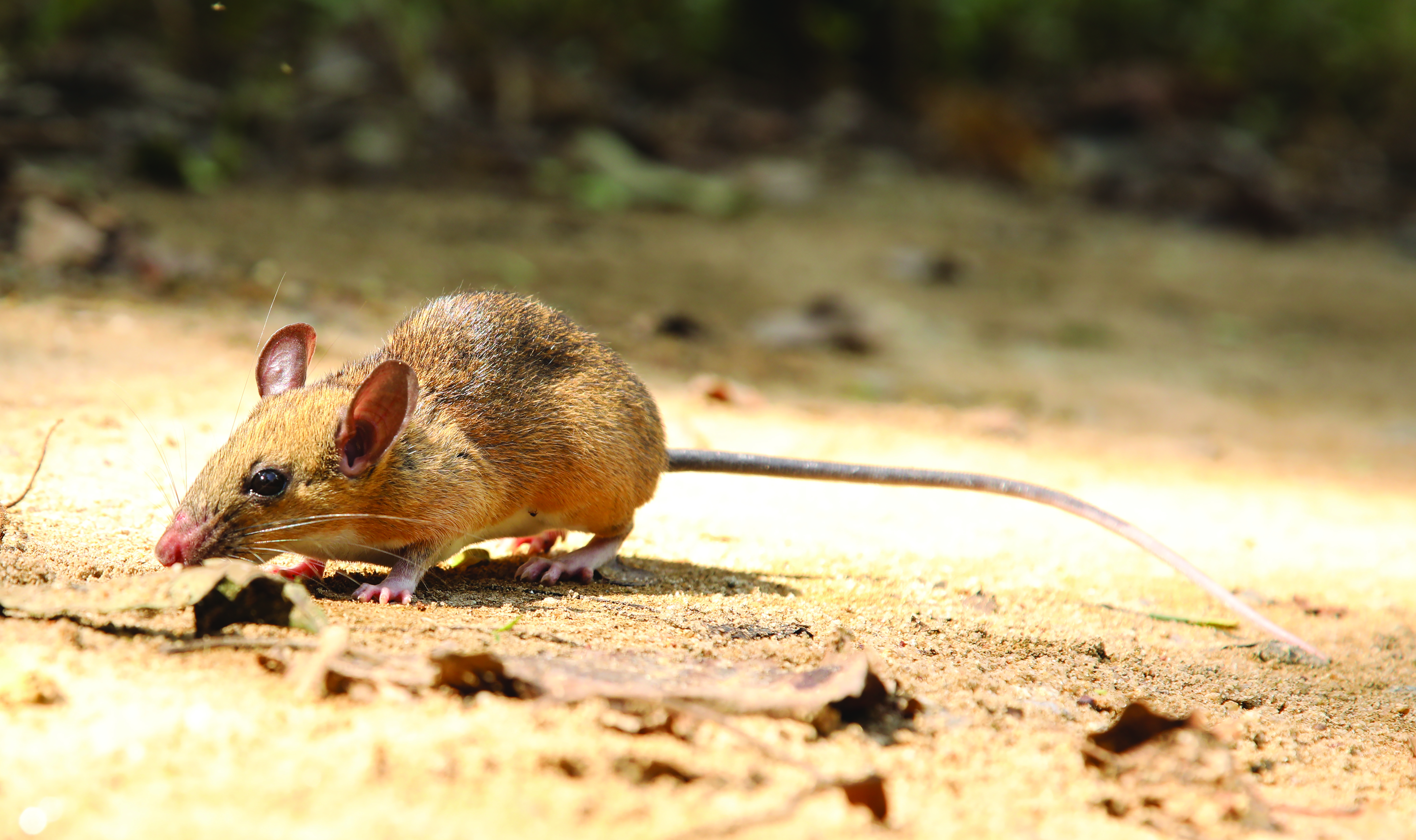
Spiny rats (Genus Maxomys) are an endemic rodent species in Southeast Asia belonging to the family Murinae. There are currently 18 species recognized in the genus Maxomys, with a general distribution extending from mainland Southeast Asia eastward over the Sunda Shelf to some nearby islands. The phylogeography of M. surifer (Miller, 1900) in Thailand, particularly in peninsular Thailand, is presented in this study. A phylogenetic tree and haplotype networks were reconstructed to comprehend the geographic variation in the study area. Analyses included 898 base pairs of mitochondrial cytochrome b sequence data for 92 individuals of M. surifer, comprising 59 newly obtained sequences and 33 sequences from GenBank. The phylogenetic tree with the maximum likelihood inference revealed five highly divergent lineages within M. surifer. Three lineages (Clades I - III) were found in peninsular Thailand: Clade I includes specimens from a small area in the southern part of the peninsula; Clade II consists of specimens from both the mainland of peninsular Thailand and nearby islands in the Andaman Sea, including those from the type locality; Clade III comprises specimens from the central to northern parts of peninsular Thailand, extending toward the Kra Isthmus. Clades IV and V involved specimens from the Indochinese subregion. The results extend a view proposed in previous studies that M. surifer comprises several highly differentiated and well-supported phylogenetic lineages, possibly belonging to several distinct species. This study, for the first time, clearly showed five distinct clades found in Thailand with geographic overlap between Clades I and II, Clades II and III, and Clades IV and V. As well, the island populations in the Andaman Sea were included in Clade II, and also showed genetic difference between the distant islands (Adang and Rawi islands) and the island closer to the peninsular Thailand (Tarutao island). We propose that Peninsular Thailand acted as a center of isolation and diversification for three clades (Clades I, II, and III), and that subsequent dispersal events shaped their current complex and mosaic distribution with overlapping ranges in the Peninsular Thailand.
References
Aplin, K. 2016. Maxomys surifer. The IUCN Red List of Threatened Species 2016: e.T12905A22455389.https://dx.doi.org/10.2305/IUCN.UK.20162.RLTS.T12905A22455389.en./, 28 January 2025.
Achmadi, A. S. 2010. Biogeography and Variation of Maxomys (Rodentia: Muridae) from the East and West of Wallace’s Line. A thesis submitted in fulfillment of the degree of Master of Science, Faculty of Resource Science and Technology, Universiti Malaysia Sarawak, 188 pp.
Achmadi, A. S., Maryanto, I. and Maharadatunkamsi. 2012. Systematic and descriptions of new species within genus Maxomys from East Kalimantan, Borneo Island. Treubia, 39:1-28.
Achmadi, A. S., Esselstyn, J. A., Rowe, K. C., Maryanto, I. and Abdullah, M. T. 2013. Phylogeny, diversity, and biogeography of Southeast Asian spiny rats (Maxomys), Journal of Mammalogy, 94: 1412-1423.
Amori, G., Gippoliti, S. and Helgen, K. M. 2008. Diversity, distribution, and conservation of endemic island rodents. Quaternary International, 182: 6-15.
Bandelt, H., Forster, P. and Röhl, A. 1999. Median-joining networks for inferring intraspecific phylogenies. Molecular Biology and Evolution, 16: 37-48.
Balakirev, A. E., Abramov, A. V. and Rozhnov, V. V. 2017. The phylogeography of red spiny rats Maxomys surifer (Rodentia, Muridae) in Indochina with comments on taxonomy and description of new subspecies. Zoological Studies, 56: 1-19.
de Bruyn, M., Nugroho, E., Hossain, M. M., Wilson, J. C. and Mather, P. B. 2005. Phylogeographic evidence for the existence of an ancient biogeographic barrier: the Isthmus of Kra Seaway. Heredity, 94: 370–378.
Chasen, F. N. 1940. A handlist of Malaysian mammals. Bulletin of the Raffles Museum, Singapore, 15, 209 pp.
Corbet, G. B. and Hill, J. E. 1992. The mammals of the Indomalayan region: a systematic review. Oxford University Press, Oxford, United Kingdom, vii + 488 pp
Dejtaradol, A. 2009. Taxonomic review of Rhinolophus pusillus and Rhinolophus lepidus (Chiroptera: Rhinolophidae) in Thailand. PhD Thesis, Prince of Songkla University, Thailand.
Department of National Parks. 2022. Park Area Information published in the 133 Government Gazettes. Department of National Parks, Wildlife and Plant Conservation (in Thai). Available from: https://catalog.dnp.go.th/dataset/areaofnp/resource/ 3b372140-f2bf-4811-8819bb8a8b1a100a/, 10 December, 2024.
Department of National Parks. 2023. Information of 23 National Parks Areas (Preparation). Department of National Parks, Wildlife and Plant Conservation (in Thai). Available from: https://catalog.dnp.go.th/dataset/areaofnp/resource/4e6d4cb8-1ed1-4e1b-b5fe 8c992c728a40/, 10 December, 2024.
Edler, D., Klein, J., Antonelli, A. and Silvestro, D. 2021. raxmlGUI 2.0: A graphical interface and toolkit for phylogenetic analyses using RAxML. Methods in Ecology and Evolution, 12: 373-377.
Gray, D., Piprell, C. and Graham, M. 1994. National Parks of Thailand. Industrial Finance Corporation of Thailand, Bangkok, 250 pp.
Gorog, A. J., Sinaga, M. H. and Engstrom, M. D. 2004. Vicariance or dispersal? Historical biogeography of three Sunda shelf murine rodents (Maxomys surifer, Leopoldamys sabanus and Maxomys whiteheadi). Biological Journal of the Linnean Society, 81: 91-109.
Hall, T. A. 1999. BioEdit: a user-friendly biological sequence alignment editor and analysis program for Windows 95/98/NT. Nucleic Acids Symposium Series, 41: 95-98.
Inger, R. F. and Voris, H. K. 2001 The biogeographical relations of the frogs and snakes of Sundaland. Journal of Bio-geography, 28: 863–891.
Jantarit, S., Satasook, C. and Deharveng, L. 2013. The genus Cyphoderopsis Carpenter (Collembola: Paronellidae) in Thailand and a faunal transition at the Isthmus of Kra in Troglopedetinae. Zootaxa, 3721: 49-70.
Jentink, F. A. 1879. On various species of Mus, collected by S. C. I. W. Van Musschenbroek Esq. in Celebes. Notes from the Leyden Museum 1(1878): 7-13.
Kloss, C. B. 1916. On a collection of mammals from Siam. Journal of the Natural History Society of Siam, 2: 1-32.
Kloss, C. B. 1919. On mammals collected in Siam. The Journal of the Natural History Society of Siam, 3: 333-407.
Lacher, T. E., Young, Jr. R. P., Kennerley, R. J., Turvey, S. T., Roach, N. S. and McCay, S. D. 2017. Conserving the Biodiversity of the Largest Order of Mammals: Priorities and Actions for the Rodentia. in: Wilson, D. E., Lacher, T. E., Jr and Mittermeier, R.A. eds. Handbook of the Mammals of the World, Volume 2: Rodent II by Lynx Edicions Publisher. Barcelona: 13-20.
Latinne, A., Waengsothorn, S., Rojanadilok, P., Eiamampai, K., Sribuarod, K. and Michaux, J. R. 2013. Diversity and endemism of Murinae rodents in Thai limestone karsts, Systematics and Biodiversity, 11: 323-344.
Lekagul, B. and McNeely, J. A. 1988. Mammals of Thailand 2nd edition. Association for the Conservation of Wildlife, Sahakranbhat Co., Bangkok. 758 pp.
Miller, G. S. 1900. Seven new rats collected by Dr. Abbott in Siam. Proceedings of the Biological Society of Washington, 13: 137-150.
Morand, S., Blasdell, K., Bordes, F., Buchy, P., Carcy, B., Chaisiri, K., Chaval, Y., Claude, J., Cosson, J. F., Desquesnes, M., Jittapalapong, S., Jiyipong, T., Karnchanabanthoen, A., Pornpan, P., Rolain, J. M. and Tran, A. 2019. Changing landscapes of Southeast Asia and rodent-borne diseases: decreased diversity but increased transmission risks. Ecological Applications, 29: e01886
Musser, G. G. 1969. Results of the Archbold Expeditions. No. 92. Taxonomic notes on Rattus dollmani and Rattus hellwaldi (Rodentia, Muridae) of Celebes. American Museum Novitates, 2386: 1-24.
Musser, G. G. 1979. Results of the Archbold Expeditions. No. 102. The species of Chiropodomys, arboreal mice of Indochina and the Malay Archipelago. Bulletin of the American Museum of Natural History, 162: 381-445.
Musser, G. G., Marshall, Jr. J. T. and Boeadi. 1979. Definition and contents of the Sundaic genus Maxomys (Rodentia, Muridae). Journal of Mammalogy, 60: 592-606.
Musser, G. G. and Carleton, M. D. 2005. Family Muridae. In: Wilson D. E. and Reeder D. M. (Eds). Mammal species of the world: A taxonomic and geographic reference, 3rd ed. Johns Hopkins University Press Baltimore Maryland: 894–1531.
Nor, S. M. 2001. Elevational diversity patterns of small mammals on Mount Kinabalu, Sabah, Malaysia. Global Ecology and Biogeography, 10: 41-62.
Pimsai, U., Pearch, M. J., Satasook, C., Bumrungsri, S. and Bates, P. J. J. 2014. Murine rodents (Rodentia: Murinae) of the Myanmar-Thai-Malaysian peninsula and Singapore: taxonomy, distribution, ecology, conservation status, and illustrated identification keys. Bonner zoological Bulletin, 63: 15-114.
Poulton, E. B. 1904. "What is a species?". Proceedings of the Entomological Society of London, 1903: 77-116.
Pratumthong, D. and Khlaipet, A. 2022. Species Diversity of Mammals in Thungyai Naresaun- Hui Kha Kheang world heritage site, Thailand. The 2nd Symposium of the Natural History Museum: Biodiversity and the current State of the Changing World: 145-155.
Rambaut, A. 2018. FigTree, Tree Figure Drawing Tool version 1.4.4. Institute of Evolutionary Biology, University of Edinburgh. http://tree.bio.ed.ac.uk/
Robinson, H. C. and Kloss, C. B. 1914. On new mammals, mainly from Bandon and the adjacent Island, East Coast of the Malay Peninsula. Annals and Magazine of Natural History, 13: 223-234.
Rozas, J., Ferrer-Mata, A., Sanchez-DelBarrio, J. C., Guirao-Rico, S., Librado, P., Ramos-Onsins, S. E. and Sanchez-Gracia, A. 2017. DnaSP 6: DNA sequence polymorphism analysis of large data sets. Molecular Biology and Evolution, 34, 3299-3302. https://doi.org/10.1093/molbev/msx248
Ruedas, L. A. and Kirsch, J. A. W. 1997. Systematics of Maxomys Sody, 1936 (Rodentia: Muridae: Murinae): DNA/DNA hybridization studies of some Borneo–Javan species and allied Sundaic and Australo-Papuan genera. Biological Journal of the Linnean Society 61: 385-408.
Sody, H. J. V. 1936. Seventeen new generic, specific, and subspecific names for Dutch East Indian mammals. Natuurkundig Tijdschrift voor Nederlandsch Indie. 96: 42–55.
Soisook, P., Bumrungsri, S., Satasook, C., Thong, V. D., Bu, S. S. H., Harrison, D. L. and Bates, P. J. 2008. A taxonomic review of Rhinolophus stheno and R. malayanus (Chiroptera: Rhinolophidae) from continental Southeast Asia: an evaluation of echolocation call frequency in discriminating between cryptic species. Acta Chiropterologica, 1: 221-242.
Tamura, K., Stecher, G. and Kumar, S. 2021. MEGA11: Molecular Evolutionary Genetics Analysis Version 11. Molecular Biology and Evolution, 38: 3022-3027, https://doi.org/10.1093/ molbev/msab120.
Thummajitsakul, S., Klinbunga, S., Smith, D. and Sittipraneed, S. 2008. Genetic diversity and population structure of Trig-ona pagdeni Schwarz in Thailand. Apidologie, 39: 446-455.
Tougard, C. 2001. Biogeography and migration routes of large mammal faunas in South–East Asia during the Late Middle Pleistocene: focus on the fossil and extant faunas from Thailand. Palaeogeography, Palaeoclimatology, Palaeoecology, 168: 337-358.
Thompson, J. D., Higgins, D. G. and Gibson, T. J. 1994. CLUSTAL W: Improving the sensitivity of progressive multiple sequence alignment through sequence weighting, position-specific gap penalties and weight matrix choice. Nucleic Acids Research, 22: 4673–4680. https://doi.org/10.1093/nar/22.22.4673
Travel News. 2008. "Peninsular Thailand". Travel News, Destinations, Vacations. Available from https://travel-ismo.blogspot.com/2008/01/peninsular-thailand.html#google_vignette/, 10 December, 2024.
Wilson, D. E., Mittermeier, R. A. and Thomas, Jr. E. L. 2017. Muridae, Handbook of the Mammals of the World – Volume 7 Rodents II, Barcelona: Lynx Edicions, 858: 536-884.
Woodruff, D. S., 2003. Neogene marine transgressions, palaeo-geography and biogeography transition on the Thai-Malay Peninsula. Journal of Biogeography 30: 551-567.
U. S. Food and Drug Administration (FDA). 2023. Available from: https://www.fda.gov/drugs/new-drugs-fda-cders-new-molecular-entities-and-new-therapeutic-biological-products/novel-drug-approvals-2023/, 1 January 2024
Downloads
Additional Files
Published
How to Cite
Issue
Section
Categories
License
Chulalongkorn University. All rights reserved. No part of this publication may be reproduced, translated, stored in a retrieval system, or transmitted in any form or by any means, electronic, mechanical, photocopying, recording or otherwise, without prior written permission of the publisher