
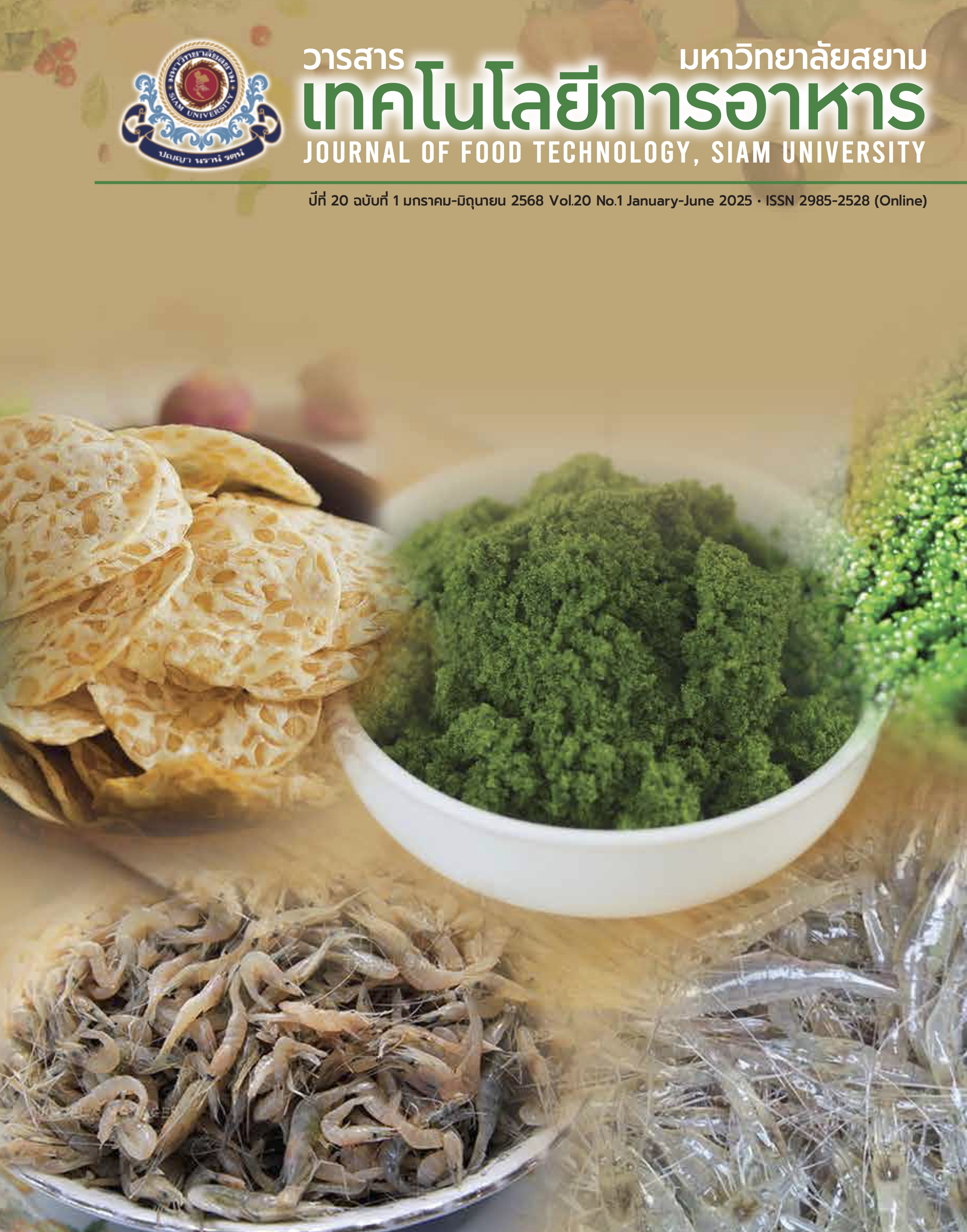
Development of Crispy Tempeh Chip Products
Article Sidebar
Main Article Content
Abstract
This study aimed to evaluate the effect of the tempeh to flour ratio in developing crispy tempeh chip products, using three different ratios: 60:40, 70:30, and 80:20. There are two groups of tempeh: the soybean tempeh group (formulations 1-3) and the mixed legume tempeh group, which includes four different types of legume tempeh: soybean, mung bean, red bean, and tiger-striped peanut (formulations 4-6). We found that formulation 6 (mix-legume tempeh-to-flour ratio, 80:20) was ambitious in forming a thin sheet before baking. The product of formulations 1-5 exhibited the yellow-brown color with the lightness (L*) value ranking between 45.20 and 57.39 and the yellowness (b*) value ranking between 27.55 and 32.80. The high tempeh portion caused an increase in the moisture, protein, and fat contents (p≤0.05) but reduced ash (mineral) and carbohydrate contents (p≤0.05). In addition, the high portion of tempeh led to increases in phenolic, protein, peptide, and antioxidant activity (p≤0.05). Formulation 3 (soybean tempeh-to-flour ratio, 80:20) contained the highest level of total phenolic and total flavonoid of 4.29 mg GAE/g DW and 10.37 mg QE/g DW, respectively. Formulation 2 (soybean tempeh-to-flour ratio, 70:30) contained the highest total peptide content at 156.64 mg BSA/g DW (p≤0.05). However, formulation 1 (soybean tempeh-to-flour ratio, 60:40) provided the highest hedonic scores of all attributes, ranked between like moderately and like very much. Meanwhile, the overall liking score of formulation 1 was similar to formulation 4 (mix-legume tempeh-to-flour ratio, 60:40) (p>0.05). This study demonstrated the potential of different legume tempeh as a healthy snack product.
Article Details

This work is licensed under a Creative Commons Attribution-NonCommercial-NoDerivatives 4.0 International License.
Copyrights of all articles in the Journal of Food Technology available in print or online are owned by Siam University and protected by law.
References
Zhang, H., Feng, X., Liu, S., Ren, F. and Wang, J. (2023). Effects of high hydrostatic pressure on nutritional composition and cooking quality of whole grains and legumes. Innovative Food Science and Emerging Technologies. 83: 103239. doi:10.1016/j.ifset.2022.103239.
Zhang, X., Zhang, Z., Shen, A., Zhang, T., Jiang, L., El-Seedi, H., Zhang, G. and Sui, X. (2024). Legumes as an alternative protein source in plant-based foods: Applications, challenges, and strategies. Current Research in Foods Science. 9: 100876. doi:10.1016/j.crfs.2024.100876.
Erkan, S.B., Gürler, H.N., Bilgin, D.G., Germec, M. and Turhan, I. (2020). Production and characterization of tempehs from different sources of legume by Rhizopus oligosporus. LWT - Food Science and Technology. 119: 108880. doi:10.1016/j.lwt.2019.108880.
Nicole, T.Z.H., Nichelle, T.S., Elizabeth, T.E. and Yuliarti, O. (2021). Formulation of functional crackers enriched with fermented soybean (tempeh) paste: rheological and microstructural properties. Future Foods. 4: 100050. doi:10.1016/j.fufo.2021.100050.
Qiao, Y., Zhang, K., Zhang, Z., Zhang, C., Sun, Y. and Feng, Z. (2022). Fermented soybean foods: A review of their functional components, mechanism of action and factors influencing their health benefits. Food Research International. 158: 111575. doi:10.1016/j.foodres.2022.111575.
Huang, L., Huang, Z., Zhang, Y., Zhou, S., Hu, W. and Dong, M. (2019). Impact of tempeh flour on the rheology of wheat flour dough and bread staling. LWT - Food Science and Technology. 111: 694–702.
Teoh, S.Q., Chin, N.L., Chong, C.W., Ripen, A.M., How, S. and Lim, J.J.L. (2024). A review on health benefits and processing of tempeh with outlines on its functional microbes. Future Foods. 9: 100330. doi:10.1016/j.fufo.2024.100330.
Yin, L., Zhang, Y., Wu, H., Wang, Z., Dai, Y., Zhou, J., Liu, X., Dong, M. and Xia, X. (2020). Improvement of the phenolic content, antioxidant activity, and nutritional quality of tofu fermented with Actinomucor elegans. LWT-Food Science and Technology. 133: 110087. doi:10.1016/j.lwt.2020.110087.
Yanti, Violina, V., Putri, C.E. and Lay, B.W. (2023). Branched chain amino acid content and antioxidant activity of mung bean tempeh powder for developing oral nutrition supplements. Foods. 12(14): 2789. doi:10.3390/foods12142789.
Trade Policy and Strategy Office. (2024). The growing market for healthy snacks presents a significant opportunity for entrepreneurs in Thailand. Ministry of Commerce, 2024. [Online] Available from https://tpso.go.th/news/2404-0000000006. [Accessed January 9, 2025]. (in Thai).
Kan, L., Nie, S., Hu, J., Wang, S., Bai, Z., Wang, J., Zhou, Y., Jiang, J., Zeng, Q. and Song, K. (2018). Comparative study on the chemical composition, anthocyanins, tocopherols and carotenoids of selected legumes. Food Chemistry. 260: 317–326.
Bureau of Nutrition. (2018). Food composition table of Thai foods. Department of Health, Ministry of Public Health, 2018. [Online] Available from https://nutrition2.anamai.moph.go. th/th/thai-food-composition-table. [Accessed March 25, 2025]. (in Thai).
Taheri, S.E.H., Bazargan, M., Vosough, P.R. and Sadeghian, A. (2024). A comprehensive insight into peanut: Chemical structure of compositions, oxidation process, and storage conditions. Journal of Food Composition and Analysis. 125: 105770. doi:10.1016/j.jfca.2023.105770.
Adebo, J.A., Njobeh, P.B., Gbashi, S., Oyedeji, A.B., Ogundele, O.M., Oyeyinka, S.A. and Adebo, O.A. (2022). Fermentation of cereals and legumes: Impact on nutritional constituents and nutrient bioavailability. Fermentation. 8(2): 63. doi:10.3390/fermentation8020063.
Martín-Miguélez, J.M., Bross, J., Prado, D., Merino, E., Moré, R.P., Otero, J., Aduriz, A.L. and Delgado, J. (2025). Review: Rhizopus sp. beyond tempeh. An Occidental approach to mold-based fermentations. International Journal of Gastronomy and Food Science. 39: 101090. doi:10.1016/j.ijgfs.2024.101090.
Liu, W-T., Huang, C-L., Liu, R., Yang, T-C., Lee, C-L., Tsao, R. and Yang, W-J. (2023). Changes in isoflavone profile, antioxidant activity, and phenolic contents in Taiwanese and Canadian soybeans during tempeh processing. LWT - Food Science and Technology. 186: 115207. doi:10.1016/j.lwt.2023.115207.
Oliveira, L.C., Schmiele, M. and Steel, C.J. (2017). Development of whole grain wheat flour extruded cereal and process impacts on color, expansion, and dry and bowl-life texture. LWT - Food Science and Technology. 75: 261-270.
AOAC. (2000). Official methods of analysis (16thed.). The Association of Official Analytical Chemists, Maryland.
Bolger, A.M., Rastall, R.A., Oruna-Concha, M.J. and Rodriguez-Garcia, J. (2021). Effect of D-allulose, in comparison to sucrose and D-fructose, on the physical properties of cupcakes. LWT - Food Science and Technology. 150: 4-11.
Saikaew, K., Siripornadulsil, W. and Siripornadulsil, S. (2023). Improvements in the color, phytochemical, and antioxidant properties of frozen ripe mango pieces using calcium chloride dipping and chitosan coating. Journal of Food Science. 88: 3239–3254.
Re, R., Pellegrinin, N., Proteggente, A., Pannala, A., Yang, M. and Rice-Evans, C. (1999). Antioxidant activity applying an improved ABTS radical cation decolorization assay. Free Radical Biology and Medicine. 26: 1231–1237.
Swieca, M., Gawlik-Dziki, U., Jakubczyk, A., Bochnak, J., Sikora, M. and Suliburska, J. (2019). Nutritional quality of fresh and stored legumes sprouts – Effect of Lactobacillus plantarum 299v enrichment. Food Chemistry. 288: 325-332.
Bradford, M.M. (1976). A rapid and sensitive method for the quantitation of microgram quantities of protein utilizing the principle of protein-dye binding. Analytical Biochemistry. 72(1): 248-254.
Wang, Y., Xu, K., Lu, F., Wang, Y., Ouyang, N. and Ma, H. (2021). Increasing peptide yield of soybean meal solid-state fermentation of ultrasound-treated Bacillus amyloliquefaciens. Innovative Food Science & Emerging Technologies. 72: 102704. doi:10.1016/j.ifset.2021.102704.
Peng, X. and Yao, Y. (2017). Carbohydrates as fat replacers. Annual Review of Food Science and Technology. 8: 331–51.
Bourouis, I., Pang, Z. and Liu, X. (2023). Recent advances on uses of protein and/or polysaccharide as fat replacers: Textural and tribological perspectives: A review. Journal of Agriculture and Food Research. 11: 100519. doi:10.1016/j.jafr.2023.100519.
Toyosaki, T. (2018). Effects of medium-chain triacylglycerols on Maillard reaction in bread baking. Journal of the Science of Food and Agriculture. 98(8): 3169-3174.
Xu, L., Zhu, H. and Yi, C. (2023). Soybean protein isolate affects in vitro digestion properties of fermented indica rice starch by regulating its gel characteristics. Food Hydrocolloids. 145: 109165. doi:10.1016/j.foodhyd.2023.109165.
Montanha, G.S., Perez, L.C., Brandão, J.R., de Camargo, R.F., Tavares, T.R., de Almeida, E. and Carvalho, H.W.P. (2024). Profile of mineral nutrients and proteins in soybean seeds (Glycine max (L.) Merrill): Insights from 95 varieties cultivated in Brazil. Journal of Food Composition and Analysis. 134: 106536. doi:10.1016/j.jfca.2024.106536.
Lim, J., Nguyen, T.T.H., Pal, K., Kang, C.G., Park, C., Kim, S. W. and Kim, D. (2022). Phytochemical properties and functional characteristics of wild turmeric (Curcuma aromatica) fermented with Rhizopus oligosporus. Food Chemistry: X. 13: 100198. doi:10.1016/j.fochx.2021.100198.
Wang, F., Shen, H., Yang, X., Liu, T., Yang, Y., Zhou, X., Zhao, P. and Guo, Y. (2021). Effect of free amino acids and peptide hydrolysates from sunflower seed protein on the formation of pyrazines under different heating conditions. RSC Advances. 11: 27772–27781.
Kan, L., Nie, S., Hu, J., Liu, Z. and Xie, M. (2016). Antioxidant activities and anthocyanins composition of seed coats from twenty-six kidney bean cultivars. Journal of Functional Foods. 26: 622-631.
Yang, Q-Q., Ge, Y-Y., Gunaratne, A., Kong, K-W., Li, H-B., Gul, K., Kumara, K., Arachchi, L. V., Zhu, F., Corke, H. and Gan, R-Y. (2020). Phenolic profiles, antioxidant activities, and antiproliferative activities of different mung bean (Vigna radiata) varieties from Sri Lanka. Food Bioscience. 37: 100705. doi:10.1016/j.fbio.2020.100705.
Nunes, Y.C., Santos, G.O., Machado, N.M., Otoboni, A.M.M. B., Laurindo, L.F., Bishayee, A., Fimognari, C., Bishayee, A. and Barbalho, S.M. (2024). Corrigendum to peanut (Arachis hypogaea L.) seeds and by-products in metabolic syndrome and cardiovascular disorders: A systematic review of clinical studies. Phytomedicine. 123: 155170. doi:10.1016/j.phymed.2024.155870.
Su, G., Xie, Y., Liu, R., Cui, G., Zhao, M. and Zhang, J. (2023). Effect of transglutaminase on taste characteristics of pea protein hydrolysates through altering the composition of amino acids and peptides. Food Bioscience. 56: 103261. doi:10.1016/j.fbio.2023.103261.
