
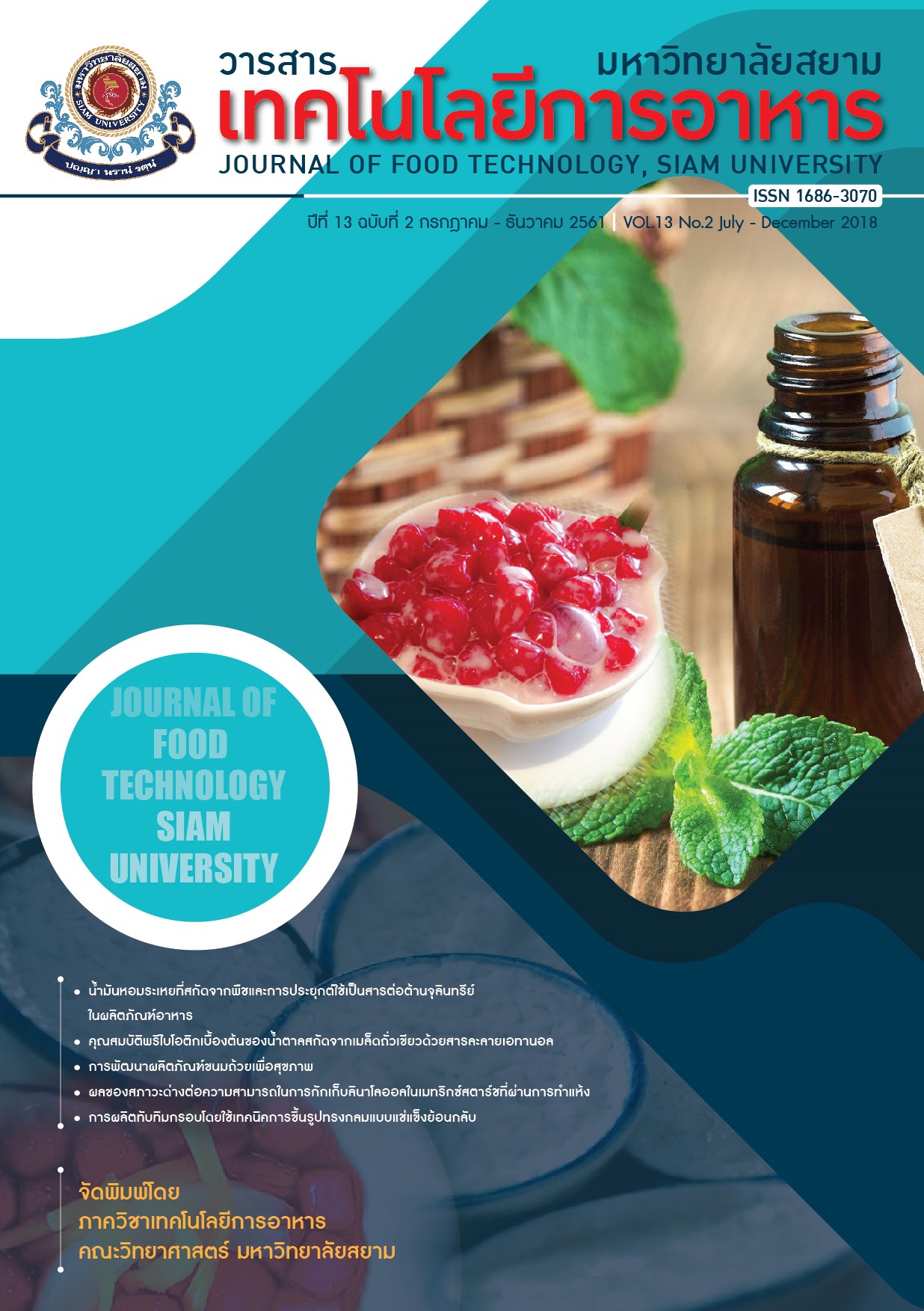
การผลิตทับทิมกรอบโดยใช้เทคนิคการขึ้นรูปทรงกลมแบบแช่แข็งย้อนกลับ
Article Sidebar
Main Article Content
บทคัดย่อ
งานวิจัยนี้เป็นการพัฒนาผลิตภัณฑ์ทับทิมกรอบ โดยใช้เทคนิคการขึ้นรูปทรงกลมแบบแช่แข็งย้อนกลับ ทำการศึกษาความเข้มข้นที่เหมาะสมของสารละลายโซเดียมอัลจิเนต และแคลเซียมแลคเตท ด้วยการทดลองแบบพื้นที่ผิวตอบสนอง (Response surface methodology; RSM) ออกแบบการทดลองแบบ Central composite design (CCD) นำตัวอย่างที่ได้มาทดสอบทางกายภาพในด้านน้ำหนัก ขนาด ค่าความสว่าง ค่าสีแดง ค่าสีเหลือง และความหนาของแผ่นฟิล์ม จากนั้นนำทับทิมกรอบที่ผลิตได้จากสภาวะที่เหมาะสมมาทดสอบทางด้านประสาทสัมผัสด้วยวิธีการให้คะแนนความชอบ จากผลการทดลอง พบว่า ปริมาณความเข้มข้นของโซเดียมอัลจิเนตและแคลเซียมแลคเตทที่แตกต่างกัน ส่งผลต่อลักษณะทางกายภาพของทับทิมกรอบทรงกลมอย่างมีนัยสำคัญทางสถิติ (p<0.05) และเมื่อกำหนดให้ค่าความหนาของแผ่นฟิล์มเป็นปัจจัยตอบสนองที่มีอิทธิพลมากที่สุด โดยมีค่าสัมประสิทธิ์การตัดสินใจ (R2) เท่ากับ 0.86 และมีความหนาของแผ่นฟิล์มจากสมการทำนายเท่ากับ 0.03 มิลลิเมตร พบว่า สภาวะที่เหมาะสมในการผลิตทับทิมกรอบทรงกลม คือ การใช้โซเดียมอัลจิเนตร้อยละ 1.05 และแคลเซียมแลคเตทร้อยละ 0.77 ผลิตภัณฑ์ทับทิมกรอบทรงกลมที่ได้มีค่าความหนาของแผ่นฟิล์มเท่ากับค่าทำนาย และไม่พบความแตกต่างทางด้านประสาทสัมผัสของทับทิมกรอบทรงกลม โดยผลิตภัณฑ์ที่ได้มีคะแนนความชอบด้านสี ความสามารถในการแตก รูปร่างทรงกลม และความชอบโดยรวมอยู่ในเกณฑ์ชอบปานกลาง
Article Details
บทความทุกบทความในวารสารเทคโนโลยีการอาหาร ทั้งในรูปแบบสิ่งพิมพ์ และในระบบออนไลน์ ถือเป็นลิขสิทธิ์ของมหาวิทยาลัยสยาม และได้รับการคุ้มครองตามกฎหมาย
เอกสารอ้างอิง
[2] P. Nithitantiwat and W. Udomsapaya. (2017). Food consumption behavior among Thai adolescents, impacts, and solutions. Journal of Phrapokklao Nursing College. 28(1): 122-128.
[3] Navarro, V., Serrano, G., Lasa, D., Aduriz, A.L. and Ayo, J. (2012). Cooking and nutritional science: Gastronomy goes further. International journal of gastronomy and food science. 1(1): 37-45
[4] Barrett, R. (2012). Molecular Gastronomy, Olin college of engineering. [Online] Available from https://rosebarrett.yolasite.com/ resources/Molecular %20Gastronomy%20 Case%20Study.pdf. [Accessed April 9, 2018].
[5] Lee, P. and Rogers, M.A. (2012). Effect of calcium source and exposure-time on basic caviar spherification using sodium alginate. International Journal of Gastronomy and Food Science. 1: 96-100.
[6] W. Pumpho. (2015). Tofu production using spherification technique. M.S. thesis, Agro-Industry., King mongkut’s institute of technology ladkrabang, Thailand.
[7] Nussinovitch, A. (1997). Hydrocolloid Application; Gum technology in the food and other industries. Blackie academic & professional, United Kingdom.
[8] Y. Likidsomboon and P. Pinsirodom. (2016). Preparation of “rice pearls” from Riceberry rice using spherification technique, In proceeding of 14th Naresuan agricultural conference, pp. 254-259, Naresuan University, Thailand.
[9] W. Pumpho and A. Dholvitayakhun. (2018). Effect of concentration and time to produce black jelly ball, In proceeding of 2th National Graduate Research Conference, pp. 935-939. Chiang Mai: Maejo University, Thailand.
[10] M. Horrattanachai and A. Chulerk. (1995). Traditional Thai desserts, Mae Ban publisher.
[11] Derringer, G. and Suich, R. (1980). Simultaneous optimization of several response variables. Journal of Quality Technology. 12(4): 214-219.
[12] Meilgaard, M., Civille, C.V. and Carr, B.T. (1990). Sensory Evaluation Techniques. CRC Press, Inc., Florida, USA.
[13] Sen, D.J. (2017). Cross linking of calcium ion in alginate produce spherification in molecular gastronomy by pseudoplastic flow. World Journal of Pharmaceutical Sciences. 5(1): 1-10.
[14] Harrington, E.C. (1965). The desirability function. Industrial Quality Control. 21(10): 494-498.
[15] Lupo, B., Maestro, A., Gutiérrez, J. M., and González, C. (2015). Characterization of alginate beads with encapsulated cocoa extract to prepare functional food: Comparison of two gelation mechanisms. Food Hydrocolloids. 49: 25-34.
[16] Tsai, F.-H., Kitamura, Y. and Kokawa, M. (2017). Liquid-core alginate hydrogel beads loaded with functional compounds of radish by-products by reverse spherification: Optimization by response surface methodology. International Journal of Biological Macromolecules. 96: 600-610.
