
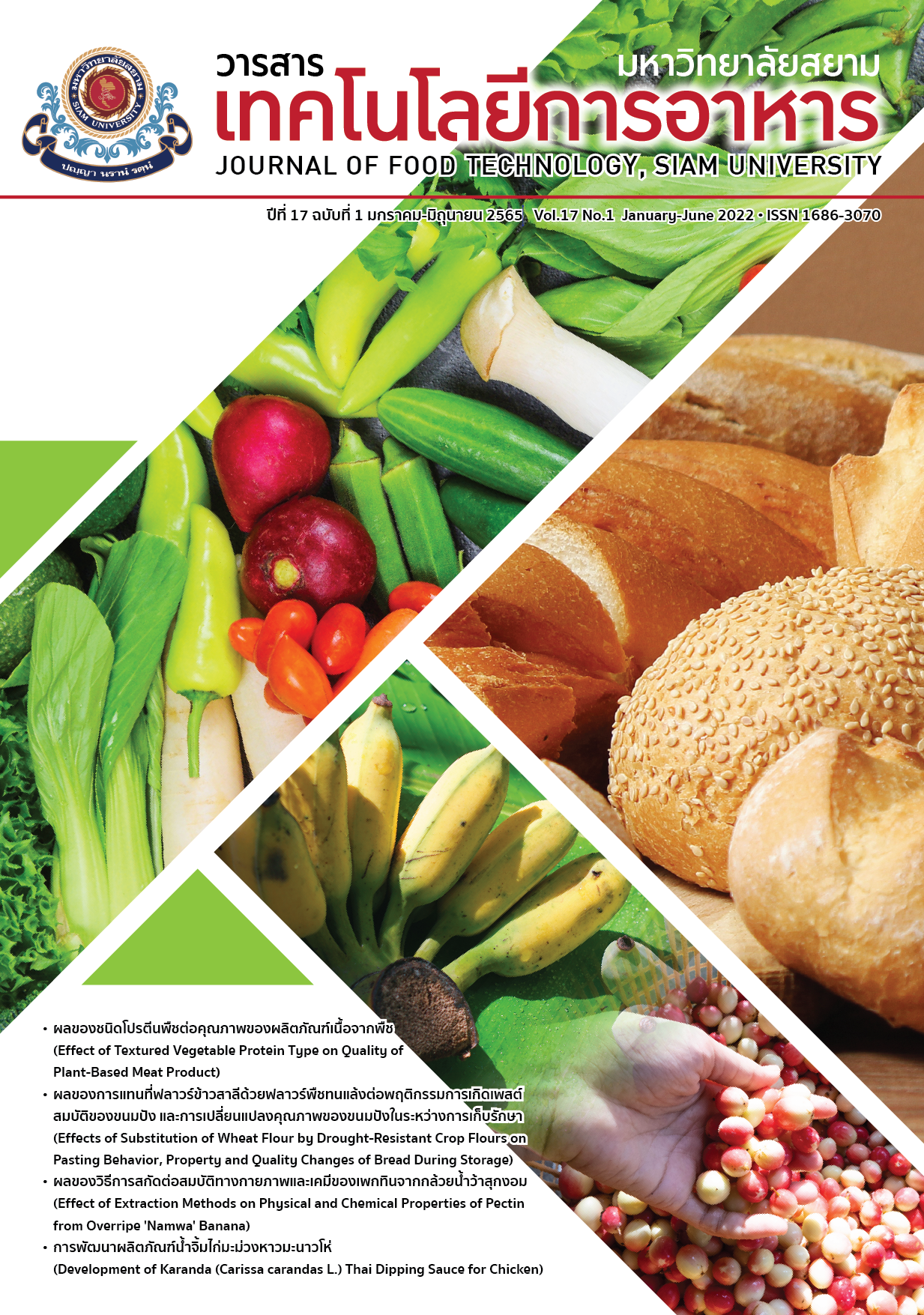
ผลของการแทนที่ฟลาวร์ข้าวสาลีด้วยฟลาวร์พืชทนแล้งต่อพฤติกรรมการเกิดเพสต์ สมบัติของ ขนมปัง และการเปลี่ยนแปลงคุณภาพของขนมปังในระหว่างการเก็บรักษา
Article Sidebar
Main Article Content
บทคัดย่อ
งานวิจัยนี้ศึกษาพฤติกรรมการเกิดเพสต์ของฟลาวร์ผสมจากข้าวสาลีและพืชทนแล้ง ได้แก่ ลูกเดือย ข้าวฟ่างมิลเล็ต และถั่วลูกไก่ รวมถึงการพัฒนาขนมปังจากฟลาวร์ผสมดังกล่าว โดยแปรระดับการแทนที่ฟลาวร์ข้าวสาลีด้วยฟลาวร์พืชทนแล้งเป็น 3 ระดับ ได้แก่ ร้อยละ 10, 20 และ 30 โดยน้ำหนัก สำหรับพฤติกรรมการเกิดเพสต์ พบว่าตัวอย่างที่เติมฟลาวร์พืชทนแล้งมี peak viscosity, trough viscosity และ breakdown viscosity ต่ำกว่าตัวอย่างควบคุม (ฟลาวร์ข้าวสาลี) (p≤0.05) การเติม ฟลาวร์ลูกเดือยและฟลาวร์ถั่วลูกไก่มีผลให้ pasting temperature, final viscosity และ setback viscosity ของฟลาวร์ผสมมีค่าต่ำกว่าตัวอย่างควบคุม ในขณะที่ตัวอย่างที่เติมฟลาวร์มิลเล็ตมีค่าดังกล่าวไม่แตกต่างจากตัวอย่างควบคุม เมื่อนำฟลาวร์พืชทนแล้งมาใช้แทนที่ฟลาวร์ข้าวสาลีในสูตรขนมปัง พบว่าขนมปังที่เติมฟลาวร์พืชทนแล้งมีปริมาตรจำเพาะต่ำกว่าตัวอย่างควบคุม (p≤0.05) การแทนที่ด้วยฟลาวร์พืชทนแล้งมีผลต่อสีของเปลือกนอกและเนื้อในของขนมปัง สำหรับสมบัติด้านเนื้อสัมผัสพบว่าการเติมฟลาวร์พืชทนแล้งทำให้ขนมปังมีความแข็ง (hardness) และความเคี้ยวได้ (chewiness) สูงกว่าตัวอย่างควบคุม ทั้งในตัวอย่างขนมปังที่เตรียมเสร็จใหม่ๆ (วันที่ 0) และตลอดการเก็บรักษาเป็นเวลา 9 วัน ในขณะที่การคืนรูป (springiness) และการเกาะติด (cohesiveness) ของขนมปังที่เติมฟลาวร์พืชทนแล้งที่เตรียมเสร็จใหม่ๆ มีค่าต่ำกว่าตัวอย่างควบคุม อย่างไรก็ตามขนมปังที่เติมฟลาวร์พืชทนแล้งกลับมีค่าการคืนรูปและการเกาะติดใกล้เคียงกับตัวอย่างควบคุมในระหว่างการเก็บรักษา สำหรับการติดตามการเกิดรีโทรเกรเดชันของสตาร์ช พบว่าขนมปังที่เติม ฟลาวร์พืชทนแล้งมีปริมาณสตาร์ชที่ละลายน้ำได้ต่ำกว่าตัวอย่างควบคุม โดยปริมาณสตาร์ชที่ละลายน้ำได้มีค่าลดลงเมื่อระดับการแทนที่ของฟลาวร์พืชทนแล้งเพิ่มขึ้น
Article Details

อนุญาตภายใต้เงื่อนไข Creative Commons Attribution-NonCommercial-NoDerivatives 4.0 International License.
บทความทุกบทความในวารสารเทคโนโลยีการอาหาร ทั้งในรูปแบบสิ่งพิมพ์ และในระบบออนไลน์ ถือเป็นลิขสิทธิ์ของมหาวิทยาลัยสยาม และได้รับการคุ้มครองตามกฎหมาย
เอกสารอ้างอิง
Dai, A. (2011). Drought under global warming: a review. WIREs Climate Change. 2(1): 45-65.
McGrath, M. (2012). Bananas could replace potatoes in warming world. BBC News. [Online] Available from http://www.bbc.co.uk/ news/science-environment-20126452. [Accessed September 3, 2021].
Alexandratos, N. (2006). World agriculture: towards 2030/2050, Interim report. Food and Agriculture Organization of the United Nations, Rome.
Tilman, D. and Clark, M. (2014). Global diets link environmental sustainability and human health. Nature. 515, 518-522.
Smith, P. and Gregory, P.J. (2013). Climate change and sustainable food production. Proceedings of the Nutrition Society. 72(1): 21-28.
Shahbandeh, M. (2021). Grain production worldwide 2020/21, by type. Statistica. [Online] Available from https://www. statista.com/statistics/263977/world-grain -production-by-type/. [Accessed October 23, 2021].
Tack, J., Barkley, A. and Nalley, L.L. (2015). Effect of warming temperatures on US wheat yields. Proceedings of the National Academy of Science of the United States of America. 112(22): 6931-6936.
CGIAR. (2015). Drought-tolerant crops for drylands. CGIAR. [Online] Available from http://www.cgiar.org/www-archive/www. cgiar.org/pdf/drought_tolerant_crops_for_drylands.pdf. [Accessed October 12, 2019].
Bao, J.S. (2008). Accurate measurement of pasting temperature by the rapid visco-analyser: A case study using rice flour. Rice Science. 15(1): 69-72.
Khunta, F. (2009). Effects of hydroxypropylmethyl cellulose and carboxymethyl cellulose on staling and keeping quality of wheat bread. Master’s thesis, Chulalongkorn University, Bangkok (in Thai).
AOAC. (2005). Official methods of analysis (18th ed.). Association of Official Analytical Chemists. Washington, D.C.
Bárcenas, M.E. and Rosell, C.M. (2006). Different approaches for improving the quality and extending the shelf life of the partially baked bread: Low temperatures and HPMC addition. Journal of Food Engineering. 72(1): 92-99.
Shaikh, I.M., Ghodke, S.K. and Ananthanarayan, L. (2007). Staling of chapatti (Indian unleavened flat bread). Food Chemistry. 101(1): 113-119.
Blazek, J. and Copeland, L. (2008). Pasting and swelling properties of wheat flour and starch in relation to amylose content. Carbohydrate Polymers. 71(3): 380-387.
Gómez, M., Oliete, B., Rosell, C.M., Pando, V. and Fernández-Fernández, E. (2008). Studies on cake quality made of wheat–chickpea flour blends. LWT. 41(9): 1701-1709.
Ragaee, S. and Abdel-Aal, E.M. (2006). Pasting properties of starch and protein in selected cereals and quality of their food products. Food Chemistry. 95(1): 9-18.
Ahmed, J. and Thomas, L. (2007). Pasting properties of starch: Effect of particle size, hydrocolloids and high pressure. In J. Ahmed (ed.), Glass transition and phase transitions in food and biological materials (pp. 427-451). John Wiley & Sons, West Sussex.
Lazaridou, A., Duta, D., Papageorgiou, M., Belc, N. and Biliaderis, C.G. (2007). Effects of hydrocolloids on dough rheology and bread quality parameters in gluten-free formulations. Journal of Food Engineering. 79(3): 1033-1047.
Wikipedia. (2020). Chickpea bread. [Online] Available from https://en.wikipedia.org/ wiki/Chickpea_bread. [Accessed December 24, 2021].
Rattanapanone, N. (2014). Food chemistry. Odeon Store, Bangkok (in Thai).
USDA. (2021). Food Data Central. USDA. [Online] Available from https://fdc.nal. usda.gov/. [Accessed January 18, 2021].
Li, W., Gao, J., Wu, G., Zheng, J., Ouyang, S., Luo, Q. and Zhang, G. (2016). Physicochemical and structural properties of A- and B-starch isolated from normal and waxy wheat: Effects of lipids removal. Food Hydrocolloids. 60: 364-373. doi:10.1016/ J.FOODHYD.2016.04.011
Naivikul, O. and Pornkitprasan, T. (1987). Comparison of chemical and physical properties of Job's tears flour and starch. Kasetsart Journal, Natural Science. 21(4): 371-377. (in Thai).
Mahajan, P., Bera, M.B., Panesar, P.S. and Chauhan, A. (2021). Millet starch: a review. International Journal of Biological Macromolecules. 180(3): 61-79.
