
Role Assignment to Thai Word Using Multilayer Perception Network
Article Sidebar
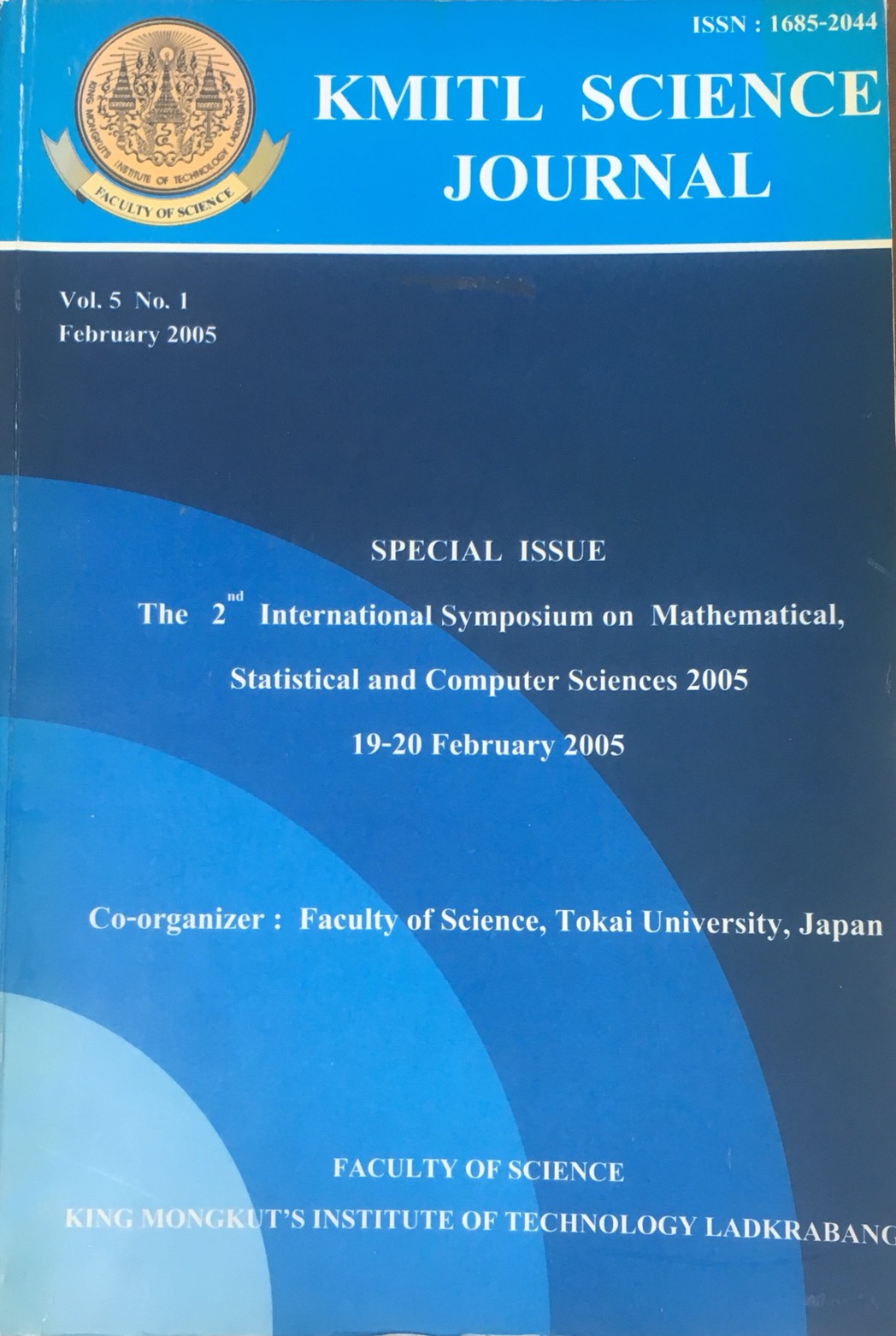
Main Article Content
Abstract
Thai language has some certain characteristics, which lead to a number of interesting research problems in natural language processing. For instance, Thai words in a sentence do not have feature embedded form, i.e., Thai words always have the same form in any sentences. This partially explains the lack of feature information in Thai part of speech (POS). Thai POS tagging only tags word category, such as noun, pronoun, verb, proposition and so on. Category information alone is inadequate for further language processing. This paper proposes the idea of tagging word role in a sentence using multilayer perceptron as a toll. The role assignment information can be used in complimentary to category assignment in Thai language processing.
Keywords: Part of speech tagging, Thai language processing, POS tagging with neural network, multilayer perceptron network, role feature tagging
Corresponding author: E-mail: ponrudee@it.kmitl.ac.th
Article Details
Copyright Agreement Statement
The corresponding author has to submit Copyright Agreement form after the article is accepted for publication in order to warrant that this contribution is original and that he/she has full power to make this grant. The author signs for and accepts responsibility for releasing this material on behalf of any and all co-authors.
The author(s) grant Current Applied Science and Technology a non-exclusive, irrevocable, royalty-free license to publish, reproduce, distribute, and archive the article in print and electronic form with effect if and when the article is accepted for publication. In the event that the article is withdrawn prior to acceptance or is declined, this agreement shall have no effect, and no party shall be bound by it.
The author(s) retain copyright of this article, including but not limited to the right to reproduce and distribute the article, to include it in a thesis or book, and to post it on an institutional or personal repository, provided that the original publication in Current Applied Science and Technology is properly cited.
References
[2] Charoenpornsawat, P., Kijsirikul, B., Meknavin, S., 1998. Feature-based Thai unknown word boundary identification using Winnow. IEEE Asia-Pacific Conference, Nov 1998. 547-550.
[3] Sornlertlamvanich, V., Charoenporn T., and Isahara, H., 1997. ORCHID: Thai Part-of-Speech Tagged Corpus. In Technical Report Orchid Corpus.
[4] Ma, Q., 2002. Natural Language Processing with Neural Networks. In Proceedings of the Language Engineering Conference (LEC’02), 13-15 Dec. 2002, 45-46.
[5] Ahmed., Raju S.B., Chandrasekhar Pammi V.S., and Prasad M.K., 2002. Application of Multilayer Perceptron Network for Tagging Parts-of-Speech, Proceedings of the Language Engineering Conference (LEC’02), 13-15 Dec. 2002, 57-63.
[6] Murata, M., Ma, Q., and Isahara, H., 2001. Part of Speech Tagging in Thai Language Using Support Vector Machine. The Second Workshop on Natural Language Processing and Neural Networks (NLPNN’2001).
[7] Netisopakul, P., Keawwan, K., 2004. Simple Thai Sentence Segmentation Using M-ATN. Graduate Project Report, Faculty of Information Technology, King Mongkut’s Institute of Technology Ladkrabang.
[8] Varakulsiripunth, R., Junwun, S., and Maneenate, N., 1989. Thai Syntactical Analysis by M-ATN. Papers on Natural Language Processing: Multi-lingual Machine Translation and Related Topics (1987-1994), 192-202.
[9] Haykin, S., 1998. Neural Networks: A Comprehensive Foundation (2ed), Prentice Hall.
