
Hematological Values of Eld's Deer (Rucervus eldii) in Thailand: A Retrospective study
Article Sidebar
Main Article Content
Abstract
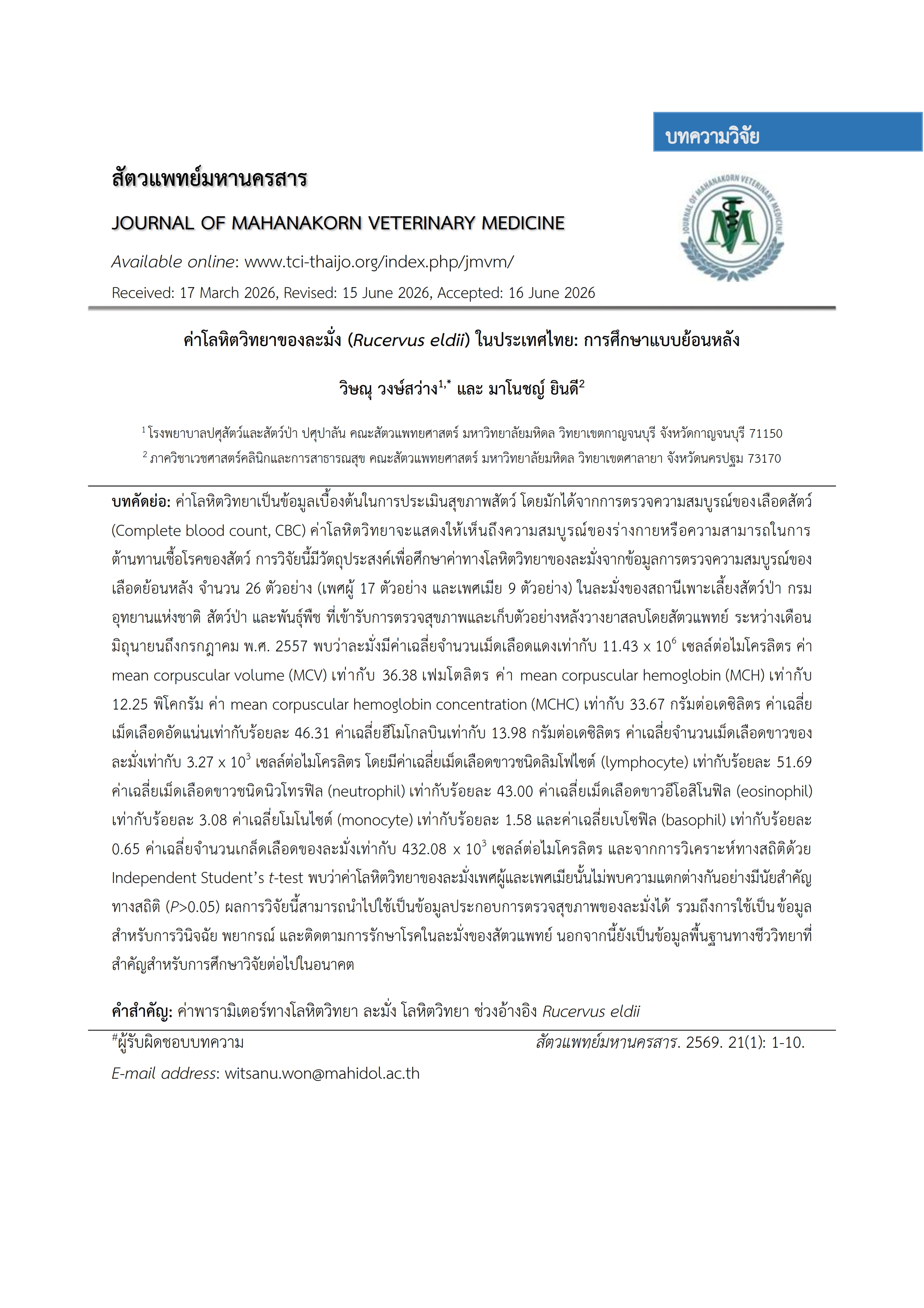
Hematological values are used as basic indicators for assessing animal health and commonly obtained through a complete blood count (CBC) examination. These parameters reflect the physiological condition and disease resistance of animals. This study aimed to investigate the hematological values of Eld’s deer (Rucervus eldii) using retrospective CBC data from 26 samples (17 males and 9 females). The samples were collected from deer at a wildlife breeding station, Department of National Parks, Wildlife, and Plant Conservation, Thailand, undergoing routine health examinations and sampling under anesthesia between June and July 2014. The results showed that the mean red blood cell count was 11.43 x 10⁶/µL. The mean corpuscular volume (MCV) was 36.38 fL, the mean corpuscular hemoglobin (MCH) was 12.25 pg, and the mean corpuscular hemoglobin concentration (MCHC) was 33.67 g/dL. The mean packed cell volume (PCV) was 46.31%, and the mean hemoglobin concentration was 13.98 g/dL. The mean white blood cell count was 3.27 x 10³ cells/µL. Differential leukocyte counts showed mean lymphocyte, neutrophil, eosinophil, monocyte, and basophil percentages of 51.69%, 43.00%, 3.08%, 1.58%, and 0.65%, respectively. The mean platelet count was 432.08 x 10³ cells/µL. Statistical analysis using the Independent Student’s t-test revealed no statistically significant differences in hematological parameters between male and female Eld’s deer (P>0.05). The findings of this study can serve as useful reference data for health assessment in Eld’s deer, as well as for the disease diagnosis, prognosis, and treatment monitoring by veterinarians. In addition, these results provide important baseline biological data for future research on this species.
Article Details

This work is licensed under a Creative Commons Attribution-NonCommercial-NoDerivatives 4.0 International License.
References
เฉลียว ศาลากิจ เจริญศักดิ์ ศาลากิจ ชัยณรงค์ คันธพนิต นิรชา โรจนแพทย์ กาวิล นันท์กลาง. (2542). ค่าโลหิตวิทยาของกวางรูซ่าในประเทศไทย. ว. เกษตรศาสตร์ (วิทย.), 33, 80-87.
เฉลียว ศาลากิจ. (2548). โลหิตวิทยาทางสัตวแพทย์. นครปฐม: โรงพิมพ์ศูนย์ส่งเสริมและฝึกอบรมการเกษตรแห่งชาติ มหาวิทยาลัยเกษตร
ศาสตร์.
Audige, L. (1992). Haematological values of rusa deer (Cervus timorensis russa) in New Caledonia. Aust Vet J, 69, 265-268.
Aye Myat Thu, Guo-Gang Li, Mingxia Zhang, Tluang Hmung Thang, Aung Myat Soe, Win Naing, and Rui-Chang Quan. (2019). Group size and social organization of the endangered Eld's deer (Rucervus eldii thamin): Results from a long-term study in Myanmar. Glob. Ecol. Conserv, 18, e00618.
Frohlich, J., Kubickova, S., Musilova, P., Cernohorska, H., Muskova, H., Vodicka, R., and Rubes, J. (2017). Karyotype relationships among selected deer species and cattle revealed by bovine FISH probes. PLoS One, 12(11), e0187559.
Latimer, K.S., Mahaffey, E.A., and Prasse, K.W. (2003). Duncan and Prasse’s veterinary laboratory medicine: Clinical pathology (4th ed.). Wiley-Blackwell.
Nimitsuntiwong W., Homswat S., Boonprakob U., Kaewmokul S. and Schmidt, A. (2000). Hematological and plasma biochemical values in captive Eld’s-Brow antlered deer (Cervus eldi thamin) in Thailand. J. Vet. Med. Sci, 62(1), 93–95.
Prescott, J. (1987). The Status of the Thailand Brow-Antlered deer (Cervus eldi siamensis) in captivity. Mammalia, 51(4), 571-577.
