
Prototype of a Cryo-cuff Temperature-Controlled Machine for Rehabilitation: A Study Assessing the Satisfaction of Professional Medical Personnel Prior to Conducting Trials on Patients
Keywords:
A Cryo-cuff machine, Rehabilitation, Knee painAbstract
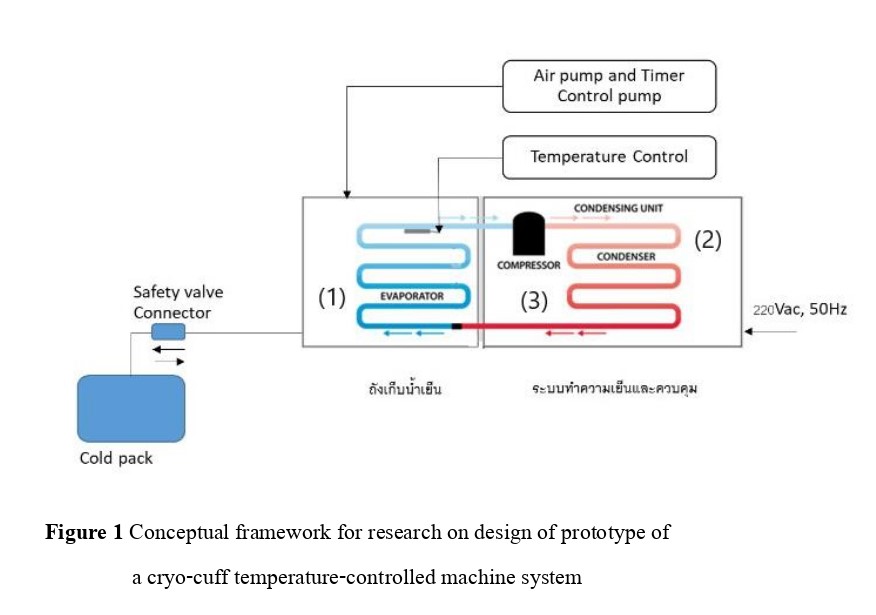
Background and Objectives We developed a cryo-cuff temperature-controlled machine for use in physical therapy that produces cold water without needing ice, replacing the traditional cold compress. This reduces the cost of purchasing ice to maintain the cold compress temperature for patients, making the treatment more convenient.
Methods We developed a prototype of a cryo-cuff temperature-controlled machine and evaluated the satisfaction of medical personnel in a pre-clinical study involving 20 participants across four areas: benefits, safety, ease of use, and product quality. Data was collected from the sample group at hospitals under the Bangkok Metropolitan Administration (Orthopedics Department, Central Hospital, and Rehabilitation Department, Ratchaphiphat Hospital).
Results The developed prototype can control the temperature of the compress to remain within the range of 10-20 degrees Celsius (average temperature at 16 ±3 degrees Celsius) throughout the cold compress duration of no more than 20 minutes per session, as per the requirements of rehabilitation medicine. The prototype has passed performance efficiency tests and working process safety checks. The results of the medical personnel satisfaction assessment showed satisfaction in all aspects at a high and the highest level, totaling over 80%. The overall average was 87%, and the average score for all aspects was 4.1 (mean = 4.1, S.D. = 0.2).
Conclusion and Recommendation The study achieved its research objectives on the development of a cryo-cuff temperature-controlled machine for use in physical therapy. Users found it more convenient, as they did not need to refill ice every time they applied the cold compress. Medical personnel can use the results as a guideline for the experimental process and as a tool for further study and research in the field of clinical rehabilitation medicine for patients.
References
Sadakan Eamchunprathip, Thawatchai Tepapal, (2017) , Effects of Cold Compression with Self-efficacy on the Pain and Recovery Among Patients Received Open Reduction Internal Fixation of femur, Nursing Journal Volume 44 No. 1 January-March 2017, 39-49
Nuchsara Eungapithum, Sukanya Parisunyakul, Nantaporn Sansiriphun, (2012), Effect of Cold and Heat Compression on Labor Pain, Nursing Journal Volume 39 Number 4 October - Demenber 2012, 46-58.
Natcha Trakarnjan, Pasajeeporn Yodphithak, (2020), Rehabilitation of Patients after Artificial Knee Replacement Surgery, Regional Health Promotion Center 9 Journal Vol. 14 No. 34 May-August 2020, 271-284
Jeaujan Charoenbhakdi, Witoon Homla, (2021), An innovative “ Wonder Cold Pad for pain relief” in patients with orthopedic surgery, Thai Journal of Nursing, 70(3), 2021, 20-28.
Wilaiwan Keawhong, Jindaporn Saikain, (2023), Cold Pack for Release Chin Swelling, Online: https://hpc2appcenter.anamai.moph.go.th/academic/web/files/2566/innovation/MA2566-004-04-0000001031-0000001037.pdf
Kullenberg, B., Ylipa, S., Soderlund, K., & Resch, S. (2006). Postoperative cryotherapy after total knee arthroplasty , The Journal of Arthroplasty , 21 , 1176-1179
Downloads
Published
How to Cite
Issue
Section
License
Copyright (c) 2025 Princess of Naradhiwas University Journal

This work is licensed under a Creative Commons Attribution-NonCommercial-NoDerivatives 4.0 International License.