
The Relationship between Depression, Anxiety, and Resilience among Pregnant Women During a Public Health Crisis
Keywords:
Pregnant Women, Resilience, Depression, Anxiety, Public Health CrisisAbstract
Background and Objectives This descriptive correlational study aimed to investigate the relationship between depression, anxiety, and resilience among pregnant women in public health crisis situations, encompassing various forms of crises such as outbreaks of serious infectious diseases, including COVID-19, influenza, SARS, monkeypox, natural disasters, air pollution, social conflict or war, and economic crises.
Methods The sample group consisted of pregnant women aged 20 years and older, selected using convenience sampling. The sample size was 1,293 people, divided into 324 from the South and 323 each from the Central, Northern, and Northeastern regions. The research instruments included 4-part questionnaires: Part 1, Personal Information Record; Part 2, resilience measurement; Part 3, depression measurement; and Part 4, State Anxiety Scale. The reliability coefficients using Cronbach's alpha were .98, .96, and .91, respectively. General data were analyzed using descriptive statistics, and since the data were normally distributed, the Pearson correlation coefficient was used to find the relationship between depression, anxiety, and resilience among pregnant women.
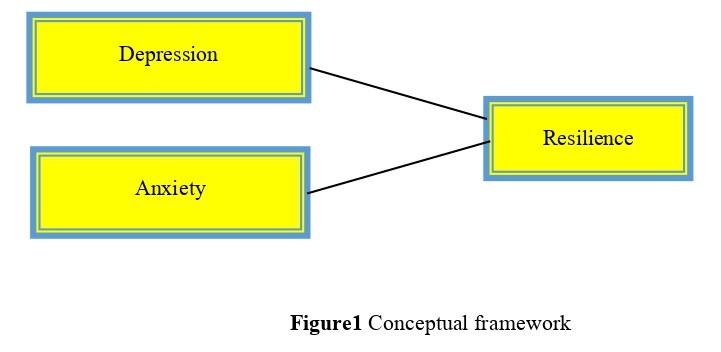
Results Depression was negatively correlated with resilience among pregnant women at a statistically significant low level (r = -.23, p < .001), and anxiety was negatively correlated with resilience among pregnant women at a statistically significant moderate level (r = -.30, p < .001). The research findings indicated that if pregnant women had high resilience, they could reduce the occurrence of depression and anxiety during public health crisis situations.
Conclusion and Recommendation The research findings should be used to create guidelines for nurses or develop programs for pregnant women to strengthen their resilience and be prepared to face life's crises.
References
Al-abri, K., Edge, D., & Armitage, C. J. (2023). Prevalence and correlates of perinatal depression. Social Psychiatry and Psychiatric Epidemiology, 58(10), 1581 – 1590. https://doi.org/ 10.1007/s00127-022-02386-9
American Psychiatric Association. (2013). Diagnostic and statistical manual of mental disorders: DSM-5™ (5th ed.). American Psychiatric Publishing. https://doi.org/10.1176/appi.books. 9780890425596
Biaggi, A., Conroy, S., Pawlby, S., & Pariante, C. M. (2016). Identifying the women at risk of antenatal anxiety and depression: A systematic review. Journal of Affective Disorders, 191, 62 – 77. https://doi.org/10.1016/j.jad.2015.11.014
Caffieri, A., Gomez-Gomez, I., Barquero-Jimenez, C., De-Juan-Iglesias, P., Margherita, G., & Motrico, E. (2024). Global prevalence of perinatal depression and anxiety during the COVID-19 pandemic: An umbrella review and meta-analytic synthesis. Acta Obstetricia et Gynecologica Scandinavica, 103, 210 – 224. https://doi.org/10.1111/aogs.14740
Cunningham, F. G., Leveno, K. J., Dashe, J. S., Hoffman, B. L., Spong, C. Y., & Casey, B. M. (Eds.). (2022). Williams obstetrics (26th ed.). McGraw-Hill Education.
Damsanuan, C. (2018). The factors as predictors of resilience quotient of adolescents in Nongki District, Burirum Province. Journal of MCU Humanities Review, 4(1), 19 – 28. https://so03.tci-thaijo.org/index.php/human/article/download/165031/119560/459406
Department of Disease Control. (2024). Framework for the development of Emergency Operations Centers and Incident Command Systems for public health emergencies, 2023–2027. https://www.ddc.moph.go.th/uploads/ckeditor2/ddce/files/12_06_2567.pdf
Grotberg, E. (1995). A guide to promoting resilience in children: Strengthening the human spirit (Early Childhood Development: Practice and Reflections, No. 8). Bernard Van Leer Foundation.
Grotberg, E. H. (1997). The international resilience project: Findings from the research and the effectiveness of interventions. https://files.eric.ed.gov/fulltext/ED419584.pdf
Grotberg, E. H. (2001). Resilience program for children in disaster. Ambulatory Child Health, 7, 75–83. https://doi.org/10.1046/j.1467-0658.2001.00114.x
Grotberg, E. H. (2005). Resilience for tomorrow. http://resilnet.uiuc.edu/library/grotberg2005_ Resilience-for-tomorrow-brazil.pdf
Jampawal, T. (2021). State anxiety. Buddhist Psychology Journal, 3(1), 13 – 20. https://so03.tci-thaijo.org/index.php/jbp/article/view/242981
Kahyaoglu Sut, H., & Kucukkaya, B. (2020). Anxiety, depression, and related factors in pregnant women during the COVID-19 pandemic in Turkey: A web-based cross-sectional study. Perspectives in Psychiatric Care, 57(2), 860 – 868. https://doi.org/10.1111/ppc.12627
Kasak, R., Serisathien, Y., & Bangpichet, A. (2014). Factors predicting depression in adolescent pregnant woman. Nursing Science Journal of Thailand, 31(2), 38 – 48.
Kinser, A. P., Jallo, N., Amstadter, B. A., Thacker, R. L., Jones, E., Moyer, S., Rider, A., Karjane, N., & Salisbury, L. A. (2021). Depression, anxiety, resilience, and coping: The experience of pregnant and new mothers during the first few months of the COVID-19 pandemic. Journal of Women’s Health, 30(5), 654 – 664. https://doi.org/10.1089/jwh.2020.8866
Ma, X., Wang, Y., Hu, H., Tao, X. G., Zhang, Y., & Shi, H. (2019). The impact of resilience on prenatal anxiety and depression among pregnant women in Shanghai. Journal of Affective Disorders, 250, 57 – 64. https://doi.org/10.1016/j.jad.2019.02.058
McCleskey, J., & Gruda, D. (2021). Risk-taking, resilience, and state anxiety during the COVID-19 pandemic: A coming of (old) age story. Personality and Individual Differences, 170, 110485. https://doi.org/10.1016/j.paid.2020.110485
Nazife, B., Pınar, I. V., & Cuma, D. (2021). Relationship of depression, anxiety and stress levels with religious coping strategies among Turkish pregnant women during the COVID-19 pandemic. Journal of Religion and Health, 60(5), 3379 – 3393. https://doi.org/10.1007/s10943-021-01391-7
Nintachan, P., Saengon, S., & Thaweekun, T. (2010). Development resilience assessment (Research report). Ramathibodi Nursing School, Faculty of Medicine, Ramathibodi Hospital, Mahidol University.
Nintachan, P., Saengon, S., Wittayasuporn, J., Piaseu, N., Thaweekun, T., & Orathai, P. (2009). Enhancing resilience. Judtong.
Pimsuwan, P., Baosoung, C., & Sansiriphun, N. (2020). Pregnancy-related anxiety, risk knowledge, and pregnancy risk perception among advanced age pregnant women. Nursing Journal, 47(3), 50 – 60.
Puertas-Gonzalez, J. A., Mariño-Narvaez, C., Romero-Gonzalez, B., Vilar-Lopez, R., & Peralta-Ramirez, M. I. (2023). Resilience, stress and anxiety in pregnancy before and throughout the pandemic: A structural equation modelling approach. Current Psychology, 42, 22013 – 22023. https://doi.org/10.1007/s12144-022-03305-6
Preis, H., Mahaffey, B., Heiselman, C., & Lobel, M. (2020). Vulnerability and resilience to pandemic-related stress among U.S. women pregnant at the start of the COVID-19 pandemic. Social Science & Medicine, 266, 113348. https://doi.org/10.1016/j.socscimed.2020.113348
Ran, B., Moore, M. T., Greenberg, M. D., DiDomenico, E. G., Brown, A. L., White, K. L., Gur, R.C., & Gur, E. R. (2020). Resilience, COVID-19-related stress, anxiety and depression during the pandemic in a large population enriched for healthcare providers. Translational Psychiatry, 10(1), 291. https://doi.org/10.1038/s41398-020-00982-4
Setiawati, Y., Wahyuhadi, J., Joestandari, F., Maramis, M. M., & Atika, A. (2021). Anxiety and resilience of healthcare workers during COVID-19 pandemic in Indonesia. Journal of Multidisciplinary Healthcare, 14, 1 – 8. https://doi.org/10.2147/JMDH.S276655
Silva, J. M. M., Leite, C. R. P. E., Nogueira, D. A., & Clapis, M. J. (2016). Depression in pregnancy: Prevalence and associated factors. Investigación y Educación en Enfermería, 34(2), 342 – 350. https://doi.org/10.17533/udea.iee.v34n2a14
Song, H., Zhang, M., Wang, Y., Yang, L., Wang, Y., & Li, Y. (2021). The impact of resilience on anxiety and depression among grass-roots civil servants in China. BMC Public Health, 21(1), 1 – 10. https://doi.org/10.1186/s12889-021-10710-2
Spielberger, C. D., Gorsuch, R. L., Lushene, R., Vagg, P. R., & Jacobs, G. A. (1983). Manual for the State-Trait Anxiety Inventory. Consulting Psychologists Press.
Sriyong, M. (1979). Beck Depression Inventory IA (BDI-IA) [Master’s thesis]. Ramkhamhaeng University.
Stein, A., Pearson, R. M., Goodman, S. H., Rapa, E., Rahman, A., McCallum, M., & Pariante, C. M. (2014). Effects of perinatal mental disorders on the fetus and child. The Lancet, 384(9956), 1800 – 1819. https://doi.org/10.1016/S0140-6736(14)61277-0
Tapinta, D. (2013). Depression: Cognitive and behavioral therapy and counseling (2nd ed.). Wanida Publisher.
Thananowan, N., Wongsirimas, N., Ketcham, D., & Kesornsamut, P. (2012). Effects of variables transmission from intimate partner violence and psychosocial factors on antenatal and postpartum depression in Thai women. Journal of Nursing Science, 30(4), 28 – 36. https://he02.tci-thaijo.org/index.php/ns/article/view/10523/9524
Ugwumadu, A. (2015). Management of stillbirth and perinatal loss. Obstetrics, Gynaecology and Reproductive Medicine, 25(8), 217 – 221. https://doi.org/10.1016/j.ogrm.2015.05.002
Wongniyom, K., & Apinuntavech, S. (2014). The prevalence and associated factors of depression in teenage pregnancy at Siriraj Hospital. Journal of the Psychiatric Association of Thailand, 59(3), 195 – 205. https://www.psychiatry.or.th/JOURNAL/59-3/02-Kusalaporn.pdf
World Health Organization. (2025). Health emergencies. https://www.who.int/our-work/health-emergencies
Xiao, X., Xiao, J., Yao, J., Chen, Y., Saligan, L., Reynolds, N. R., & Wang, H. (2020). The role of resilience and gender in relation to infectious-disease-specific health literacy and anxiety during the COVID-19 pandemic. Neuropsychiatric Disease and Treatment, 16, 3011 – 3021. https://doi.org/10.2147/NDT.S277231
Xu, L. L., Li, J. Q., Pu, Y. Q., Zhou, C., Feng, S. W., & Luo, Q. (2020). Effect of prenatal depression during late pregnancy on maternal and neonatal outcomes. Clinical and Experimental Obstetrics & Gynecology, 47(5), 681 – 686. https://doi.org/10.31083/j.ceog.2020.05.5398
Zhang, Y., & Ma, Z. F. (2020). Impact of the COVID-19 pandemic on mental health and quality of life among local residents in Liaoning Province, China: A cross-sectional study. International Journal of Environmental Research and Public Health, 17(7), 2381. https://doi.org/10.3390/ijerph17072381
Downloads
Published
How to Cite
Issue
Section
License
Copyright (c) 2025 Princess of Naradhiwas University Journal

This work is licensed under a Creative Commons Attribution-NonCommercial-NoDerivatives 4.0 International License.