Problem Situation and People's Participation in Preventing the COVID-19 Outbreak in the Western Border Areas of Thailand
Keywords:
Problem situation, Family participation, COVID-19 disease, BorderAbstract
Background and Objectives Currently, many countries around the world are facing the problem of the spread of the coronavirus disease 2019, or COVID-19, especially in the western border areas of Thailand, where the problem is severe and continuously increasing. This concern has led to the current research study, which aimed to investigate the situation, problems, and people’s participation in preventing the re-emergence of COVID-19 in the western border areas of Thailand.
Methods This study employed a qualitative research approach, utilizing in-depth interviews with 42 participants and focus group discussions with 120 participants, conducted between November 2022 and November 2023. The research findings were analyzed using qualitative data analysis methods, specifically thematic analysis.
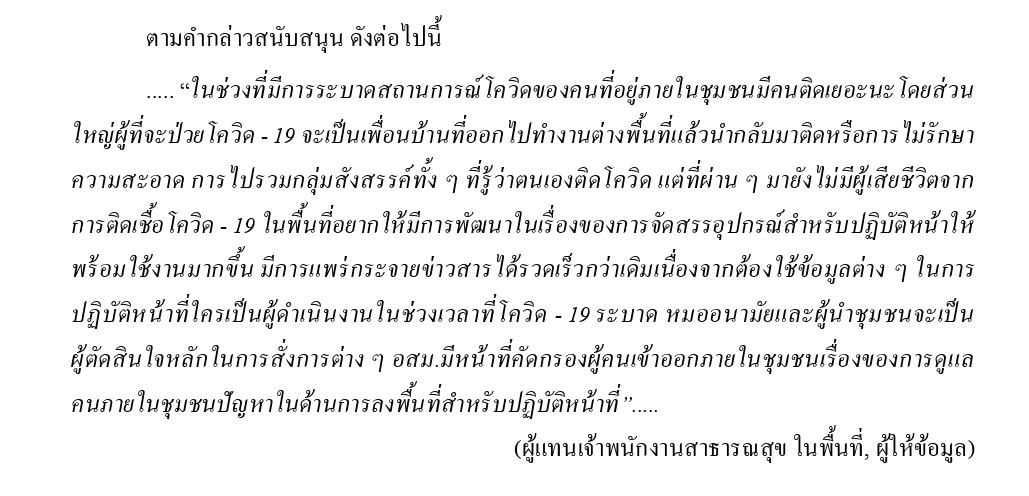
Results The research findings indicated that the situation and problems in preventing the re-emergence of COVID-19 in the western border areas of Thailand consisted of three main issues: personal factors (host). It was found that 1) the people lack knowledge and understanding of preventing the re-emergence of COVID-19 in the western border areas, 2) people in the area have incorrect wisdom and beliefs, which contribute to the re-emergence of COVID-19, 3) the people lack media literacy skills to protect themselves from COVID-19, and 4) the people are not aware of self-protective behaviors against COVID-19 in the western border areas of Thailand. Regarding the causes of the disease (agent), it was found that 1) the COVID-19 virus, foreign populations, and environmental factors contributed to the issue, 2) the system for monitoring the re-emergence of COVID-19 in the area was unprepared, and 3) there was a lack of community participation in preventing and controlling the re-emergence of COVID-19 in the western border areas.
Conclusion and Recommendations Providing education about attitudes and behaviors regarding the re-emergence of COVID-19 in the western border areas should utilize accessible media, such as audio broadcasts through village loudspeakers, as well as continuous screening and surveillance services from relevant agencies.
References
COVID Situation Administration Center - 19. (2020, April 30). Announcements and stage order. http://www.thaigov.go.th/news/contents/details/27963
Department of Disease Control. (2021). Report on the COVID-19 situation https://covid19.ddc.moph.go.th
Department of Provincial Administration. (2015, April 27). Announcement from the Central Registration Office, Departmaent of Provincial Administration regarding the number People throughout the kingdom Separated into Bangkok and various provinces according to evidence Civil. http://stat.bora.dopa.go.th/stat/y_stat58
Ketudao, R., Thiengtrongdee, A., & Thoin, P. (2022). The development of a surveillance, prevention, and control model for Coronavirus Disease 2019 (COVID-19) in specific areas (Bubble and Seal) of business establishments in Maha Sarakham Province. Journal of Public Health Academic, 31(1), 1–12. https://thaidj.org/index.php/JHS/article/view/11740
Puengwora, W. (2008). Motivational factors related to job performance of professional nurses working in community health centers in Sakon Nakhon Province [Master’s thesis]. Khon Kaen University
Udompittayasan, W., Loraka, T., & Khianpho, R. (2019). Embrace culture: Learning to understand the health culture of service recipients. Journal College of Nursing and College of Public Health. 6(3), 202 - 210. http://doi.org/10.3390/ijerph17072558
United Nations Industrial Development Organization. (June 23, 2020). Organization UNID. Impact assessment of covid-19 on thai industrial sector. https://thailand.un.org/th/50830-karpraemin phlkrathbcakokhwid-19-ytxphakhxutsahkrrmithy
United Nations, Thailand. (2020, November 30). Assessment of the combined economic and social impacts from Spread of COVID-19 in Thailand 2020. https://thailand.un.org/sites/default/files/202102/UN%20Thailand%20SociofEconomic%20Impact%20Assessment%20of%20Covid-19%20in%20Thailand-THlow%20res.pdf.
Worathanarat, T. (2019, April 14). Coronavirus 2019 (covid-19). https://www.isranews.org/isranews-article/85871-covid.html
World Health Organization (2020, May 8). Origin of sars-cov-2. https://apps.who.int/iris/bitstream/handle/10665/332197/WHO-2019nCoVfFAQVirus_origin-2020.1-eng.pdf
World Health Organization (2021, April 30). Coronavirus disease (COVID-19). https://www.who.int/ docs/default-source/coronaviruse/situation-re
Worldmeter. (April 13, 2021). Covid live update. https://www.worldometers.info/coronavirus/?utm_ campaign=homeAdvegas1?%20
Downloads
Published
How to Cite
Issue
Section
License
Copyright (c) 2025 Princess of Naradhiwas University Journal

This work is licensed under a Creative Commons Attribution-NonCommercial-NoDerivatives 4.0 International License.