
Sex Identification of Beautiful Birds from Feathers by PCR Method
Article Sidebar
Main Article Content
Abstract
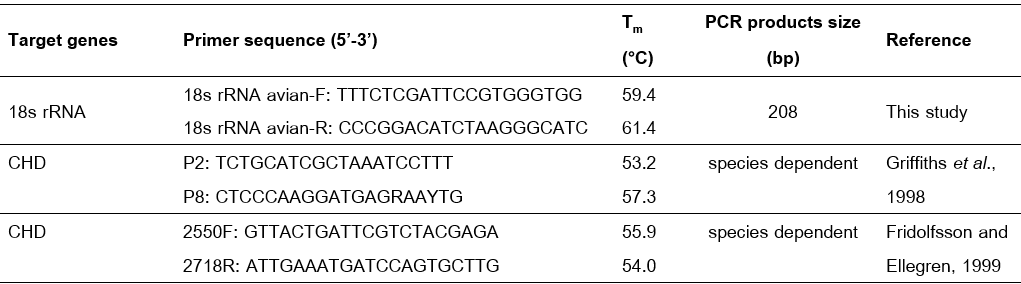
PCR is an accurate and effective method for sex identification of young birds. However, extracting DNA from birds' blood samples can cause stress and injury to the birds. Using feathers instead of blood for DNA extraction is a more convenient and safer alternative for birds. When comparing DNA extraction from blood and chicken feathers, DNA from feathers was found to be as effective as that from blood in amplifying DNA using PCR. Sex identification was performed by extracting DNA from their feathers and used two pairs of primers, P2-P8 and 2550F-2718R, specific to the CHD gene in birds, with the 18s rRNA gene primer as a control. The results showed that the P2-P8 primer pair could only be used to identify the sexes of Sun Conure parrots. Female sun conures have a DNA band of approximately 350 base pairs corresponding to the CHD gene. The 2550F-2718R primer pair can be used to identify the sexes of both Sun Conures and Green Cheek Normal parrots. The female Sun Conure parrot has a DNA band of the CHD gene measuring approximately 650 base pairs, and the female Green Cheek Normal parrot has a DNA band of the CHD gene measuring approximately 450 base pairs.
Article Details

This work is licensed under a Creative Commons Attribution-NonCommercial-NoDerivatives 4.0 International License.
The content and information in the article published in Journal of Rajamangala University of Technology Srivijaya It is the opinion and responsibility of the author of the article. The editorial journals do not need to agree. Or share any responsibility.
References
Çakmak, E., Pekşen, Ç.A. and Bilgin, C.C. 2017. Comparison of three different primer sets for sexing birds. Journal of Veterinary Diagnostic Investigation 29(1): 59-63.
Divers, S.J. 2015. Endoscopic sex identification in chelonians and birds (psittacines, passerines, and raptors). Veterinary Clinics of North America: Exotic Animal Practice 18(3): 541-554.
Fridolfsson, A.K. and Ellegren, H. 1999. A simple and universal method for molecular sexing of non-ratite birds. Journal of Avian Biology 30(1): 116-121.
Griffiths, R., Double, M.C., Orr, K. and Dawson, R.J.G. 1998. A DNA test to sex most birds. Molecular Ecology 7(8): 1071-1075.
Harvey, M.G., Bonter, D.N., Stenzler, L.M. and Lovette, I.J. 2006. A comparison of plucked feathers versus blood samples as DNA sources for molecular sexing. Journal of Field Ornithology 77(2): 136-140.
Horváth, M.B., Martínez-Cruz, B., Negro, J.J., Kalmár, L. and Godoy, J.A. 2005. An overlooked DNA source for non-invasive genetic analysis in birds. Journal of Avian Biology 36: 84-88.
Jensen, T., Pernasetti, F.M. and Durrant, B. 2003. Conditions for rapid sex determination in 47 avian species by PCR of genomic DNA from blood, shell-membrane blood vessels, and feathers. Zoo Biology 22: 561-571.
Oktanella, Y. 2019. Sex identification based on molecular marker of CHDZ and CHDW gene in some species of Indonesian birds. Advances in Animal and Veterinary Sciences 7(10): 844-847.
Poeaim, S., Chobarporn, N., Weeraphan, T., Puttharak, N. and Poeaim, A. 2012. Sex identification of some parrots. Thai Journal of Genetics 5(2): 194-202.
Reynolds, S.J., Martin, G.R., Wallace, L.L., Wearnand, C.P., and Hughes, B.J. 2008. Sexing sooty terns on Ascension Island from morphometric measurements. Journal of Zoology 274: 2-8.
Ribas, C.C. and Miyaki, C.Y. 2004. Molecular systematics in Aratinga parakeets: species limits and historical biogeography in the "solstitialis" group, and the systematic position of Nandayus nenday. Molecular Phylogenetics and Evolution 30(2004): 663-675.
TehSwee, A. and Kumaran, J. 2010. Gender identification of domesticated chicken using a PCR-based method. Pertanika Journal of Tropical Agricultural Science 33(2): 329-336.
Vucicevic, M., Stevanov-Pavlovic, M., Stevanovic, J., Bosnjak, J., Gajic, B., Aleksic, N. and Stanimirovic, Z. 2013. Sex determination in 58 bird species and evaluation of CHD gene as a universal molecular marker in bird sexing. Zoo Biology 32(3): 269-276.
