Feasibility of Using Durian Seeds, Jackfruit Seeds and Cassava as a Replacement for Rice in the Culture of Trichoderma harzianum in the Khao Khitchakut Community
Article Sidebar
Main Article Content
Abstract
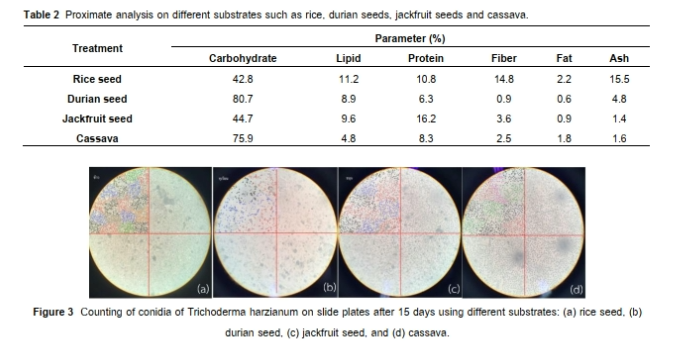
Currently, in the Khao Kitchakut community of Chanthaburi province, the production volumes of durian, jackfruit and cassava have increased, resulting in a large amount of waste materials from the agricultural sector and the fruit product processing industry. Consequently, a significant amount of agricultural and fruit processing byproducts exists. In particular, there is a substantial quantity of discarded seeds which, if not properly managed, could become a breeding ground for various plant diseases like root rot, stem rot, pink disease, and fruit rot in durian. Therefore, maximizing the utilization of these remaining seed portions becomes imperative. The objective of this study is to investigate the feasibility of using durian seeds, jackfruit seeds, and cassava as alternatives to rice for cultivating Trichoderma harzianum. The experimental design employs a Completely Randomized Design (CRD) with four treatments, with ten repetitions: Treatment 1 – rice seeds; Treatment 2 – durian seeds; Treatment 3 – jackfruit seeds; and Treatment 4 – cassava.The rice method showed the highest mycelial growth and sporulation, with 100% colonization and 1.66x10⁶ spores per milliliter, respectively. Cassava and jackfruit seeds exhibited the lowest mycelial growth and sporulation, while durian seeds showed only 20% colonization and 0.5x10⁴ spores per milliliter, respectively. This was due to contamination by Aspergillus sp. and Penicillium sp., resulting in the lowest mycelial growth and sporulation of Trichoderma sp. Therefore, we conclude that using durian and jackfruit seeds as substitutes for rice to cultivate Trichoderma sp. is not suitable for the propagation of the fungus.
Article Details

This work is licensed under a Creative Commons Attribution-NonCommercial-NoDerivatives 4.0 International License.
The content and information in the article published in Journal of Rajamangala University of Technology Srivijaya It is the opinion and responsibility of the author of the article. The editorial journals do not need to agree. Or share any responsibility.
References
Amid, B.T. and Mirhosseini, H. 2012. Optimisation of aqueous extraction of gum from durian (Durio zibethinus) seed: A potential, low cost source of hydrocolloid. Food Chemistry 132(3): 1258-1268.
Amin, M.A., Ahmed, A.S., Yin, Y.Y., Yahya, N. and Ibrahim, N. 2007. Extraction, purification and characterization of durian (Durio zibethinus) seed gum. Food Hydrocolloids 21(2): 273-279.
APAARI. 2018. Durian in Thailand: A Success Story. Asia-Pacific Association of Agricultural Research Institutions. Bangkok, Thailand.
Baraheng, S. and Karrila, T. 2019. Chemical and functional properties of durian (Durio zibethinus Murr.) seed flour and starch. Food Bioscience 30: 400-412.
Beleia, A., Butarelo, S.S. and Silva, R.S.F. 2006. Modeling of starch gelatinization during cooking of cassava (Manihot esculenta Crantz.). LWT-Food Science and Technology 39: 399-404.
Bobbio, F.O., EI-Dash, A.A., Bobbio, P.A., and Rodrigues, L.R. 1978. Isolation and characterization of the physio-chemical properties of the starch of jackfruit seeds (Artocarpus heterophyllus). Cereal Chemistry 55: 505-511.
Brown, M.J., Hor, Y.L. and Greenwood, J.S. 2001. Reserve accumulation and protein storage vacuole formation during development of recalcitrant seeds of Durio zibethinus L. Seed Science Research 11(4): 293-303.
Chamswarng, C. and Intanoo, W. 2002. Production of Trichoderma fresh culture by simple technique for controlling damping-off of yard long bean caused by Sclotium rolfsii, pp. 114-122. In Proceeding of 40th Kasetsart University Annual Conference (Subject: Plants). Bangkok, Thailand.
Charles, A.L., Chang, Y.H., Ko, W.C., Sriroth, K. and Huang, T.C. 2004. Some physical and chemical properties of starch isolates of Cassava genotypes. Starch/Stärke 56(9): 413-418.
Charoenphun, N., Setarnawat, S. and Sai-ut, S. 2018. Chemical Composition and Trends in Utilization of By-products and Wastes from 4 Types of Tropical Fruit Processing. Thai Science and Technology Journal (TSTJ) 28(1): 113-128. (in Thai)
Charoenrak, P. and Chamswarng, C. 2016. Efficacies of wettable pellet and fresh culture of Trichoderma asperellum biocontrol products in growth promoting and reducing dirty panicles of rice. Agriculture and Natural Resoures 50: 243-249.
Chen, K.J., Tang, J.C., Xu, B.H., Lan, S.L. and Cao, Y. 2019. Degradation enhancement of rice straw by co-culture of Phanerochaete chrysosporium and Trichoderma viride. Scientific Reports 9: 19708.
Faridah, S.M.A., Atikah, N.M.R.L. Jau-Shuy, L., Hasmadi, M., Rosni, M.S., Wolyna, P. and Noorakmar, A.W. 2021. Physicochemical and thermal properties of durian seed flour from three varieties of durian native of Sabah. Food Research 5(4): 374-381.
Leemud, P. Karrila, S., Kaewmanee, T. and Karrila, T. 2020. Functional and physicochemical properties of Durian seed flour blended with cassava starch. Journal of Food Measurement and Characterization 14: 388-400.
Narklaor, D., Sangnark, A. and Limroongreungrat, K. 2011. Improvement in Quality of Jackfruit Seed Flour by Pregelatinization. Burapha Science Journal 16(1): 12-21. (in Thai)
Pongpisutta, R., Rattanakreetakul, C., Bincader, S., Chatchaisiri, K. and Boonruangrod, P. 2020. Detection of fungal pathogen causing durian dieback disease. Khon Kaen Agriculture journal 48(4): 703-714. (in Thai)
Rengsutthi, K. and Charoenrein, S. 2011. Physico-chemical properties of jackfruit seed starch (Artocarpus heterophyllus) and its application as a thickener and stabilizer in chili sauce. LWT-Food Science and Technology 44(5): 1309-1313.
Sharmani, H.R., Halabi, H.H., and Abedy, A.N. 2019. Efficacy of rice husks compost and Trichoderma harzianum on Rhizoctonia solani and its effect on seeds germination and seedling health. Earth and Enviromental Science 388: 1-12.
Thongkamngam, T. and Anutrakunchai, S. 2019. Survey and collection of fungal pathogen of durian in Chanthaburi province, pp. 117-122. In Proceedings of 3rd International Symposium on Agricultural Technology and 17th International Symposium on Biocontrol and Biotechnology. Krabi, Thailand.
Tulyathan, V., Tananuwong, K., Songjinda, P. and Jaiboon, N. 2002. Some physicochemical properties of jackfruit (Artocarpus heterophyllus Lam) seed flour and starch. Science Asia 28: 37-41.
