
Deterioration of Sandwich Composites between Plastics and Woven Bamboo Plates under Natural Weathering
Article Sidebar
Main Article Content
Abstract
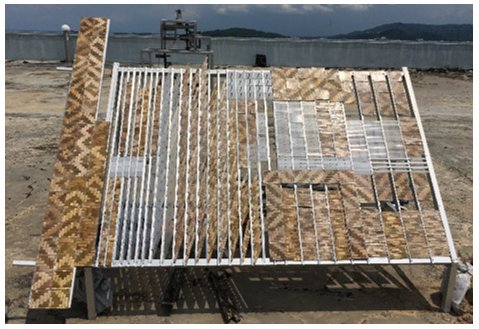
The objective of this research was to analyze the effects of plastic types (polystyrene, polypropylene, and polylactic acid) and woven bamboo patterns (weave pattern and marble pattern) on the mechanical and physical properties of sandwich composites made from plastic and woven bamboo plates, subjected to natural weathering for 6 months. In manufacturing the sandwich composites, the sample panels were compressed using a compression molding machine. From the results of experiment, analysis of variance (ANOVA) indicated that the plastic types significantly (p<0.05) affected modulus of rupture, tensile strength, shear strength, and puncture force, while with the same plastic type and woven bamboo pattern the 2-sample t-test revealed that the sandwich composites showed a significant decrease in mechanical properties (p<0.05). Further, after being subjected to natural weathering for 6 months, the sandwich composites made from polypropylene showed the highest mechanical properties (7.22-16.1 MPa) and those made from polylactic acid exhibited the lowest mechanical properties (2.1-9.1 MPa). The sandwich composites made from plastic and bamboo plates with a weave pattern had significantly higher mechanical properties than those with a marble pattern, both before and after exposure to natural weathering. Finally, considering physical changes, it was revealed that the sandwich composites made from plastic and woven bamboo plates exhibited less surface roughness and fewer cracks than 100% pure plastic after exposure to natural weathering.
Article Details

This work is licensed under a Creative Commons Attribution-NonCommercial-NoDerivatives 4.0 International License.
The content and information in the article published in Journal of Rajamangala University of Technology Srivijaya It is the opinion and responsibility of the author of the article. The editorial journals do not need to agree. Or share any responsibility.
References
Cheewawuttipong, W., Homkhiew, C. and Rawangwong, S. 2022. A comparative study on the effect of oil palm fiber contents and types on properties of rubberwood sawdust-polypropylene composites. Rajamangala University of Technology Srivijaya Research Journal 14(1): 31-46. (in Thai)
Gramlich, W.M., Gardner, D.J. and Neivandt, D.J. 2006. Surface treatments of wood–plastic composites (WPCs) to improve adhesion. Journal of Adhesion Science and Technology 20(16): 1873-1887.
Guo, G., Finkenstadt, V.L. and Nimmagadda, Y. 2019. Mechanical properties and water absorption behavior of injection-molded wood fiber/carbon fiber high-density polyethylene hybrid composites. Advanced Composites and Hybrid Materials 2: 690-700.
Hao, X., Yi, X., Sun, L., Tu, D., Wang, Q. and Ou, R. 2019. Mechanical properties, creep resistance, and dimensional stability of core/shell structured wood flour/polyethylene composites with highly filled core layer. Construction and Building Materials 226: 879-887.
Hao, X., Zhou, H., Xie, Y., Mu, H. and Wang, Q. 2018. Sandwich-structured wood flour/HDPE composite panels: Reinforcement using a linear low-density polyethylene core layer. Construction and Building Materials 164: 489-496.
Homkhiew, C., Ratanawilai, T. and Thongruang, W. 2014. The optimal formulation of recycled polypropylene/rubberwood flour composites from experiments with mixture design. Composites Part B: Engineering 56: 350-357.
Homkhiew, C., Rawangwong, S. and Boonchouytan, W. 2021. Effects of ground rubber tire and natural rubber contents on mechanical properties of thermoplastic elastomer. Rajamangala University of Technology Srivijaya Research Journal 13(3): 553-567. (in Thai)
Homkhiew, C., Srivabut, C., Rawangwong, S. and Boonchouytan, W. 2022. Performance of wood-plastic composites manufactured from post-consumer plastics and wood waste under coastal weathering in Thailand. Fibers and Polymers 23(9): 2679-2693.
Huang, Y., Ji, Y. and Yu, W. 2019. Development of bamboo scrimber: a literature review. Journal of Wood Science 65(25): 1-10.
Jaturonlux, N. and Ratanawilai, T. 2023. The study of thickness ratio and bamboo fiber and recycled-polypropylene core layer on acoustic and mechanical properties of sandwich composites. Rajamangala University of Technology Srivijaya Research Journal 15(2): 477-493. (in Thai)
Muhammad, A., Rahman, Md.R., Hamdan, S. and Sanaullah, K. 2019. Recent developments in bamboo fiber-based composites: a review. Polymer Bulletin 76: 2655-2682.
Nasirzadeh, R. and Sabet, A.R. 2014. Study of foam density variations in composite sandwich panels under high velocity impact loading. International Journal of Impact Engineering 63: 129-139.
Nkeuwa, W.N., Zhang, J., Semple, K.E., Chen, M., Xia, Y. and Dai, C. 2022. Bamboo-based composites: a review on fundamentals and processes of bamboo bonding. Composites Part B: Engineering 235: 1-20.
Noivangklung, P. 1990. Bamboo weaving patterns. Journal of the National Research Council of Thailand 22(2): 1-51. (in Thai)
Oliveira, L.Á., Vieira, M.M., Santos, J.C., Freire, R.T.S., Tonatto, M.L.P., Panzera, T.H., Zamani, P. and Scarpa, F. 2022. An investigation on the mechanical behaviour of sandwich composite structures with circular honeycomb bamboo core. Discover Mechanical Engineering 1(7): 1-19.
Phuangchik, T. 2013. Is bamboo amazing plant. Thai Science and Technology Journal 21(2): 179-185. (in Thai)
Phungchik, T., Promklai, P. and Jirakiattikul, Y. 2013. Study on growth of some bamboo varieties. Thai Science and Technology Journal 21(6): 533-542. (in Thai)
Promjan, J., Ratanawilai, T. and Homkhiew, C. 2022. The property of sandwich-structure rubberwood-plastic composites with different plastic core layer. The Journal of KMUTNB 32(3): 700-711. (in Thai)
Ratanawilai, T. and Taneerat, K. 2018. Alternative polymeric matrices for wood-plastic composites: Effects on mechanical properties and resistance to natural weathering. Construction and Building Materials 172: 349-357.
Saengwong-ngam, R., Matan, N. and Matan, N. 2020. Physical properties, mechanical properties and antifungal activity of PLA bioplastic film containing Michelia Alba oil on brown rice. Journal of Science and Technology, Ubon Ratchathani University 22(1): 14-21. (in Thai)
Sangnak, P. Phetphaisit, C.W. and Seananud, P. 2021. Influence of natural rubber/modified chitosan on barrier, thermal and mechanical properties of PLA film packaging. Thai Science and Technology Journal 29(1): 46-61. (in Thai)
Sikka, S., Sikka, P. and Chiarakul, T. 2015. Development of bamboo handicraft in Isaan. Art and Architecture Journal Naresuan University 6(1): 110-120. (in Thai)
Spiridon, I., Darie, R.N. and Kangas, H. 2016. Influence of fiber modifications on PLA/fiber composites; Behavior to accelerated weathering. Composites Part B: Engineering 92: 19-27.
Srivabut, C., Ratanawilai, T. and Hiziroglu, S. 2021. Statistical modeling and response surface optimization on natural weathering of wood-plastic composites with calcium carbonate filler. Journal of Material Cycles and Waste Management 23: 1503-1517.
Sun, H., Li, H., Dauletbek, A., Lorenzo, R., Corbi, I., Corbi, O. and Ashraf, M. 2022. Review on materials and structures inspired by bamboo. Construction and Building Materials 325: 1-24.
Vitale, J.P., Francucci, G., Xiong, J. and Stocchi A. 2017. Failure mode maps of natural and synthetic fiber reinforced composite sandwich panels. Composites Part A: Applied Science and Manufacturing 94: 217-225.
Wang, B.J. and Young, W.B. 2022. The natural fiber reinforced thermoplastic composite made of woven bamboo fiber and polypropylene. Fibers and Polymers 23: 155-163.
Xu, K., Tu, D., Chen, T., Zhong, T. and Lu, J. 2016. Effects of environmental-friendly modified rubber seed shell on the comprehensive properties of high density polyethylene/rubber seed shell composites. Industrial Crops and Products 91: 132-141.
