
Development of Trichoderma Cream Formulation for Controlling the Repeated Dissemination Disease of Stem Rot in Durian Plantations in the Eastern Region
Article Sidebar
Main Article Content
Abstract
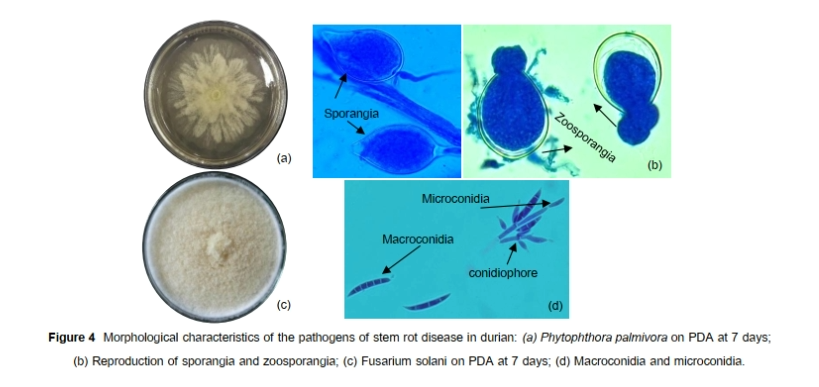
Stem rot disease spreading in durian causes severe damage to durian trees. The spread of the disease can cause durian trees to die. Therefore, it is necessary to find ways to prevent and eliminate stem rot disease in durian plantations. This research aims to develop a Trichoderma cream formulation to control the repeated dissemination of stem rot disease in durian plantations in the eastern region. The study was conducted by collecting samples of stem rot disease in durian, dentifyingthe pathogenic fungi and Trichoderma fungi, and morphologically classifying the fungi. It was found that the cause of the disease was Phytophthora palmivora and Fusarium solani, while the Trichoderma fungus was classified by molecular biology as T. asperellum. Then, it was tested for initial efficacy using a dual-culture test, which found that T. asperellum could inhibit the hyphal growth of P. palmivora and F. solani at 79.8 and 88.7 percent, respectively. After that, the percentage of stem rot disease occurrence in durian was tested after applying the Trichoderma cream, the chemical metalaxyl and fosetyl-aluminium. It was found that the Trichoderma cream reduced disease occurrence to only 25 percent (dry and non-spreading lesions), while the chemical method with metalaxyl and fosetyl-aluminium resulted in a high percentage of disease occurrence, up to 94 and 96 percent (spreading lesions without drying). This indicates that the use of chemical substances such as metalaxyl and fosetyl-aluminium cannot control stem rot disease in durian trees. Therefore, the development of a Trichoderma cream formulation may be one way to reduce the problem of repeated dissemination of stem rot disease in durian plantations in the eastern region. Alternatively, if chemical substances are to be used for treatment, other chemical groups should be tested to replace the current group.
Article Details

This work is licensed under a Creative Commons Attribution-NonCommercial-NoDerivatives 4.0 International License.
The content and information in the article published in Journal of Rajamangala University of Technology Srivijaya It is the opinion and responsibility of the author of the article. The editorial journals do not need to agree. Or share any responsibility.
References
Abad, R.G. and Cruz, K.J.T. 2013. Incidence of Phytophthora fruit rot on four durian cultivars in Davao city, Philippines. Acta Horticulture 1006: 35-39.
Anupama, C., Binu, C., Nair, T., Suma, B. and Balasudaran, M. 2009. RAPD characterization of Corticium salmonicolor causing pink disease of trees. Indian Journal of Forestry 32(4): 591-594.
Booth, C. 1971. The Genus Fusarium. The Eastern Press Limited, London.
Brasileiro, B.T.R.V., Coimbra, M.R.M., Morais, J.M.A. and Oliveira, N.T. 2004. Genetic variability within Fusarium solani species as revealed by PCR-fingerprinting based on PCR markers. Brazilian Journal of Microbiology 35(3): 205-210.
Chacon, M.G., Caicedo, E. and Ordonez, M.E. 2022. Sensitivity to metalaxyl, mefenoxam, and cymoxanil in Phytophthora andina isolates collected from tree tomato (Solanum betaceum) in Ecuador. Tropical Plant Pathology 47: 786-794.
Chantarasiri, A. and Boontanom, P. 2021. Fusarium solani and Lasiodiplodia pseudotheobromae, fungal pathogens causing stem rot disease on durian trees (Durio zibethinus) in Eastern Thailand. New Disease Reports 44(1): e12026.
Chataisiri, K., Pongpisutta, R., Rattanakreetakul, D. and Bincader, S. 2018. Pythium sp. causing rot of durian and efficacy of chemical fungicides to control. Agriculture Science Journal 49(Suppl.): 171-174. (in Thai)
Chi, N.M., Thu, P.Q., Nam, H.B., Quang, D.Q., Phong, L.V., Van, N.D., Trang, T.T., Kien, T.T., Tam, T.T.T. and Dell, B. 2020. Management of Phytophthora palmivora disease in Citrus reticulata with chemical fungicides. Journal of General Plant Pathology 86(6): 494-502.
Deising, H.B., Reimann, S. and Pascholati, S.F. 2008. Mechanisms and significance of fungicide resistance. Brazilian Journal of Microbiology 39(2): 286-295.
Dennis, C. and Webster, J. 1971. Antagonist properties of species group of Trichoderma; Production of volatile antibiotics. Transactions British Mycological Society 57(1): 25-39.
Drenth, A. and Guest, D. 2004. Diversity and management of Phytophthora in Southest Asia. Australian Centre for International Agricultural Research. Australian.
Elansky, S., Apryshko, V.P., Milyutina, D.I. and Kozlovsky, B.E. 2007. Resistance of Russian strains of Phytophthora infestans to fungicides metalaxyl and dimethomorph. Moscow University Biological Sciences Bulletin 62(1): 11-14.
Intana, W., Issarakraisila, M., Sattasakulchai, S., Yenjit, P. and Suwanno, T. 2007. Efficacy of Trichoderma harzianum mutant strains on mycelial growth inhibition and Phytophthora palmivora population reduction in durian orchard. Kamphaengsaen Academic Journal 5(3): 1-9. (in Thai)
Kongtragoul, P., Ishikawa, K. and Ishii, H. 2021. Metalaxyl resistance of Phytophthora palmivora causing durian diseases in Thailand. Horticulturae 7(10): 375.
Koohapitagtam, M. 2016. Research Reports on characterization of morphology and pathogenicity of Phytophthora palmivora a causal agent of root rot and stem rot of durian in Thailand. Burapha University. (in Thai)
Kwangtid, P. and Sangchote, S. 2002. Management of fruit of durian (Durio zibethinus Murr.) caused by Phytophthora palmivora (Butler) Butler. Agriculture Science Journal 33(6): 45-48. (in Thai)
Nianwichai, P., Tongsri, V., Taraput, N., Srisopha, W., Sichai, K., Bussbong, N., Songkumarn, P. and Koohapitagtam, M. 2022. Macozeb resistance of Phytophthora palmivora, a causal agent of stem rot and leaf blight of durian in eastern Thailand. King Mongkut’s Agriculture Journal 40(3): 225-235. (in Thai)
Oszust, K., Pylak, M. and Frac, M. 2021. Trichoderma-based biopreparation with prebiotics supplementation for the naturalization of raspberry plant rhizosphere. International Journal of Molecular Sciences 22(12): 6356.
Piasai, R., Chalmers, P., Piasai, O. and Khewkhom, N. 2021. Postharvest fungicide dips to control fruit rot of ‘Monthong’ durian (Durio zibethinus). European Journal of Plant Pathology 160: 325-336.
Pongpisutta, R., Ratanakreetakul, C., Bincader, S., Chatchaisiri, K. and Boonruangrod, P. 2020. Detection of fungal pathogen causing durian dieback disease. Khon Kaen Agriculture Journal 48(4): 703-714. (in Thai)
Prommate, A., Valyasevi, S., Arunothayanan, H., Megovern, R.J., Cheewankoon, R. and To-anun, C. 2019. Antagonistic activities of Chaetomium spp. on Phytophthora palmivora (P-05) from durian root and stem rot. Khon Kaen Agriculture Journal 47(6): 1251-1264. (in Thai)
Thongbansai, P., Thongkamngam, T. and Jaenaksorn, T. 2016. Study on antagonistic activity of Trichoderma sp. for controlling Curvularia lunata the causal agent of dirty panicle in rice (Oryza sativa L.). Agriculture Science Journal 47(3): 59-62. (in Thai)
Thongkamngam T. and Anutrakunchai, S. 2019. Survey and collection the fungal pathogen of durian in Chanthaburi province. pp.117-122. In Proceedings of 3nd International Symposium on Agricultural Technology and 17th International Symposium on Biocontrol and Biotechnology. King Mongkut's Institute of Technology Ladkrabang, Bangkok.
Thongkamngam, T., Koohakan, P. and Jaenaksorn, T. 2013. In vitro assessment of antagonistic efficacy of Trichoderma isolates against Fusarium oxysporum f. sp. lactucae incitant of wilt on hydroponically grown lettuce. King Mongkut’s Agriculture Journal 31(3): 57-67. (in Thai)
Vawdrey, L.L., Langdon, P. and Martin, T. 2005. Incidence and pathogenicity of Phytophthora palmivora and Pythium vexans associated with durian decline in far northern Queensland. Australasian Plant Pathology 34(1): 127-128.
Vinale, F., Sivasithamparam, K., Ghisalberti, E.L., Marra, R., Woo, S.L. and Lorito, M. 2008. Trichoderma plant pathogen interactions. Soil Biology and Biochemisty 40(1): 1-10.
White, T.J., Bruns, T.D., Lee, S.B. and Taylor, J.W. 1990. Amplification and direct sequencing of fungal ribosomal RNA genes for phylogenetics: PCR Protocols a Guide to Methods and Applications. Academic Press, New York.
Zhu, G., Huang, F., Feng, L., Qin, B., Yang, Y., Hen, Y. and Lu, X. 2008. Sensitivities of Phytophthora infestans to metalaxyl, cymoxanil, and dimethomorph. Agricultural Sciences in China 7(7): 831-840.
