
Puffed Brown Rice from Hom Chaiya using Heated Plate: Composition and Glycemic Index
Article Sidebar
Main Article Content
Abstract
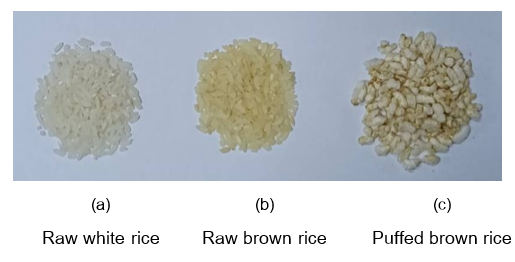
The purpose of this research was to determine the proximate composition of Hom Chaiya rice, and glycemic index (GI) and glycemic load (GL) using in vitro starch digestion model of puffed brown rice from Hom Chaiya produced with a heated plate. The moisture content was found to be greater in raw white rice (14.40%) and raw brown rice (13.80%) than that in puffed brown rice (4.07%). Raw brown rice and puffed brown rice contained significantly (p<0.05) higher levels of protein, fat, dietary fiber, and ash contents of 8.69-8.76%, 2.76-2.87%, 3.65-3.89%, and 1.16-1.25%, respectively - than raw white rice, which contained 8.05% 1.30%, 2.28%, and 0.70%, respectively. The carbohydrate content of puffed brown rice (79.6%) was higher than that of raw white rice (73.27%) and raw brown rice (69.50%). Cooked white rice contained 85.21% starch, which was higher than that in cooked brown rice (78.98%) and puffed brown rice (82.11%). Puffed brown rice showed a slower starch digestion rate than both cooked white rice and cooked brown rice. The GI value of puffed brown rice was 75.43, lower than that of cooked white rice (97.00) and cooked brown rice (89.89). In addition, the GL value of puffed brown rice was 18.27, lower than that of cooked white rice (40.32) and cooked brown rice (45.30). Therefore, consumption of Hom Chaiya puffed brown rice is likely to be beneficial for individuals seeking to control blood sugar level based on its GI and GL values.
Article Details

This work is licensed under a Creative Commons Attribution-NonCommercial-NoDerivatives 4.0 International License.
The content and information in the article published in Journal of Rajamangala University of Technology Srivijaya It is the opinion and responsibility of the author of the article. The editorial journals do not need to agree. Or share any responsibility.
References
AOAC. 2016. Official Methods of Analysis of AOAC International (20th ed). Gaithersburg, USA.
Bupata, C., Pathaveerat, S. and Sanchatjate, P. 2020. Study on puffing of rice using a rice cake machine. Thai Society of Agricultural Engineering Journal 26(2): 37-46. (in Thai)
Chooklin, S., Muadsri, T. and Purintrapibal P. 2017. Nutritional values of Trang indigenous brown rice. Rajamangala University of Technology Srivijaya Research Journal 12(2): 285-296. (in Thai)
Goñi, I., Garcia-Alonso, A. and Saura-Calixto, F. 1997. A starch hydrolysis procedure to estimate glycemic index. Nutrition Research 17(3): 427-437.
Itagi, H., Sartagoda, K.J.D., Pratap, V., Roy, P., Tiozon, R.N., Regina, A. and Sreenivasulu, N. 2023. Popped rice with distinct nutraceutical properties. LWT - Food Science and Technology 173: 114346.
Kaur, B., Ranawana, V. and Henry, J. 2016. The glycaemic index of rice and rice products : A review, and table of GI values. Critical Reviews in Food Science and Nutrition 56: 215-236.
Kaewkaenkoon, K., Pattamang, W., Pang-On, N., Lapjit, F.P., Phumchantuk, P., Borisutdhi, Y. and Choenkwan, S. 2017. In-situ rice genetic conservation through local communities : A lesson on conservation in Northeast Thailand. Khon Kaen Agriculture Journal 45 (Suppl. 1): 1528-1533. (in Thai)
Luh, B.S., Barber, S. and Benedito de Barber, C. 1991. Rice bran : Chemistry and technology, pp. 732-781. In Luh, B.S., ed. Rice utilization. Springer Publishers, New York.
Na-Nakorn, K., Kulrattanarak, T., Hamaker, B.R. and Tongta, S. 2019. Starch digestion kinetics of extruded reformed rice is changed in different ways with added protein or fiber. Food and Function 10(8): 4577-4583.
Panlasigui, L.N. and Thompson, L.U. 2006. Blood glucose lowering effects of brown rice in normal and diabetic subjects. International Journal of Food Sciences and Nutrition 57(3-4): 151-158.
Phanruang, S., Thongnoi, P. and Buabdee, O. 2022. Development of rice germ powder fortified protein. PSRU Journal of Science and Technology 7(1): 129-139. (in Thai)
Rattanadet, W. 2019. Impact of germination on the chemical profile of HomChaiya Rice Wort and Beer. Master of Science, Prince of Sonkgla University, Hatyai Campus.
Sangkod, U., Junrod, K., Aiamsaard, K., Thampitak, K. and Hwanhlem, N. 2021. Chemical characteristics of rice bran and its growth enhancement of probiotic Pediococcus acidilactici V202. Naresuan Agriculture Journal 18(2): 1-11. (in Thai)
Segnini, S., Pedreschi, F. and Dejmek, P. 2004. Volume measurement method of potato chips. International Journal of Food Properties 7(1): 37-44.
Sethupathy, P., Suriyamoorthy, P., Moses, J.A. and Chinnaswamy, A. 2020. Physical, sensory, in-vitro starch digestibility and glycaemic index of granola bars prepared using sucrose alternatives. International Journal of Food Science & Technology 55(1): 348-356.
Sivakamasundari, S.K., Priyanga, S., Moses, J.A. and Anandharamakrishnan, C. 2021. Impact of processing techniques on the glycemic index of rice. Critical Reviews in Food Science and Nutrition 62(12): 3323-3344.
Somkeatkun, W. and Ruengdet, K. 2020. The farming promotion approaches of local Chaiya native rice in Chaiya district, Suratthani province. Journal of Liberal Arts and Management Science Kasetsart University 7(2): 37-53. (in Thai)
Sonsomboonsuk, S., Junyusen, T., Moolkaew, P., Junyusen, P., Treeamnuk, T., Taengsopha, P., Chatchavanthatri, N., Nawong, S. and Pakawanit, P. 2024. Effects of cooking methods on the physicochemical, textural and microstructural properties of hot salt puffed germinated brown rice. Journal of Agriculture and Food Research 15: 101001.
Sopade, P.A. and Gidley, M.J. 2009. A Rapid in-vitro digestibility assay based on glucometry for investigating kinetics of starch digestion. Starch/Stärke 61(5): 245-255.
Thai Industrial Standards Institute. 2019. OTOP Standard 743/2019 Puffed rice. Ministry of Industry. (in Thai)
Venkatachalam, K. and Charoenphun, N. 2023. Influence of Pomelo (Citrus maxima) Pericarp essential oil on the physicochemical properties of HomChaiya rice (Oryza sativa L. cv. HomChaiya) flour-derived edible films. Membranes 13(4): 435.
Venn, B.J. and Green, T.J. 2007. Glycemic index and glycemic load: measurement issues and their effect on diet-disease relationships. European Journal of Clinical Nutrition 61(Suppl. 1): s122-s131.
Wongpiyachon, S., Songchitsomboon, S., Wasusun, A., Sukviwat, W. and Maneenin, P. 2017. Glycemic index of 12 Thai rice varieties. Thai Rice Research Journal 8(2): 54-69. (in Thai)
Zhiqiang, J., Fenglin, B., Yanbin, C. and Bianxia, B. 2019. Interactions between protein, lipid and starch in foxtail millet flour affect the in vitro digestion of starch. CyTA-Journal of Food 17(1): 640-647.