
Study of Adhesion Force Between Rubber Pins and Concrete Slats
Article Sidebar
Main Article Content
Abstract
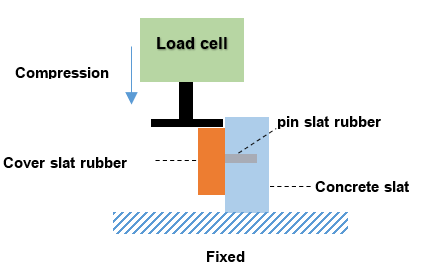
This investigation focused on the adhesion between rubber pins and concrete slats by creating a rubber material and testing the adhesion between natural rubber pins and concrete slats. The pin features 15 distinct contact areas and densities. The adhesion of the rubber pin to the slat was then evaluated using both pulling and pressing force. The size of the contact area and the thickness of the rubber pins were found to result in a strong bond between the rubber pins and the slat concrete. The finite element method was used to calculate the reaction force between different types of rubber pins and concrete slats. When calculating the theoretical holding force, it was found that the theoretical holding force tended to correspond with the experimental results. Consequently, the cohesive force between the rubber pin and the concrete slat is a result of the reaction force. The force increases when the contact area, thickness, and mechanical properties of the rubber pin material are enhanced. This study determines the reaction force between the rubber pin and the concrete slat using the finite element method, which can be utilized to predict the adhesion between rubber fasteners and concrete slats in order to design animal pen slabs.
Article Details

This work is licensed under a Creative Commons Attribution-NonCommercial-NoDerivatives 4.0 International License.
The content and information in the article published in Journal of Rajamangala University of Technology Srivijaya It is the opinion and responsibility of the author of the article. The editorial journals do not need to agree. Or share any responsibility.
References
Carroll, G.A., Boyle, L.A., Teixeira, D.L., Van Staaveren, N., Hanlon, A. and O’Connell, N.E. 2016. Effects of Scalding and Dehairing of Pig Carcasses at Abattoirs on The Visibility of Welfare-Related Lesions. Animal 10(3): 460-467.
Chookate, A. 2019. Properties Improvement and Cost Reduction of Artificial Slatted Woods from Reclaimed Natural Rubber/ Ethylene-Vinyl Acetate Blends. Master degree of Science (Polymer Science and Technology), Faculty of Science, Department of Polymer Science and Technology, Prince of Songkla University. (in Thai)
EASYFIX Equine Persse Business Park Perssepark Ballinasloe Co. 2021. Galway, Ireland. SR Slat Rubber. Available Source: https://easyfix.com/product/sr-slat-rubber/, March 12, 2021.
Ferdinand, P.B., Elwood, R.J.Jr., John, T.D., David, F.M. and Sanjeev, S. 2017. Mechanics of materials (5thed). McGraw-Hill Publishers, New York.
Industrial Standards Institute, Ministry of Industry. 2013. Industrial product standards for animal pen floor mats. TIS 2041 - 2013. Government Gazette page10, vol. 130, special part 52 d. (date April 26, 2013). (in Thai)
Jaborek, J.R., Lowe, G.D. and Fluharty, F.L. 2016. Effects of Pen Flooring Type and Bedding on Lamb Growth and Carcass Characteristics. Small Ruminant Research 144: 28-34.
Kaewpa, P., Tepvisut, R. and Pechurai, W. 2019. Effect of Carbon Black/CaCO3 Ratio on Mechanical Properties of Nature Rubber Stall Mat, pp. 989-997. In The 13th Research Administration Network of Conference. Chiangmai University, Chiangmai Grandview Convention Center. (in Thai)
Kaewsakul, W., Jandam, N., Kalkornsurapranee, E., Saiwari, S. and Thitithammawong, A. 2016. High Modulus Rubber Vulcanizates from Natural Rubber/EVA Blends Filled with Reinforcing Fillers. Advanced Materials Research 1134: 171-177.
KilBride, A., Gillman, C., Ossent, P. and Green, L. 2009. Impact of Flooring on The Health and Welfare of Pigs. In Practice 31(8): 390-395.
Linden, J. 2013. Advice on Floor Types and Maintenance to Reduce Leg Problems and Improve Health and Hygiene in no. 37 in the ‘Action for Productivity’ series from BPEX. Available Source: https://www.thepigsite.com/articles/flooring, March 12, 2021.
Mack, L.A., Lay Jr, D.C., Eicher, S.D., Johnson, A.K., Richert, B.T. and Pajor, E.A. 2014. Group Space Allowance has Little Effect on Sow Health, Productivity, or Welfare in A Free-Access Stall System. Journal of Animal Science 92(6): 2554-2567.
Mekbungwan, A., Yothinsirikul, W. and Khanthaprab, S. 1994. Research Report on Effects of Floors Types on The Growth Performance in Growing Pigs. (weight 10-30 kg.). Maejo Institute of Agricultural Technology, Maejo University. (in Thai)
Panivivat, R., Kegley, E.B., Pennington, J.A., Kellogg, D.W. and Krumpelman, S.L. 2004. Growth Performance and Health of Dairy Calves Bedded with Different Types of Materials. Journal of Dairy Science 87(11): 3736-3745.
Penev, T., Miteva, C., Dimova, V., Roydev, R., Mitev, J. and Manolov, Z. 2013. Assessing frictional properties of rubber floors in free housing systems for dairy cows. Trakia Journal of Sciences 2: 197-204.
Plastics Institute of Thailand. 2014. Rubber Intelligence Unit. Office of Industrial Economics. Available Source: http://www.oie.go.th, March 16, 2022.
Russell, C.H. 2010. Engineering Mechanics Dynamics (12thed). Pearson Prentice Hall Publishers, New Jersey.
Sarnklong, C., Puangchomphu, O., Wasupen, K. and Witthayakun, S. 2004. Effect of Beeding Types on Milk Yield, Milk Quality and Health in Dairy Cows. Journal of Veterinary Medicine 14(1): 70-80. (in Thai)
Suso, P. 2011. Mechanical Properties of Plastic Tertiary Blends High Density Polyethylene, Low Density Polyethylene and Polypropylene. Master degree of Engineering (Manufacturing Engineering), Faculty of Engineering, Department of Industrial Engineering. Rajamangala University of Technology Thanyaburi. (in Thai)
Telezhenko, E., Bergsten, C., Magnusson, M., Ventorp, M. and Nilsson, C. 2008. Effect of different flooring systems on weight and pressure distribution on claws of dairy cows. Journal of Dairy Science 91(5): 1874-1884.
