
A Study on the Optimum Conditions for Producing Bacterial Cellulose and Its Antioxidant Properties from Mulberry Pomace by Acetobacter xylinum
Article Sidebar
Main Article Content
Abstract
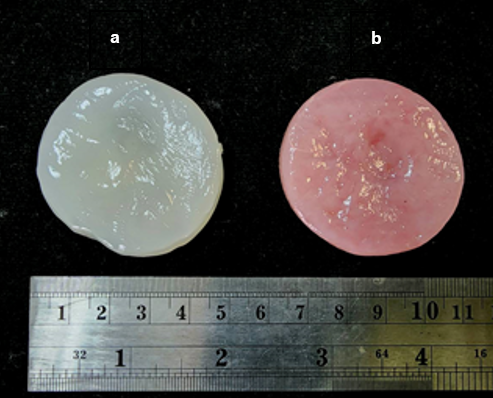
Nata de Coco or cellulose produced by bacteria that create cellulose can be applied in various food applications. The objectives of this research were to study the optimal conditions for producing cellulose from mulberry pomace leftover from agricultural processing using Acetobacter xylinum strain and to study the antioxidant properties, comparing with cellulose from coconut juice. The experiment results showed that the optimal conditions for producing cellulose from mulberry pomace were an inoculum amount of 10% (v/v), a pH of 4.0 and incubation at 30 degrees Celsius for 14 days, whcih yielded the highest cellulose production. This was compared to cellulose production using coconut juice, which yield at 19.5±0.19 and 16.7±0.95 g/100 mL, respectively. A total soluble solids content was showed at 9.20±0.17 and 5.03±0.06 °Brix, respectively. When analyzing the physical quality of cellulose from mulberry pomace and coconut juice, it was found that cellulose from mulberry pomace had a significantly higher red color value (a*) with a statistical difference level of (p<0.05). The gel strength of cellulose from mulberry pomace was higher than that from coconut juice, measuring 28.27±0.35 and 19.67±0.37 newtons, respectively. Additionally, cellulose from mulberry pomace contained total monomeric anthocyanin at 853.09±5.37 mg equivalent to cyanidin-3-glucoside per 100 g of dry weight, total phenolic compound content at 131.16±0.466 mg equivalent to gallic acid per 100 g of dry weight, and total flavonoids at 214.0±0.37 mg equivalent to catechin per 100 grams of dry weight, and exhibited antioxidant properties (DPPH) with an IC50 value of 3.63±0.51 mg/mL..
Article Details

This work is licensed under a Creative Commons Attribution-NonCommercial-NoDerivatives 4.0 International License.
The content and information in the article published in Journal of Rajamangala University of Technology Srivijaya It is the opinion and responsibility of the author of the article. The editorial journals do not need to agree. Or share any responsibility.
References
AOAC. 2002. Official method of analysis of AOAC international (17thed). Horwitz, Willium: Association of official analytical chemistrs. Inc.
Asami, D.K., Hong, Y.J., Barrett, D.M. and Mitchell, A.E. 2003. Comparison of the total phenolic and ascorbic content of freeze-dried and air dried marionberry, strawberry and corn grown using conventional, organic and sustainable agricultural practices. Journal of Agricultural and Food Chemistry 51: 1237-1241.
Bunyakorn, M. 2017. Production of Nata de Coco for processing of a gac drink mixed with nata de coco and dehydrated sweetened nata de coco. KKU Science Journal 45(3): 501-512. (in Thai)
Chemama, T., Pumas, C., Tragoolpua, Y. and Thongwai, N. 2020. Feasibility study for D-Lactic acid production from Thai Rice by Leuconostoc pseudomesenteroides TC49 and D-Lactic acid purification. Chaing Mai Journal of Science 47(3): 403-417.
Çoban, E.P. and Biyik, H. 2011. Effect of various carbon and nitrogen sources on cellulose synthesis by Acetobacter iovaniensis HBB5. African Journal of Biotechnology 10(27): 5346-5354.
Dejsakungkranont, M. 2018. A study on the optimum condition for bacterial cellulose production from red dragon fruit (Hylocereus polyrhizus (Weber) Britton & Rose) using response surface methodology. Khon Kaen Agriculture Journal 46(2): 213-226. (in Thai)
Du, H., Yang, H., Wang, X., Zhu, F., Tang, D., Cheng, J. and Liu, X. 2021. Effect of mulberry pomace on physicochemical and textural properties of stirred-type flavored yogurt. Journal of Dairy Science 104(12): 12403-12414.
Ercisli, S. and Orhan, E. 2007. Chemical composition of white (Morus alba), red (Morus nigra) mulberry fruit. Food Chemistry 103(4): 1380-1384.
Jagannath, A., Kalaiselven, A., Manjunatha, S.S., Raju, P.S. and Bawa, A.S. 2008. The effect of pH sucrose and ammonium sulphate concentrations on the production of bacterial cellulose (Nata De Coco) by Acetobacter xylinum. World Journal of Microbiology and Biotechnology 24(11): 2593-2599.
Jaturapiree, A., Chaichana, E., Saowapark, T., Chuenpraphai, B. and Jaturapiree, P. 2019. Production and characterization of bacterial cellulose produced by Acetobacter xylinum TISTR 975 from Pineapple peel juice. RMUTP Research Journal 13(1): 180-192. (in Thai)
Kanklai, J., Somwong, C.T., Rungsirivanich, P. and Thongwai, N. 2021. Screening of GABA-producing lactic acid bacteria from Thai fermented foods and probiotic potential of Levilactobacillus brevis F064A for GABA-fermented mulberry juice production. Microorganisms 9(33): 1-17.
Khemacheewakul, J. 2017. Factors affecting production of cellulose by Acetobacter sp. and fermentation technology. RMUTSB Academic Journal 5(1): 91-103. (in Thai)
Kim, D.K., Jeong, S.W. and Lee, C.Y. 2003. Antioxidant capacity of phenolic phytochemicals from various cultivars of plums. Food Chemistry 81(3): 321-326.
Lapuz, M.M., Gallardo, E.G. and Palo, M.A. 1967. The nata organism cultural requirement, characteristics and identity. Philippine Journal of Science 96(2): 91-108.
Leelahemaratana, S. and Tongchitpakdee, S. 2021. Chemical composition and radical scavenging activity of mulberry pomace, pp. 548-555. In Proceedings of 49th Kasetsart University Annual Conference, Agro-Industry. Kasetsart University, Bangkok. (in Thai)
Li, Y., Tao, F., Cui, K., Song, Y., Nan, L., Cui, C., Li, Y., Yang, J., Wang, Y. and Jiang, L. 2020. Optimization of ultrasonic extraction of anthocyanin in mulberry residue by response surface methodology, pp. 559-569. In The 3rd International Conference on Agricultural and Food Science. IOP Conference series: earth and environmental science, Malaysia.
Mesomya, W., Pakpeankitvatana, V., Komindr., P., Cuptapun, Y., Hengsawadi, D., Tammarate, P. and Tangkanakul, P. 2006. Effects of health food from cereal and Nata De Coco on serum lipids in human. Songklanakarin Journal of Science and Technology 28(1): 23-28.
Ninwadee, K., Srijumpa, S., Tippayawat, P. and Kraiklang, R. 2022. Effect of crude extracts from mulberry and gac fruit aril to inhibiting of interleukin 1 and interleukin 6 secretion. Khong Khan University Journal for Public Health Research 1(4): 44-55. (in Thai)
Pannongwha, W., Jampamee, N., Sakulnamrat, K., Tumthong, P., Doangsri, K. and Mungngam, A. 2013. Comparison of important chemical composition and antioxidant activities of mulberry fruits provided from three varieties. RMUTI Journal 6(2): 69-82. (in Thai)
Pawloska, A.M., Oleszek, W. and Braca, A. 2008. Quali-quantitive analyses of flavonoids of Morus nigra L. and Morus alba L. (Moraceae) fruits. Journal of Agricultural and Food Chemistry 56(9): 3377-3380.
Pham, T.T. and Tran, A.T.T. 2023. Evaluation of the crystallinity of bacterial cellulose produced from pineapple waste solution by using Acetobacter xylinum. Asean Engineering Journal 13(2): 81-91.
Phromthep, K., Katakul, S., Tokhamolthom, J., Thaisong, N.P. and Thaweeseang, N. 2018. Production of bacterial cellulose from mangosteen pericarp juice. RMUTP Research Journal 9(2): 169-177. (in Thai)
Promwongpo, C., Yokhanit, W. and Khemacheewakul, J. 2018. A study of the optimal fermentation conditions for Nata de Coco production by Acetobacter xylinum TISTR 975 from Mango juice. KMUTT Research and Development Journal 40(2): 271-282. (in Thai)
Ranghunathan, D. 2013. Production of Microbial Cellulose from the new bacterial strain isolated from Temple wash water. International Journal of Current Microbiology and Applied Sciences 2(12): 275-290.
Rattana, T. and Saengsanga, T. 2020. Antioxidant and anti-food pathogen properties in food from Mycelium culture of wild mushroom. Thai Science and Technology Journal 28(12): 2249-2260. (in Thai)
Roskhrua, P. and Kitchaicharoen, M. 2020. Effect of sugar, citric acid and pectin content on quality of Mulberry fruit leather product. RMUTT Research Journal 14(1): 59-69. (in Thai)
Samappito, J., Boonchalad, P. and Tabthaisong, O. 2023. The production of bacterial cellulose from sweet fermented broken black glutinous rice. The Journal of KMUTNB 33(2): 248-562. (in Thai)
Son, H.J., Heo, M.S., Kim, Y.G. and Lee, S.J. 2001. Optimization of fermentation conditions for the production of bacterial cellulose by newly isolated Acetobacter sp. A9 in shaking cultures. Biotechnology and Applied Biochemistry 33(1): 1-5.
Son, H.J., Kim, H.G., Kim, K.K., Kim, H.S., Kim, Y.G. and Lee, S.J. 2003. Increased production of bacterial cellulose by Acetobacter sp. V6 in synthetic media under shaking culture conditions. Bioresource Technology 86(3): 215-219.
Talawar, S., Narayanswamy, B. and Ravindra, S.N. 2015. Optimization of fermentation conditions for Nata-de Coco production. Journal of Pure Applied Microbiology 9(1): 335-340.
Zhang, L., Zhang, C., Wei, Z., Huang, W., Yan, Z., Luo, Z., Beta, T. and Xu, X. 2023. Effects of four drying methods on the quality, antioxidant activity and anthocyanin components of blueberry pomace. Food Production, Processing and Nutrition 35(5): 1-14.
