Effects of Boiling and Drying Conditions on the Quality of Pra Seed (Elateriospermun tapos Blume)
Article Sidebar
Main Article Content
Abstract
The experiment was conducted to determine the effect of different boiling and drying conditions on the quality of Pra seed (Elateriospermun tapos Blume). The conditions examined the concentration of the solution used for boiling (2% sodium chloride and 0%, 0.5%, 1.0%, and 1.5% citric acid), boiling time (15, 20, and 30 minutes), and drying temperature (60, 80, and 100 oC). The objective was to identify the optimal process for producing dried Pra seed.
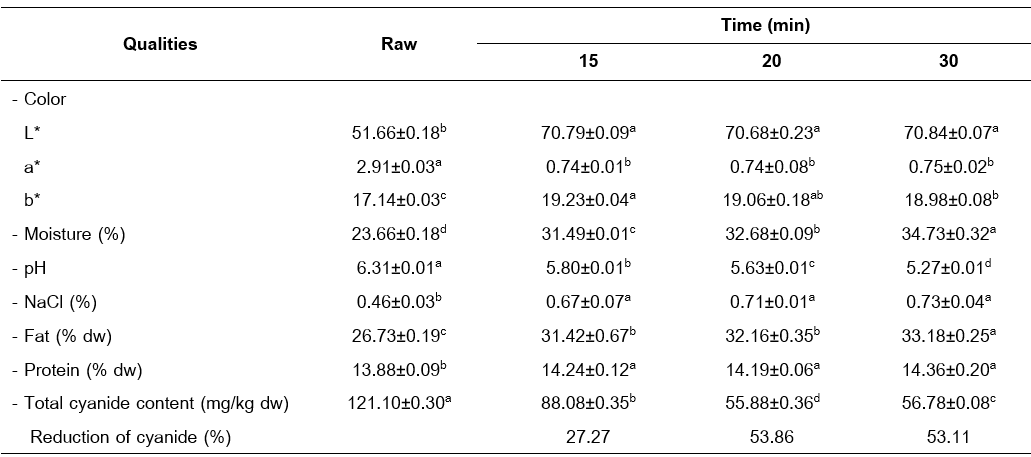
The findings indicated that the concentration of the boiling solution, boiling time, and drying temperature significantly affected the color, moisture, fat, and protein content change and reduced the total cyanide content in Pra seed (p<0.05). The optimal method for producing dried Pra seed involved boiling the seed in a solution consisting of 2% salt and 1% citric acid (w/v). The ratio of Pra seed to solution was 1:5 (w/v). The boiling process occurred at a temperature of 90±5 ๐C for 20 minutes. Subsequently, the seed was dried in a tray dryer at 80 ๐C for 210 minutes. The dried Pra seed had a higher L* value and fat content, lower moisture content, and total cyanide content than raw Pra seed. The moisture content of the dried Pra seed was 3.78%, while the fat and protein contents were 29.43% and 14.10% of the dry weight, respectively. It had a total cyanide content of 47.79 mg/kg dry weight. Additionally, it contained phenolic content of 46.52 mg gallic acid equivalents per 100 g dry weight, DPPH radical scavenging capacity of 8.83 mg ascorbic acid equivalents per 100 g dry weight, and ferric reducing antioxidant power of 5.92 mg gallic acid equivalents per 100 g dry weight. These findings indicated that the dried Pra seed produced was high-quality, safe, and suitable for consumption.
Article Details

This work is licensed under a Creative Commons Attribution-NonCommercial-NoDerivatives 4.0 International License.
The content and information in the article published in Journal of Rajamangala University of Technology Srivijaya It is the opinion and responsibility of the author of the article. The editorial journals do not need to agree. Or share any responsibility.
References
AOAC. 2000. Official methods of analysis of AOAC international (17thed). AOAC International, Arlington.
Bolarinwa, I.F., Orfila, C. and Morgan, M.R.A. 2015. Determination of amygdalin in apple seeds, fresh apples and processed apple juices. Food Chemistry 170: 437-442.
Benzie, I.F.F. and Strain, J.J. 1996. The ferric reducing ability of plasma (FRAP) as a measure of antioxidant power : The frap assay. Analytical Biochemistry 239(1): 70-76.
Bhoyen, K. and Suwonsichon, S. 2013. Effects of blanching and acid treatments on chemical and physical properties of Jerusalem artichoke powder. pp.178-185. In The 51st Kasetsart University Annual Conference. Kasetsart University, Bangkok. (in Thai)
Charoenphun, N. and Meemuk, N. 2018. Effects of different blanching methods on quality of orange sweet potatoes. Thai Science and Technology Journal 26(6): 981-992. (in Thai)
Charoensuk, A., Jaroensutasinee, M., Srisang, W. and Jaroensutasinee, K. 2012. Parah forest clusters at Khao Nan national park, Thailand. Walailak Journal of Science and Technology 9(4): 475-480.
Chinnasarn, S. and Krasaechol, N. 2020. Effect of pretreatment and drying conditions on quality of dried Green Caviar product. The Journal of KMUTNB 30(4): 668-677. (in Thai)
Choonhahirun, A. 2010. Proximate composition and functional properties of Pra (Elateriospermun tapos Blume) seed flour. African Journal of Biotechnology 9(36): 5946-5949.
Jaiwunglok, P. 2009. Effects of temperature and pH on taxiphyllin degradation in bamboo shoot. Master thesis (Food Engineering), King Mongkut’s University of Technology Thonburi. (in Thai)
Jantarit, S., Wattanasit, S. and Sotthibandhu, S. 2009. Canopy ants on the briefly deciduous tree (Elateriospermum tapos Blume) in a tropical rainforest, southern Thailand. Songklanakarin Journal of Science and Technology 31(1): 21-28.
Jitnupong, S. 2016. Changes in rights of access and withdrawal in Pra forest, and conflict: A case study of Pra forest, Khao Nan national park, Noppitam district, Nakhon Si Thammarat province. Asian Journal of Arts and Culture 16(1): 115-142. (in Thai)
Kaewsuwan, W. and Nuichan, L. 2018. Effect of blanching time on characteristic of dried Pra seed. pp. 1117-1125. In The 8th Phayao Research Conference. University of Phayao, Phayao. (in Thai)
Kunjaetong, T., Sangnark, A. and Siriwong, N. 2018. Effect of boiling and steaming time of unripen banana on their physicochemical and functional properties, pp. 797-804. In The 56th Kasetsart University Annual Conference. Kasetsart University, Bangkok. (in Thai)
Makpan, W. 2018. Survey of quantity and valuation of Pra at Buddha cave community: A boundary between Nakhon Si Thammarat and Trang provinces. KKU Science Journal 46(2): 317-323. (in Thai)
Mompiboon, P., kaewsuwan, W., Tripatch, A. and Wattananavin, T. 2018. Development of food processing technology from Pra seed (Elateriospermum tapos Blume) for commercial. Wichcha Journal 37: 114-128. (in Thai)
Ngamriabsakul, C.and Kommen, H. 2009. The preliminary detection of cyanogenic glycosides in Pra (Elateriospermum tapos Blume) by HPLC. Walailak Journal of Science and Technology 6(1): 141-147.
Nounmusig, J., Detchphetchtharak, P., Kongthong, J., Pethuan, S. and Yodpijit, S. 2023. Development of alternative milk from Parah seed (Elateriospermum tapos). Wichcha Journal 42(2): 80-93. (in Thai)
O’Brien, G.M., Taylor, A.J. and Pouler, N.H. 1991. Improved enzymatic assay for cyanogen in fresh and processed cassava. Journal of the Science of Food and Agriculture 56(3): 277-289.
Pichairat, D., Mahae, N. and Lohalaksnadech, S. 2016. Research Reports on Nutritional Value and Optimum Condition for the Production of Dried Split Gill (Schizophyllum commune Fr.). Rajamangala University of Technology Srivijaya, Trang. (in Thai)
Pokhariya, P., Tangariya, P., Sahoo, A., Awasthi, P. and Pandey, A. 2018. Reducing hydrocyanic acid content, nutritional and sensory quality evaluation of edible bamboo shoot based food products. International Journal of Chemical Studies 6(4): 1079-1084.
Prakash, A., Vadivel, V., Banu, S.F., Nithyanand, P., Lalitha, C. and Brindha, P. 2018. Evaluation of antioxidant and antimicrobial properties of solvent extracts of agro-food by-products (cashew nut shell, coconut shell and groundnut hull). Agriculture and Natural Resources 52: 451-459.
Rana, B., Awasthi, P. and Kumbhar, B.K. 2012. Optimization of processing conditions for cyanide content reduction in fresh bamboo shoot during NaCl treatment by response surface methodology. Journal of Food Science and Technology. 49(1):10-109.
Rawat, K., Nirmala, C. and Bisht, M.S. 2015. Processing techniques for reduction of cyanogenic glycosides from bamboo shoots, pp. 818-829. In The 10th World Bamboo Congress. World Bamboo, Korea.
Singhal, P., Satya, S. and Naik, S.N. 2021. Fermented bamboo shoots: A complete nutritional, anti-nutritional and antioxidant profile of the sustainable and functional food to food security. Food Chemistry: Molecular Sciences 3: 100041.
Singhal, P., Satya, S. and Naik, S.N. 2022. Effect of different drying techniques on the nutritional, antioxidant and cyanogenic profile of bamboo shoots. Applied Food Research 2: 100036.
Sirijariyawat, A., Phuetsing, S. and Polviluy, C. 2015. Effect of drying temperature on quality of Spirogyra sp. KKU Science Journal 43(3): 459-468. (in Thai)
Siyunglek, M., Techakriengkrai, T. and Siriwong, N. 2019. Preparation and application of dried almond residue for substitution of almond flour in macaron. Thai Science and Technology Journal 28(9): 1572-1584. (in Thai)
Suphamityotin, P. 2018. Drying of carrot pomace and utilization in the bread for improving nutrition values. KKU Science Journal 46(1): 93-101. (in Thai)
Supanpayak, J., Chalermchaiwat, P. and Limsuwan, T. 2020. Effect of drying condition on the quality of Sea Lettuce (Ulva rigida) and its application in crispy snack. KKU Science Journal 48(2): 227-235. (in Thai)
Teerapapthamkul, S., Thongpho, S., Jamsri, W., Promprasit, P., Unahalekhaka, J. and Chinwattanawong, P. 2011. Risk assessment of cyanide in bamboo shoots. Bulletin of the department of medical science 53(2): 67-79. (in Thai)
Thaweewong, P. and Anuntagool, J. 2022. Effect of drying on cyanide content in cassava, pp. 92-100. In The 60th Kasetsart University Annual Conference. Kasetsart University, Bangkok. (in Thai)
Thammachai, K. 2006. Quality of common figs dehydrated by tray dryer. Master thesis (Food Science and Technology), Chiang Mai University. (in Thai)
Yuenyongputtakal, W. 2013. Factors influencing on dewatering by osmotic dehydration of fruits and vegetables. Burapha Science Journal 18(1): 226-223. (in Thai)
Yuenyongputtakal, W., Thimthong, D. and Bangsri, W. 2013. Effect of Pre-treatment Method and Iron Content Enrichment on Sea Lettuce (Ulva rigida) in Osmosis Process. Thai Science and Technology Journal 21(5): 461-473. (in Thai)
Yuenyongputtakal, W., Limroongreungrat, K., Chaipanand, P. and Srimuang, T. 2017. Effect of hot air drying temperature and time on qualities of enoki mushroom (Flammulina velutipes) powder produced from uncommonly consumed part. Thai Science and Technology Journal 25(6): 1001-1014. (in Thai)
Zhang, R., Zeng, Q., Deng, Y., Zhang, M., Wei, Z., Zhang Y. and Tang, X. 2013. Phenolic profiles and antioxidant activity of litchi pulp of different cultivars cultivated in southern China. Food Chemistry 136(3-4): 1169-1176.
Zhang, L., Zhao, M., Chen, J., Wang, M. and Yu, X. 2019. Reduction of cyanide content of bitter almond and its oil using different treatments. International Journal of Food Science and Technology 54: 3083-3090.
