Effect of Tamarind Seed Husk and Sodium Nitrate for Reducing Methane Production in Rumen Fermentation: In vitro studies
Article Sidebar
Main Article Content
Abstract
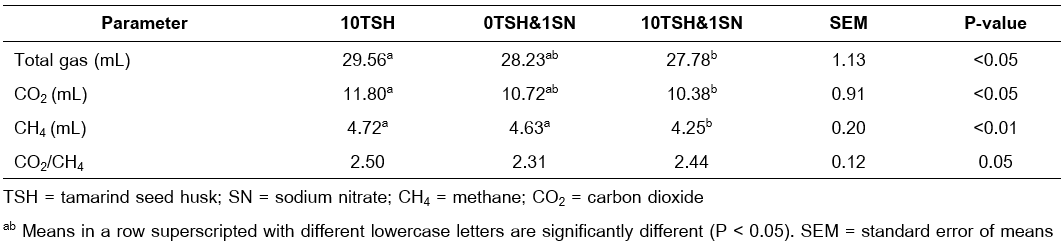
The global warming crisis is partially caused by ruminants through greenhouse gas production when they ferment their feed. The objective of this study was to evaluate tamarind seed husk (TSH) and sodium nitrate (SN) as alternative raw materials in a concentrate diet to reduce methane production in rumen fermentation. The experimental I, concentrate diets were formulated in four types, including no TSH in the diet (0TSH), and diet including 7.5%, 15.0% and 22.5% of TSH (7.5TSH, 15.0TSH and 22.5TSH), respectively. In experimental II, diet types included 10% of TSH (10TSH), 0% of TSH with 1% SN (0TSH&1SN) and 10% of TSH with 1% SN (10TSH&1SN). These concentrates were added in Hungate tubes with rice straw in a 50:50 ratio. Rumen fluid was collected from two rumen-fistulated crossbred Brahman steers and mixed with artificial saliva in a 1:1 ratio. Inoculums were incubated at 39 °C for 24 hours under anaerobic conditions. Gas and fluid were analyzed after incubation. The results of experiment I showed that pH was not different among the diets. However, ammonia nitrogen, microbial protein (MCP), volatile fatty acids, acetate/propionate ratio, dry matter digestibility, total gas, methane, and carbon dioxide production were significantly decreased as the level of tamarind seed husk increased. The results of experiment II found that 10TSH&1SN group had the lowest NH3-N, MCP, total gas, methane and carbon dioxide production. The pH, total SCFA, and A/P ratio did not differ among all diets. In conclusion, TSH could be used in the concentrate diet up to 15% which reducing methane production ability. Using 10% TSH in the concentrate with 1% SN could reduce methane production better than using 10% TSH or 1% SN alone.
Article Details

This work is licensed under a Creative Commons Attribution-NonCommercial-NoDerivatives 4.0 International License.
The content and information in the article published in Journal of Rajamangala University of Technology Srivijaya It is the opinion and responsibility of the author of the article. The editorial journals do not need to agree. Or share any responsibility.
References
Abdelbagi, M., Ridwan, R., Fitri, A. and Jayanegara, A. 2023. Performance, methane emission, nutrient utilization, and the nitrate toxicity of ruminants with dietary nitrate addition: A meta-analysis from in vivo trials. Tropical Animal Science Journal 46(1): 74-84.
Abdelbagi, M., Ridwan, R. and Jayanegara, A. 2021. The potential of nitrate supplementation for modulating the fermentation pattern and mitigating methane emission in ruminants: A meta-analysis from in vitro experiments. IOP Conference Series: Earth and Environmental Science 902(1): 012023.
Adejoro, F.A., Hassen, A., Akanmu, A.M. and Morgavi, D.P. 2020. Replacing urea with nitrate as a non-protein nitrogen source increases lambs' growth and reduces methane production, whereas acacia tannin has no effect. Animal Feed Science and Technology 259: 114360.
Adetunji, A.P., Aderinboye, R.Y., Adebayo, K.O., Ojo, V.O., Idowu, P.A. and Mtileni, B. 2020. Effect of cashew nut shell liquid at varying inclusion levels on rumen fermentation and methane production in vitro. Journal of Animal Behaviour and Biometeorology 8(2): 82-87.
AOAC. 2016. Official Methods of Analysis. Association of Official Analysis Chemists. Maryland, USA.
AOAC. 2019. Official Methods of Analysis. Association of Official Analysis Chemists. Maryland, USA.
Beauchemin, K.A., Ungerfeld, E.M., Eckard, R.J. and Wang, M. 2020. Fifty years of research on rumen methanogenesis: Lessons learned and future challenges for mitigation. Animal 14(S1): s2-s16.
Bhatta, R., Krishnamoorthy, U. and Mohammed, F. 2000. Effect of feeding tamarind (Tamarindus indica) seed husk as a source of tannin on dry matter intake, digestibility of nutrients and production performance of crossbred dairy cows in mid-lactation. Animal Feed Science and Technology 83(1): 67-74.
Bhatta, R., Krishnamoorthy, U. and Mohammed, F. 2001. Effect of tamarind (Tamarindus indica) seed husk tannins on in vitro rumen fermentation. Animal Feed Science and Technology 90(3-4): 143-152.
Bowen, J.M., Cormican, P., Lister, S.J., McCabe, M.S., Duthie, C.A., Roehe, R. and Dewhurst, R.J. 2020. Links between the rumen microbiota, methane emissions and feed efficiency of finishing steers offered dietary lipid and nitrate supplementation. PLoS One 15(4): e0231759.
Bureau of Animal Nutrition Development. 2016. Collection and Improvement in Nutritive Values Database of feed stuffs. Bureau of Animal Nutrition Development, DLD, Bangkok. (in Thai)
Butler, L.G., Price, M.L. and Brotherton, J.E. 1982. Vanillin assay for proanthocyanidins (condensed tannins): modification of the solvent for estimation of the degree of polymerization. Journal of Agricultural and Food Chemistry 30(6): 1087-1089.
Duthie, C.A., Troy, S., Hyslop, J., Ross, D., Roehe, R. and Rooke, J. 2018. The effect of dietary addition of nitrate or increase in lipid concentrations, alone or in combination, on performance and methane emissions of beef cattle. Animal 12(2): 280-287.
EFSA Panel on Contaminants in the Food Chain (CONTAM), Schrenk, D., Bignami, M., Bodin, L., Chipman, J.K., del Mazo, J., Grasl–Kraupp, B., Hoogenboom, L., Leblanc, J., Nebbia, C.S., Nielsen, E., Ntzani, E.,Petersen, A., Sand, S., Schwerdtle, T., Vleminckx, C., Wallace, H., Bampidis, V., Cottrill, B., Frutos, M. J., Furst, P., Parker, A., Binaglia, M., Christodoulidou, A., Gergelova, P., Guajardo, I. M., Wenger, C. and Hogstrand, C. 2020. Scientific Opinion on the risk assessment of nitrate and nitrite in feed. EFSA Journal 18(11): 1-110.
France, J. and Dijkstra, J. 2005. Volatile fatty acid production. Available source: https://WWW.researchgate.net/profile/Andre-Bannink-2/publication/40117257_Rumen_Function/links/02e7e53ad990e71c39000000/Rumen-Function.pdf#page=169, May 13, 2024.
Glasson, C.R., Kinley, R.D., de Nys, R., King, N., Adams, S. L., Packer, M.A., Svenson, J., Eason, C.T. and Magnusson, M. 2022. Benefits and risks of including the bromoform containing seaweed Asparagopsis in feed for the reduction of methane production from ruminants. Algal Research 64: 102673.
Huang, Q., Liu, X., Zhao, G., Hu, T. and Wang, Y. 2018. Potential and challenges of tannins as an alternative to in-feed antibiotics for farm animal production. Animal Nutrition 4(2): 137-150.
Javier-Astete, R., Jimenez-Davalos, J. and Zolla, G. 2021. Determination of hemicellulose, cellulose, holocellulose and lignin content using FTIR in Calycophyllum spruceanum (Benth.) K. Schum. and Guazuma crinita Lam. PLoS One 16(10): e0256559.
Kebreab, E. and Feng, X. 2021. Strategies to reduce methane emissions from enteric and lagoon sources. California Air Resources Board Project.
Khongpradit, A., Boonsaen, P., Homwong, N., Suzuki, Y., Koike, S., Sawanon, S. and Kobayashi, Y. 2020. Effect of pineapple stem starch feeding on rumen microbial fermentation, blood lipid profile, and growth performance of fattening cattle. Animal Science Journal 91(1): e13459.
Lee, C. and Beauchemin, K.A. 2014. A review of feeding supplementary nitrate to ruminant animals: nitrate toxicity, methane emissions, and production performance. Canadian Journal of Animal Science 94: 557-570.
Makkar, H.P.S., Sharma, O.P., Dawra, R.K. and Negi, S.S. 1982. Simple determination of microbial protein in rumen liquor. Journal of Dairy Science 65(11): 2170-2173.
Malik, P.K., Kolte, A.P., Bakshi, B., Baruah, L., Dhali, A. and Bhatta, R. 2017. Effect of tamarind seed husk supplementation on ruminal methanogenesis, methanogen diversity and fermentation characteristics. Carbon Management 8(4): 319-329.
Mansingh, B.B., Binoj, J.S., Sai, N.P., Hassan, S.A., Siengchin, S., Sanjay, M.R. and Liu, Y.C. 2021. Sustainable development in utilization of Tamarindus indica L. and its by-products in industries: A review. Current Research in Green and Sustainable Chemistry 4: 100207.
McDougall, E. 1948. Studies on ruminant saliva. 1. The composition and output of sheep's saliva. Biochemical Journal 43(1): 99.
Naumann, H.D., Tedeschi, L.O., Zeller, W.E. and Huntley, N.F. 2017. The role of condensed tannins in ruminant animal production: advances, limitations and future directions. Revista Brasileira de Zootecnia 46: 929-949.
Newbold, J., Van Zijderveld, S., Hulshof, R., Fokkink, W., Leng, R., Terencio, P., Powers, W.J., van Adrichem, P.S. J., Paton, N.D. and Perdok, H. 2014. The effect of incremental levels of dietary nitrate on methane emissions in Holstein steers and performance in Nelore bulls. Journal of Animal Science 92(11): 5032-5040.
Nolan, J.V., Godwin, I., de Raphélis-Soissan, V. and Hegarty, R. 2016. Managing the rumen to limit the incidence and severity of nitrite poisoning in nitrate-supplemented ruminants. Animal Production Science 56(8): 1317-1329.
Poornachandra, K., Malik, P., Dhali, A., Kolte, A. and Bhatta, R. 2019. Effect of combined supplementation of tamarind seed husk and soapnut on enteric methane emission in crossbred cattle. Carbon Management 10(5): 465-475.
R Core Team. 2024. R: A language and environment for statistical computing. R Foundation for Statistical Computing, Vienna, Austria. Available Source: https://WWW.R-project.org, February 20, 2024.
Sawanon, S. 2018. Rumen microbes and utilization (2nd ed). Magic Publication, Bangkok. (in Thai)
Sun, B., Ricardo-da-Silva, J.M. and Spranger, I. 1998. Critical factors of vanillin assay for catechins and proanthocyanidins. Journal of Agricultural and Food Chemistry 46(10): 4267-4274.
Thai Feed Mill Association. 2024. Monthly Raw Material Price. Available Source: https://WWW.thaifeedmill.org/price-2, March 10, 2024. (in Thai)
Thongngok, M., Jongsathapatsin, Y., Gonmanee, J. and Mangmee, W. 2020. Results of Using Tamarind Seeds Husk in Concentrate Feed Rations towards Late Lactation of Dairy Cattle Productivity Performance. Bachelor of Science (Animal Science), Rajamangala University of Technology Thanyaburi. (in Thai)
Thanomwongwatatana, S. 2018. Effect of Supplementing Tamarind Seed Husk in Ration on Productive Performance of Fattening Dairy Steer, pp. 228-233. In Budiati, T. eds. The Proceeding of the 1st International Conference on Food and Agriculture. State Polytechnic of Jember, Jawa Timur.
van Wyngaard, J., Meeske, R. and Erasmus, L. 2019. Effect of dietary nitrate on enteric methane emissions, production performance and rumen fermentation of dairy cows grazing ryegrass pasture during spring. Animal Feed Science and Technology 252: 64-73.
Vasta, V., Daghio, M., Cappucci, A., Buccioni, A., Serra, A., Viti, C. and Mele, M. 2019. Invited review: Plant polyphenols and rumen microbiota responsible for fatty acid biohydrogenation, fiber digestion, and methane emission: Experimental evidence and methodological approaches. Journal of Dairy Science 102(5): 3781-3804.
Vearaslip, T. 2005. Ruminant Nutrition (5th ed). Trio advertising & media, Chiang Mai. (in Thai)
Villar, M.L., Hegarty, R.S., Nolan, J.V., Godwin, I.R. and McPhee, M. 2020. The effect of dietary nitrate and canola oil alone or in combination on fermentation, digesta kinetics and methane emissions from cattle. Animal Feed Science and Technology 259: 114294.
Wanapat, M., Viennasay, B., Matra, M., Totakul, P., Phesatcha, B., Ampapon, T. and Wanapat, S. 2021. Supplementation of fruit peel pellet containing phytonutrients to manipulate rumen pH, fermentation efficiency, nutrient digestibility and microbial protein synthesis. Journal of the Science of Food and Agriculture 101(11): 4543-4550.
Wang, W., Lund, P., Larsen, M. and Weisbjerg, M.R. 2023. Effect of nitrate supplementation, dietary protein supply, and genetic yield index on performance, methane emission, and nitrogen efficiency in dairy cows. Journal of Dairy Science 106(8): 5433-5451.
Welty, C., Wenner, B., Wagner, B., Roman-Garcia, Y., Plank, J., Meller, R., Gehman, A.M. and Firkins, J. 2019. Rumen microbial responses to supplemental nitrate. II. Potential interactions with live yeast culture on the prokaryotic community and methanogenesis in continuous culture. Journal of Dairy Science 102(3): 2217-2231.
Yang, C., Rooke, J.A., Cabeza, I. and Wallace, R.J. 2016. Nitrate and inhibition of ruminal methanogenesis: microbial ecology, obstacles, and opportunities for lowering methane emissions from ruminant livestock. Frontiers in Microbiology 7: 172645.
