
Effect of Fermentation on Physical and Chemical Characteristics, Bioactive Compounds, and Antioxidant Activity in Bitter Bean and Bamboo Shoot
Article Sidebar
Main Article Content
Abstract
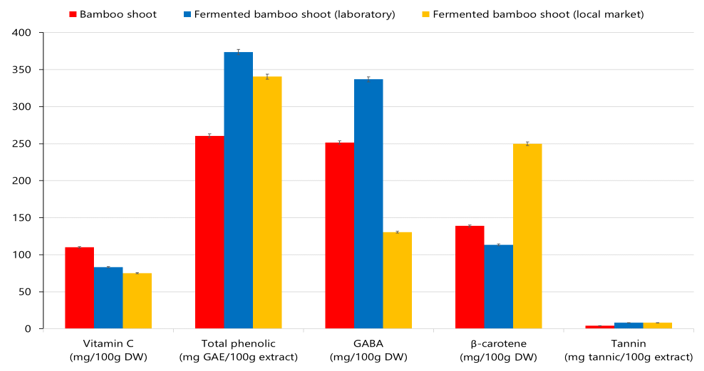
Fermentation is a folk wisdom used to extend the shelf life of food and make it taste better. In addition, fermentation produces probiotic bacteria that are beneficial to the body. This research aims to study the effects of fermentation on the physical and chemical characteristics, bioactive compounds, and antioxidant activity in bitter bean(Parkia speciosa) and bamboo shoots (Dendrocalamus asper). Bitter bean and bamboo shoots were fermented under controlled laboratory conditions using a brine solution consisting of 3 % salt and 40 % rice wash. The solution was brought to a boil and allowed to cool before being poured over the prepared samples in sterile containers. The fermentation process was carried out over a period of 14 days with the containers sealed. Bitter bean and bamboo shoots were femented in a laboratory setting and compared with market-sourced fermented bitter bean and bamboo shoots, as well as fresh bitter bean and bamboo shoots. The results showed that that fermentation led to decreased lightness (L*) and yellowness (b*), but increased redness (a*). Additionally, fermentation reduced pH while increasing ash and acid content compared to fresh bamboo shoots (p < 0.05). Furthermore, fermentation significantly boosted antioxidant activity, total phenolic content, total tannins, GABA, and beta-carotene levels (p < 0.05). However, it caused a significant reduction in vitamin C, chlorophyll A, B, and total chlorophyll levels (p < 0.05). In summary, fermenting bitter bean and bamboo shoots affected the physical and chemical characteristics, as well as the bioactive compound and antioxidant activity properties.
Article Details

This work is licensed under a Creative Commons Attribution-NonCommercial-NoDerivatives 4.0 International License.
The content and information in the article published in Journal of Rajamangala University of Technology Srivijaya It is the opinion and responsibility of the author of the article. The editorial journals do not need to agree. Or share any responsibility.
References
Arnon, D.I. 1949. Copper enzymes in isolated chloroplasts, polyphenoxidase in beta vulgaris. Plant physiology 24: 1-15.
AOAC. 2000. Official Methods of Analysis of AOAC International (17th ed). Maryland, USA.
Charoensiri, R. and Kongkhachuichai, R. 2008. Nutrition and fruit (1st ed). Nutrition Research Institute, Mahidol University and the Nutrition Promotion Foundation. (in Thai)
Di Cargo, R., Minervini, G., Rizzello, C.G., De Angelis, M. and Gobbetti, M. 2011. Effect of lactic acid fermentation on antioxidant, texture, color and sensory properties of red and green smoothies. Food Microbiology 28: 1062-1071.
Das, A., Nath, D., Kumari, S. and Saha, R. 2013. Effect of fermented bamboo shoot on the quality and shelf life of nuggets prepared from desi spent hen. Veterinary World 6(7): 419.
Đorđević, T.M., Šiler-Marinković, S.S. and Dimitrijević-Branković, S.I. 2010. Effect of fermentation on antioxidant properties of some cereals and pseudo cereals. Food Chemistry 119(3): 957-963.
Hatano, T., Kagawa, H., Yasuhara, T. and Okuda, T. 1988. Two new flavonoids and other constituents in licorice root: their relative astringency and radical scavenging effects. Chemical and Pharmaceutical Bulletin 36: 2090-2097.
Hur, S.J., Lee, S.Y., Kim, Y.C., Choi, I. and Kim, G.B. 2014. Effect of fermentation on the antioxidant activity in plant-based foods. Food Chemistry 160: 346-356.
Kampfenkel, K., Van Montagu, M. and Inzé, D. 1995. Extraction and determination of ascorbate and dehydroascorbate from plant tissue. Analytical Biochemistry 225(1): 165-167.
Katina, K., Liukkonen, K.H., Norja, A.K., Adlercreutz, H., Heinonen, S.M., Lampi, A.M., Pihlava J.M. and Poutanen, K. 2007. Fermentation-induced changes in the nutritional value of native or germinated rye. Journal of Cereal Science 46(3): 348-355.
Kuaznierewicz, B., Smiechowska, A., Bartoszek, A. and Namiesnik, J. 2008. The effect of heating and fermenting on antioxidant properties of white cabbage. Food chemistry 108: 853-861.
Merken, H.M. and Beecher, G.R. 2000. Liquid chromatographic method for the separation and quantification of prominent flavonoid aglycones. Journal of Chromatography A 897: 177-184.
Miller, N. and Rice-Evans, C. 1997. Factors influencing the antioxidant activity determined by the ABTS radical cation assay. Free Radical Research 26: 195-199.
Muhialdin, B.J., Abdul Rani, N.F. and Meor Hussin, A.S. 2020. Identification of antioxidant and antibacterial activities for the bioactive peptides generated from bitter beans (Parkia speciosa) via boiling and fermentation processes. LWT 131: 109776.
Namchoti, C., Phasuk, S. and Thakonphakdee, P. 2003. Efficacy of Feronia limonia Swingle branch crude extract as antioxidant. RMUTP Research Journal Special Issue 5: 251-260. (in Thai)
Nuntharatanapong, N., Riam-amatakun, W., Satapattayanont, P., Phetthai, R. and Atikij, R. 2018. Antioxidant, ccytotoxicity and cytoprotective activity of Polyalthia cerasoides branch aqueous extract. Isan Journal of Pharmaceutical Sciences 14(4) 142-152. (in Thai)
Pareek, S., Sagar N.A., Sharma, S., Kumar V., Agarwal, T., González-Aguilar, G.A. and Yahia, E.M. 2017. Fruit and Vegetable Phytochemicals. Elhadi M Yahia, USA.
Panyoyai, N. and Saejao, K. 2024. Effect of salt on fermentation and quality of flavoured cabbage cores. Journal of Agricultural Research and Extension 27(2): 61-70. (in Thai)
Rattanapanon, N. 2014. Food Chemistry. Odeon Store, Bangkok. (in Thai)
Sakkatamnu, P. 1998. The value of dietary fiber in preventing and curing all diseases. Ruamthon Publishing House, Bangkok. (in Thai)
Shep, B.J., Bown, A.W. and McLean, M.D. 1999. Metabolism and functions of γ-aminobutyric acid. Trends in plant science 4(11): 446-452.
Singleton, V.L., Orthofer, R. and Lamuela-Raventos, R.M. 1999. Analysis of total phenols and other oxidation substrates and antioxidants by means of Folin-Ciocalteu reagent. Methods Enzymology 299: 152-178.
Singhal, P., Satya, S. and Naik, S.N. 2021. Fermented bamboo shoots: A complete nutritional, anti-nutritional and antioxidant profile of the sustainable and functional food to food security. Food Chemistry: Molecular Sciences 3: 100041.
Speek, A.J., Temalilwa, C.R. and Schrijver, J. 1986. Determination of β-carotene content and vitamin A activity of vegetables by high-performance liquid chromatography and spectrophotometry. Food Chemistry 19(1) :65-74.
Varanyanond, W., Tungtrakul, P., Surojanametakul, V., Wattanasiritham, L. and Luxiang, W. 2005. Effects of water soaking on gamma-aminobutyric acid (GABA) in germ if different Thai rice varieties. Kasetsart Journal: Natural Science 39(3): 411-415.
Wamanon, M., Rerkngam, P. and Chantarak, S. 1996. Local vegetables of the southern region. Organization Printing House Veterans Aid, Bangkok. (in Thai)
Zhao, Y.S., Eweys, A.S., Zhang, J.Y., Zhu, Y., Bai, J., Darwesh, O.M., Zhang, H.B. and Xiao, X. 2021. Fermentation affects the antioxidant activity of plant-based food material through the release and production of bioactive components. Antioxidants 10(12): 2004.
