
House Built with Interlocking Blocks Containing Para-Wood Ash
Article Sidebar
Main Article Content
Abstract
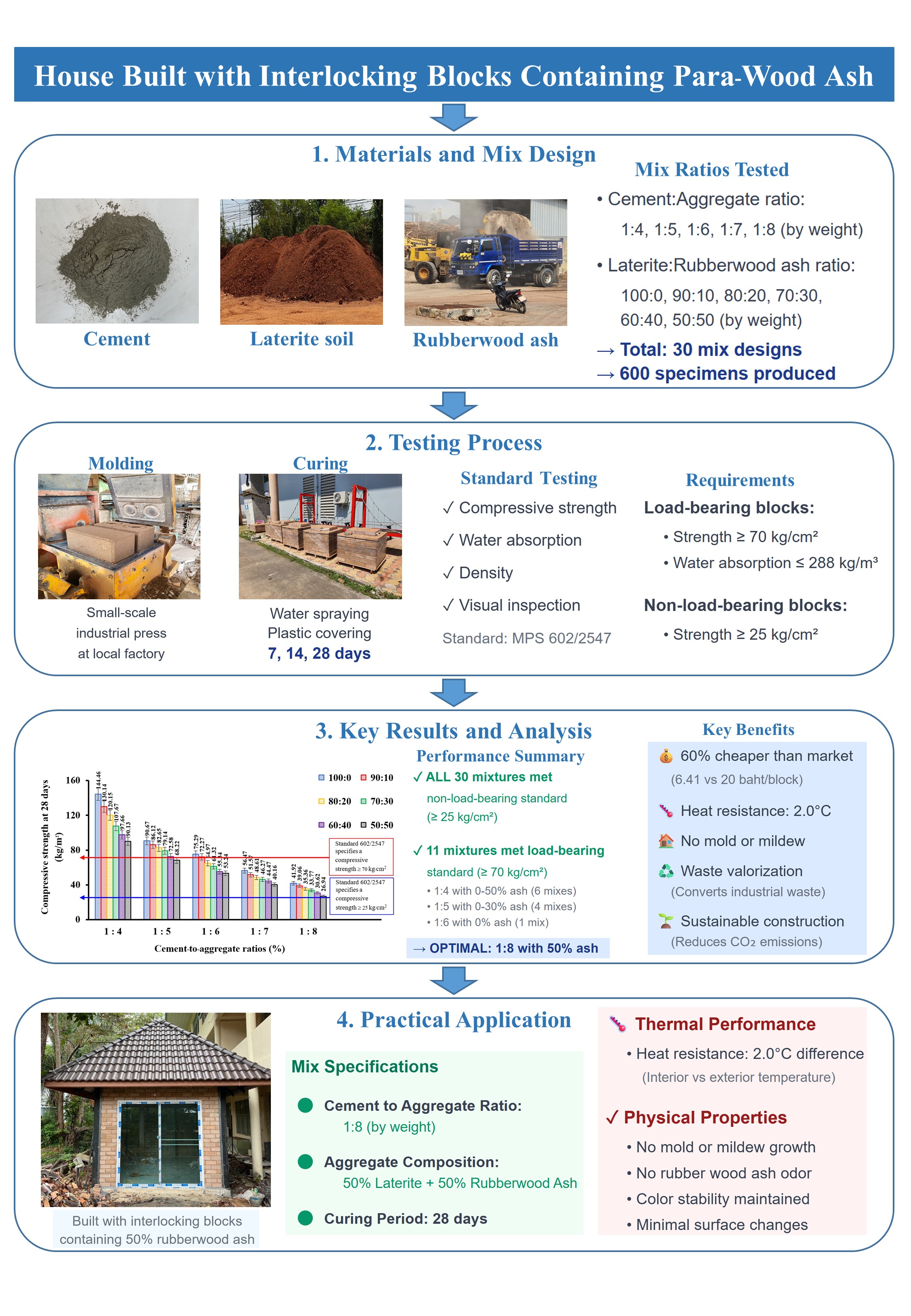
This research aimed to determine the optimal mixing ratio of rubberwood ash in the aggregate of masonry blocks. The most suitable ratio was selected to construct a prototype house wall using masonry blocks mixed with rubber wood ash. The cement-to-aggregate ratios tested were 1:4, 1:5, 1:6, 1:7, and 1:8 by weight. The aggregate was a mixture of laterite and heavy rubber wood ash in ratios of 100:0, 90:10, 80:20, 70:30, 60:40, and 50:50 by weight of the aggregate. The blocks were molded using a small-scale industrial press. The results were compared to the Community Product Standard 602/2547, which specifies that the compressive strength of non-load-bearing masonry blocks must be at least 25 kg/cm², while load-bearing blocks must have a compressive strength of at least 70 kg/cm² and a water absorption rate not exceeding 288 kg/m³. All ratios met the criteria for non-load-bearing blocks, while only 11 ratios met the standard for load-bearing blocks. These included a cement-to-aggregate ratio of 1:4 with aggregate mixed with 0, 10, 20, 30, 40, and 50 percent of rubberwood ash; a cement-to-aggregate ratio of 1:5 with aggregate mixed with 0, 10, 20, and 30 percent of rubberwood ash; and a cement-to-aggregate ratio of 1:6 with aggregate mixed with 0 percent of rubberwood ash. Therefore, the cement-to-aggregate ratio of 1:8 with 50% heavy rubberwood ash was the most suitable ratio for constructing a prototype house wall. The resulting blocks exhibited a maximum heat resistance of 2.0 degrees Celsius, were 60% cheaper than commercial products, did not develop mold or mildew, and had no odor of rubberwood ash. The masonry blocks mixed with rubberwood ash could be successfully used to construct residential walls and were deemed a practical building material. This innovative building material offers a cost-effective solution and effectively converts industrial waste into a valuable product.
Article Details

This work is licensed under a Creative Commons Attribution-NonCommercial-NoDerivatives 4.0 International License.
The content and information in the article published in Journal of Rajamangala University of Technology Srivijaya It is the opinion and responsibility of the author of the article. The editorial journals do not need to agree. Or share any responsibility.
References
Assiamah, S., Kankam, C.K., Adinkrah-Appiah, K., Afrifa, R.O., Banahehe, O.J. and Agyeman, S. 2025. The impact of burnt sawdust ash from timber species as partial cement replacements on the durability properties for sustainable interlocking blocks. Discover Civil Engineering 2(20). DOI: https://doi.org/10.1007/s44290-025-00183-2
Association of Block Manufacturers of Thailand. 2004. Community product standards for interlocking bricks (MPS 602/2547). Association of Block Manufacturers of Thailand, Bangkok.
ASTM. 1994. Standard test methods for specific gravity of soil solids by water pycnometer (D 143-94). American Society for Testing and Materials, West Conshohocken, PA.
ASTM. 1998. Standard test method for laboratory determination of water (moisture) content of soil and rock by mass1 (D 2216-98). American Society for Testing and Materials, West Conshohocken, PA.
ASTM. 2002a. Standard test methods for particle-size analysis of soils (D 422-63). American Society for Testing and Materials, West Conshohocken, PA.
ASTM. 2002b. ASTM D 1557-02 standard test methods laboratory compaction characteristics of soil using modified effort. American Society for Testing and Materials, West Conshohocken, PA.
Chumprom, P., Charoennatkul, C., Boonrasi, P., Laksanakit, C., Swasdi, S., Sookmanee, P. and Thongkun, T. 2024. The feasibility of using rubberwood bottom ash in the mixture of interlocking block. Research on Modern Science and Utilizing Technological: Innovation Journal (RMUTI Journal) 17(1): 15-26.
Dasaesamoh, A., Maming, J., Radeang, N. and Awae, Y. 2011. Physical properties and mechanical properties of para rubber wood fly ash brick. Journal of Yala Rajabhat University 6(1): 25-35.
Dasaesamoh, A., Maha, H. and Chebueraheng, H. 2014. Properties of interlocking block from para rubber wood fly ash mixed narathiwat kaolin. Journal of Science, Technology, and Environment Research for Learning 5(2): 202-208.
Hawa, A. and Tonnayopas, D. 2008. Effects of rubber wood fly ash on the properties of pumice concrete, pp. 115-119. In Proceedings of the 6th Chulalongkorn University Engineering Conference. Chulalongkorn University, Bangkok.
Karolina, R., Fachrudin, H.T., Handana, M.A.P., Farhan, A. and Ritonga, S.I. 2024. Utilizing of wood sawdust ash in eco-friendly interlocking bricks: A sustainable approach. E3S Web of Conferences 519: 04006. DOI: https://doi.org/10.1051/e3sconf/202451904006
Krishna Prakash, A., Jane Helena, H. and Awoyera, P.O. 2021. Optimization of mix proportions for novel dry stack interlocking concrete blocks using ANN. Advances in Civil Engineering 2021(1): 9952781. DOI: https://doi.org/10.1155/2021/9952781
Kuasakul, T., Charoennatkul, C. and Lukjan, A. 2017. Engineering properties of interlocking blocks containing rubber wood ash of a fishmeal factor, pp. 384-392. In The 14th National Kasetsart University Kamphaeng Saen Conference (The 14th KU-KPS) Conference. Kasetsart University Kamphaeng Saen, Nakhon Pathom.
Nguyen, M.H. and Huynh, T.P. 2022. Turning incinerator waste fly ash into interlocking concrete bricks for sustainable development. Construction and Building Materials 321: 126385. DOI: https://doi.org/10.1016/j.conbuildmat.2022.126385
Thai Industrial Cement. 2014. Curing and formwork removal of concrete, pp. 241-243. In Sethabutra, C., Maenpimolchai, S., Jitwarodom, S. and Phanmicheaw, T., eds. Cement and applications. Bangkok.
