
Growth Performance of Green Oak, Red Oak, and Green Cos in a Deep Flow Technique Hydroponic System
Article Sidebar
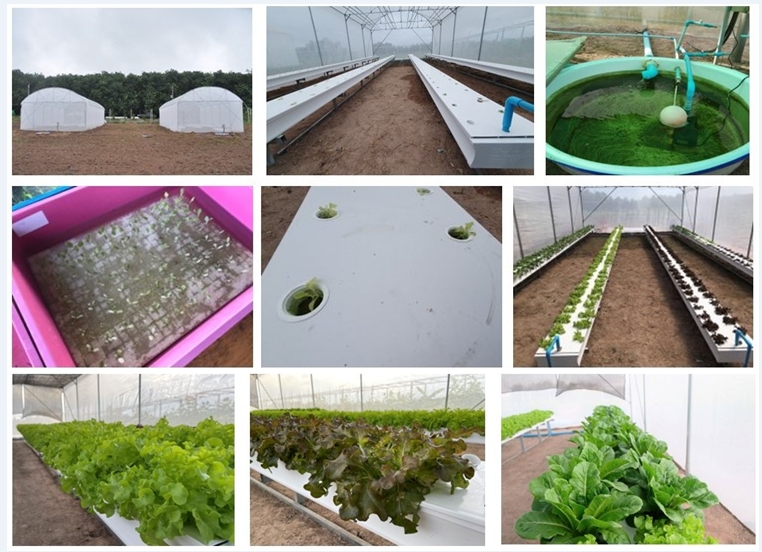
Main Article Content
Abstract
This study examined the growth performance and economic returns of three types of salad vegetables grown in a closed greenhouse using a deep flow technique (DFT) hydroponic system and adjusted to an electrical conductivity (EC) of 1.2–1.8 mS/cm and a pH of 5.6–6.5. The solution contained two balanced stock solutions: Stock A (N, P, K, Mg, S, Mo, B, Zn, Cu, and Mn) and Stock B (Ca and Fe). The study was conducted in Non Mak Khaeng, Watthana Nakhon, Sa Kaeo, Thailand, from March to April, 2024, utilizing a completely randomized design (CRD) with salad vegetable types as the treatment factor. Three lettuce varieties were tested: Green Oak, Red Oak, and Green Cos, with five replications of 10 plants each. The results revealed that Green Cos exhibited the highest growth performance in terms of root length (30.97 ± 0.32 cm), canopy height (19.33 ± 0.25 cm), and weight per plant (162.40 ± 5.29 g), with statistically significant differences (p<0.05) compared with Green Oak and Red Oak. However, Green Oak was recorded for the highest number of leaves (22.00 ± 1.00 leaves per plant). Survival rates were consistent at 100% across all three types. From an economic perspective, Green Cos yielded the highest profit of 4,872.54 THB, followed by Green Oak and Red Oak with profits of 4,526.94 THB and 3,867.88 THB, respectively. This research can be applied to the planning of salad vegetable production in a DFT hydroponic system to align with market goals. For example, it can help increase yields to meet the demands of health-conscious consumers, enhance competitiveness in the market, and ensure stable long-term income. Additionally, this approach supports the development of sustainable agricultural practice.
Article Details

This work is licensed under a Creative Commons Attribution-NonCommercial-NoDerivatives 4.0 International License.
The content and information in the article published in Journal of Rajamangala University of Technology Srivijaya It is the opinion and responsibility of the author of the article. The editorial journals do not need to agree. Or share any responsibility.
References
Buelvas, R.M., Adamchuk, V.I., Leksono, E., Tikasz, P., Lefsrud, M. and Holoszkiewicz, J. 2019. Biomass estimation from canopy measurements for leafy vegetables based on ultrasonic and laser sensors. Computers and Electronics in Agriculture 164(104896): 104896. DOI: https://doi.org/10.1016/j.compag.2019.104896
Cochavi, A., Cohen, I.H. and Rachmilevitch, S. 2020. The role of different root orders in nutrient uptake. Environmental and Experimental Botany 179(104212): 104212. DOI: https://doi.org/10.1016/j.envexpbot.2020.104212
Ekoungoulou, R. and Mikouendanandi, E.B.R.M. 2020. Lettuce (Lactuca sativa L.) production in republic of Congo using hydroponic system. OAlib 7(5): 1-17. DOI: https://doi.org/10.4236/oalib.1106339
Jiangseubchatveera, N., Saechan, C., Petchsomrit, A., Treeyaprasert, T., Leelakanok, N. and Prompanya, C. 2023. Phytochemicals and antioxidant activities of red oak, red coral and butterhead. Tropical Life Sciences Research 34(1): 1-17. DOI: https://doi.org/10.21315/tlsr2023.34.1.1
Lita, B.C. 2020. Growth and yield performance of lettuce (Lactuca sativa L.) fertilized with varying levels of compost. International Journal of Advances in Social and Economics 4(2): 50-56. DOI: https://doi.org/10.33122/ijase.v4i2.233
Maren, M. and Sergi, M. 2021. Hormonal impact on photosynthesis and photoprotection in plants. Plant Physiology 185(4):1500-1522. DOI: https://doi.org/10.1093/plphys/kiaa119
Pramono, S., Nuruddin, A. and Ibrahim, M.H. 2020. Design of a hydroponic monitoring system with deep flow technique (DFT). AIP Conference Proceedings 2217: 030195. DOI: https://doi.org/10.1063/5.0000733
Shi, M., Gu, J., Wu, H., Rauf, A., Emran, T.B., Khan, Z., Mitra, S., Aljohani, A.S.M., Alhumaydhi, F.A., Al-Awthan, Y.S., Bahattab, O., Thiruvengadam, M. and Suleria, H. A.R. 2022. Phytochemicals, nutrition, metabolism, bioavailability, and health benefits in lettuce A comprehensive review. Antioxidants (Basel, Switzerland) 11(6): 1158. DOI: https://doi.org/10.3390/antiox11061158
Siringam, K., Jirasutas, P. and Sawaengmee, W. 2015. Effect of growing methods on growth aad pigment concentrations of leaf lettuce (Lactuca sativa var. crispa L.). Phranakhon Rajabhat Research Journal 10(1): 82-95.
