
Impact of Stocking Density on Bioeconomic Performances of Blue Swimming Crab (Portunus pelagicus) Culture in Grow-Out Ponds
Article Sidebar
Main Article Content
Abstract
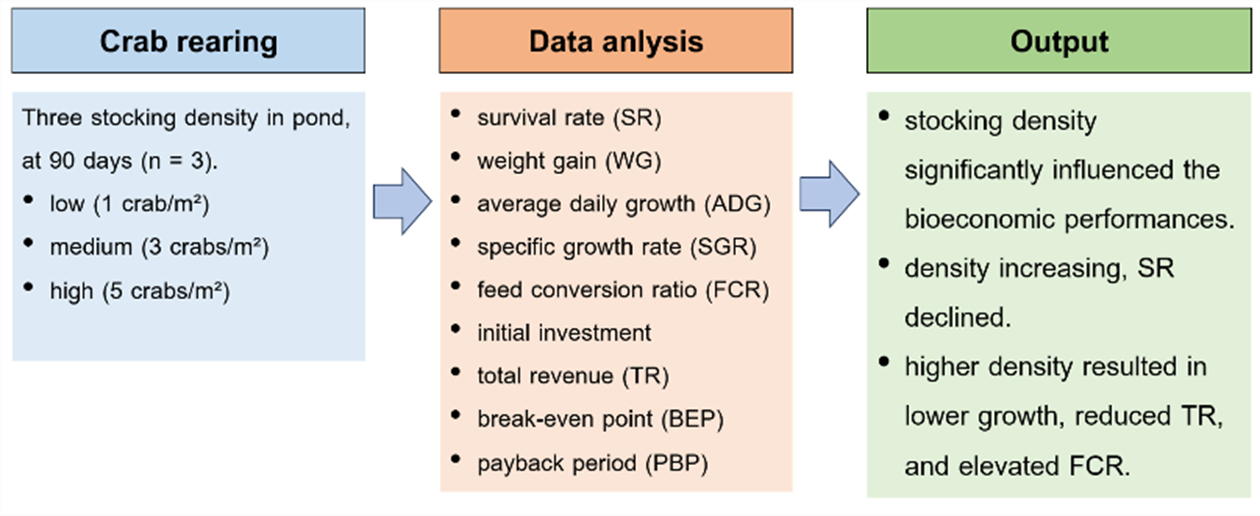
The blue swimming crab (BSC) is a commercially important species with high consumer demand, but escalating exploitation has negatively impacted its natural populations. Establishing effective cultivation methods for BSC offered a promising long-term solution to this issue. This study aimed to enhance stocking density in grow-out ponds by analyzing the effects on bioeconomic performance of BSC farming. The research involved rearing juvenile BSC in 1,600 m² earthen ponds at three stocking densities: low (1 crab/m²), medium (3 crabs/m²), and high (5 crabs/m²). Each group had three replicates (n = 3). BSC were fed an artificial shrimp feed (38% protein) at 5% of body weight per day, with feedings occurring twice daily. Over a 90-day period, survival rate (SR), weight gain (WG), average daily growth (ADG), specific growth rate (SGR), and feed conversion ratio (FCR) were assessed, alongside economic metrics such as total revenue (TR), break-even point (BEP), and payback period (PBP). Results indicated that stocking density significantly (p<0.05, one-way ANOVA) influenced the SR, WG, ADG, SGR, and revenue in BSC cultivation. As density increased, SR declined, and higher densities resulted in lower growth rates, reduced TR, and elevated FCR. In terms of culture efficiency, the densities of 1 and 3 crabs/m² proved to be more suitable for BSC culture compared to 5 crabs/m². However, economically, it was determined that rearing BSC at these three densities was not a worthwhile investment, with the density of 5 crabs/m² having the highest BEP (1.08 kg/m²) and PBP (7.5 years), while 1 crab/m² had the lowest BEP (0.38 kg/m²) and PBP (3.9 years). Therefore, appropriate BSC rearing guidelines should consider a density of no more than 3 crabs/m2 for future production.
Article Details

This work is licensed under a Creative Commons Attribution-NonCommercial-NoDerivatives 4.0 International License.
The content and information in the article published in Journal of Rajamangala University of Technology Srivijaya It is the opinion and responsibility of the author of the article. The editorial journals do not need to agree. Or share any responsibility.
References
American Public Health Association, American Water Works Association and Water Environment Federation (APHA, AWWA and WEF). 2023. Standard methods for the examination of water and wastewater (24th ed). American Public Health Association, Washington, DC.
Arkronrat, W., Konsantad, R., Leearam, C., Deemark, P., Srisupawadee, C. and Oniam, V. 2024. Impacts of stocking densities on bioeconomics and profitability of mud spiny lobster (Panulirus polyphagus Herbst, 1793) cultivation in sea cages. Agriculture and Natural Resources 58(6): 707-716. DOI: https://doi.org/10.34044/j.anres.2024.58.6.04
Bardera, G., Owen, M.A.G., Facanha, F.N., Alcaraz-Calero, J.M., Alexander, M.E. and Sloman. K.A. 2021. The influence of density and dominance on Pacific white shrimp (Litopenaeus vannamei) feeding behavior. Aquaculture 531: 735949. DOI: https://doi.org/10.1016/j.aquaculture.2020.735949
Boyd, C.E., D'Abramo, L.R., Glencross, B.D., Huyben, D.C., Juarez, L.M., Lockwood, G.S., McNevin, A.A., Tacon, A.G.J., Teletchea, F., Tomasso, J.R., Tucker, C.S. and Valenti, W.C. 2020. Achieving sustainable aquaculture: Historical and current perspectives and future needs and challenges. Journal of the World Aquaculture Society 51: 578-633. DOI: https://doi.org/10.1111/jwas.12714
Boyd, C.E., McNevin, A.A. and Davis, R.P. 2022. The contribution of fisheries and aquaculture to the global protein supply. Food Security 14: 805-827. DOI: https://doi.org/10.1007/s12571-021-01246-9
Cai, J. and Galli, G. 2021. Top 10 species groups in global aquaculture 2019. FAO, Rome.
Efrizal, Rusnam, Nurmiati, Munzir, A. and Lubis, A.S. 2024. Enhancing the growth and survival rate of broodstock female Portunus pelagicus with formulated feed enriched with amaranth (Amaranthus hybridus) extract and vitamin E. AACL Bioflux 17(4): 1697-1709.
Farhaduzzaman, A.M., Hanif, M.A., Khan, M.S., Osman, M.H., Hasan, M.N., Shovon, Rahman, M.K. and Ahmed, S.B. 2020. Perfect stocking density ensures best production and economic returns in floating cage aquaculture system. Journal of Aquaculture Research & Development 11: 607.
Food and Agriculture Organization of the United Nations (FAO). 2022. The state of world fisheries and aquaculture 2022. FAO, Rome.
Gençer, Ö. 2023. The effects of using different stocking volumes on the development of broodstocks of the blue crab, Callinectes sapidus Rathbun, 1896 (Brachyura, Portunidae). Crustaceana 96(11-12): 1173-1181. DOI: https://doi.org/10.1163/15685403-bja10348
Konsantad, R., Oniam, V., Arkronrat, W. and Leearam, C. 2024. Effect of feeding frequency on larval stage index and survival rate of blue swimming crab (Portunus pelagicus) larvae from zoea I to IV stages. Khon Kaen Agriculture Journal 52(suppl.1): 82-87. (in Thai)
Leearam, C., Konsantad, R., Arkronrat, W. and Oniam, V. 2024. Effects of artificial water color (colors and concentration levels) to reduce the mortality rate due to cannibalism of blue swimming crab (Portunus pelagicus) larvae in First crab stage. Agriculture & Technology RMUTI Journal 5(2): 40-50. (in Thai)
Liew, K.S., Yong, F.K.B. and Lim, L.S. 2024. An overview of the major constraints in Scylla mud crabs grow-out culture and its mitigation methods. Aquaculture Studies 24(1): AQUAST993. DOI: https://doi.org/10.4194/AQUAST993
Llorente, I. and Luna, L. 2016. Bioeconomic modelling in aquaculture: An overview of the literature. Aquaculture International 24: 931-948. DOI: https://doi.org/10.1007/s10499-015-9962-z
Madzivanzira, T.C., South, J., Wood, L.E., Nunes, A.L. and Weyl, O.L.F. 2020. A review of freshwater crayfish introductions in Africa. Reviews in Fisheries Science & Aquaculture 29(5): 1-24. DOI: https://doi.org/10.1080/23308249.2020.1802405
Manh, N.V., Thang, N.Q., Uyen, D.M. and Thai, T.Q. 2023. Effects of stocking density and diets on survival and growth of lavi-cultured slipper lobster (Thenus orientalis Lund, 1793). Vietnam. Journal of Marine Science and Technology 23: 81-92. DOI: https://doi.org/10.15625/1859-3097/16501
Mugwanya, M., Dawood, M.A.O., Kimera, F. and Sewilam, H.A.N. 2022. A review on recirculating aquaculture system: influence of stocking density on fish and crustacean behavior, growth performance, and immunity. Annals of Animal Science 22(3): 873-884. DOI: https://doi.org/10.2478/aoas-2022-0014
Oniam, V. and Arkronrat, W. 2022. Growth rate and sexual performance of domesticated blue swimming crab, Portunus pelagicus (Linnaeus, 1758) in earthen ponds. Trend in Sciences 19(20): 6235. DOI: https://doi.org/10.48048/tis.2022.6235
Oniam, V., Arkronrat, W. and Wechakama, T. 2012. Feed intake and survival rate assessment of blue swimming crab (Portunus pelagicus) raised in earthen pond. Journal of Agriculture 28: 83-91. (in Thai)
Phinrub, W., Khamcharoen, M., Songrak, A. and Wongsnansilp, T. 2023. Effect of foods on growth and survival rate of Blue swimming crab (Portunus pelagicus Linnaeus, 1758) in the vertical stacked boxes. Khon Kaen Agriculture Journal 51(3): 512-523. (in Thai)
Rabassó, M. and Hernández, J.M. 2015. Bioeconomic analysis of the environmental impact of a marine fish farm. Journal of Environmental Management 158: 24-35. DOI: https://doi.org/10.1016/j.jenvman.2015.04.034
Yulianto, H., Ihsan, Y., Sumiarsa, D., Ansari, A. and Hendarmawan, H. 2024. Assessing the sustainability of the blue swimming crab (Portunus pelagicus) on the Eastern Coast of Lampung: a holistic approach to conservation and resource stewardship. Frontiers in Marine Science 11: 1304838. DOI: https://doi.org/10.3389/fmars.2024.1304838
Zhang, G., Jiang, X., Zhou, W., Chen, W., Levy, T. and Wu, X. 2023. Stocking density affects culture performance and economic profit of adult all-female Chinese mitten crabs (Eriocheir sinensis) reared in earthen ponds. Aquaculture 581: 740352. DOI: https://doi.org/10.1016/j.aquaculture.2023.740352
