
Application of Machine Learning Algorithms for Prediction and Influential Parameter Analysis of Mechanical Property of Tea Residual-Filled Recycled Polypropylene Composite Materials
Article Sidebar
Main Article Content
Abstract
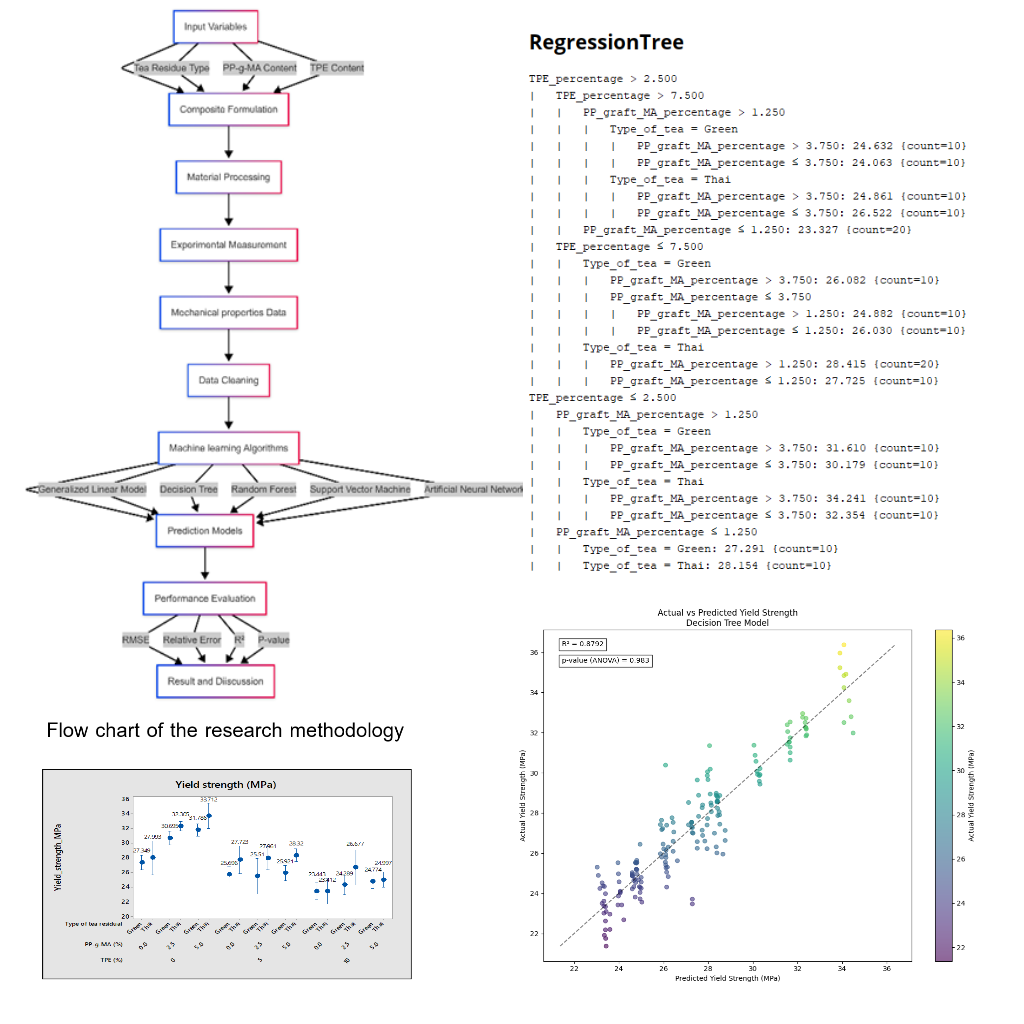
This research aims to study the application of artificial intelligence algorithms or machine learning in analyzing the influence of factors affecting the mechanical properties of recycled polypropylene composite materials mixed with tea residual. The factors examined include the type of tea waste (Thai tea and green tea), the coupling agent
(PP-g-MA), and the thermoplastic elastomer.The study uses 5 algorithms: Generalized Linear Model, Decision Tree, Random Forest, Support Vector Machine, and Artificial Neural Network. The results show that thermoplastic elastomer has a negative effect on strength and hardness, but a positive effect on flexibility and impact resistance. PP-g-MA has a positive effect on strength and interfacial adhesion. The type of tea residue affects mechanical property differently depending on structure and chemical composition.
Comparing the prediction performance of algorithms, Decision Tree and Random Forest provide the most accurate predictions for most mechanical properties, with high R² values and low error rates. The average R² values across all mechanical properties for Decision Tree and Random Forest are 0.856 and 0.858, respectively. The Artificial Neural Network shows excellence in predicting percentage elongation with RSME only 6.73%. Support Vector Machine shows limitations in predicting mechanical property, especially in predicting elongation percentage and impact resistance. The results of this research demonstrate that Decision Tree and Random Forest show the potential of using machine learning techniques to efficiently design and develop composite materials with desired properties.
Article Details

This work is licensed under a Creative Commons Attribution-NonCommercial-NoDerivatives 4.0 International License.
The content and information in the article published in Journal of Rajamangala University of Technology Srivijaya It is the opinion and responsibility of the author of the article. The editorial journals do not need to agree. Or share any responsibility.
References
Eroğlu, M.A., Altun, S. and Ciritcioğlu, H.H. 2024. Modeling of mechanical property of wood-polymer composites with Artificial Neural Networks. BioResources 19(3): 4468-4485.
Faurika, F., Khudori, A.N. and Haris, M.S. 2024. Application of Cross-Validation techniques to handle overfitting in a case study of decision tree implementation for lung cancer prediction. ROUTERS Jurnal Sistem Dan Teknologi Informasi 2(2): 111-120.
Feng, L., Wang, D. and Yan, J. 2023. Reliability Study of Wood–Plastic composites based on probabilistic finite elements. Polymers 15(2): 312.
Gümüş, B.E. 2022. Effect of MA-g-PP addition on mechanical property of polypropylene-/hollow glass spheres/nanoclay composites. Polymer Bulletin 80(3): 3405-3422.
Jiang, X., Wang, Z., Sun, D., Lu, T. and Wang, T. 2021. Toughening mechanism of unidirectional stretchable composite. Frontiers in Robotics and AI 8: 673307.
Joo, C., Park, H., Kwon, H., Lim, J., Shin, E., Cho, H. and Kim, J. 2022. Machine learning approach to predict physical properties of polypropylene composites: application of MLR, DNN, and random forest to industrial data. Polymers 14(17): 3500.
Khongrit, A., Limsiri, C. and Meehom, S. 2024a. Application of Generative Artificial Intelligence in Studying the Effect of Additives on Mechanical property of Recycled Polypropylene Composite with Green Tea Residue. pp. 913-929. In Nachaisit, P. ed. The Engineering Science Technology and Architecture Conference 15th. Faculty of Engineering, Rajamangala University of Technology Isan, Khon Kaen Campus. (in Thai)
Khongrit, A., Limsiri, C. and Meehom, S. 2024b. Comparative Analysis of Artificial Intelligence Algorithms for Predicting the Elastic Modulus of Recycled Polypropylene-Tea Residue Composites. College of Asian Scholars Journal 14(4): 31-45. (in Thai)
Khongrit, A., Limsiri, C. and Meehom, S. 2023. Effect of PP-g-MA and TPE on the Tensile Properties of Recycled Polypropylene/Thai Tea Waste Composites, pp. 176-186. In Yordle, C. ed. Sci-Tech CMRU Conference 2024 2nd. Faculty of Science and Technology, Chiang Mai Rajabhat University. (in Thai)
Khongrit, A., Vongchavalitku, S. and Khodpun, M. 2022. A Preliminary Study on Composites from Recycled Grade Polypropylene Mixed with Spent Tea. Rangsit University Journal of Engineering and Technology 25(2): 43-56. (in Thai)
Kibrete, F., Trzepieciński, T., Gebremedhen, H.S. and Woldemichael, D.E. 2023. Artificial intelligence in predicting mechanical property of composite materials. Journal of Composites Science 7(9): 364.
Liu, S., Wang, D., Guo, G., Zhang, J., Qiu, J. and Zhang, A. 2024. Effect of composition on processing and mechanical property of TPE for injection molding automotive skin. Macromolecular Chemistry and Physics 226: 2400314.
Lumumba, V., Kiprotich, D., Mpaine, M., Makena, N. and Kavita, M. 2024. Comparative analysis of Cross-Validation techniques: LOOCV, K-folds Cross-Validation, and repeated K-folds Cross-Validation in machine learning models. American Journal of Theoretical and Applied Statistics 13(5): 127-137.
Ma, Q., Zhong, Y., Wang, Z. and Bukkapatnam, S. 2023. Effect of microstructure on the machinability of natural fiber reinforced plastic composites: A novel Explainable Machine Learning (XML) approach. Journal of Manufacturing Science and Engineering 146(3): 031003.
Nakayama, K. and Sakakibara, K. 2024. Machine learning strategy to improve impact strength for PP/cellulose composites via selection of biomass fillers. Science and Technology of Advanced Materials 25(1): 2351356.
Nasri, K., Loranger, É. and Toubal, L. 2023. Effect of cellulose and lignin content on the mechanical property and drop-weight impact damage of injection-molded polypropylene-flax and -pine fiber composites. Journal of Composite Materials 57(21): 3347-3364.
Poopakdee, N. and Thammawichai, W. 2024. The effects of the crystallinity index of cellulose on the flexural properties of hybrid-cellulose epoxy composites. Journal of Metals Materials and Minerals 34(3): 1902.
Qin, N. and Bing, S. 2024. Prediction of longitudinal resonance elastic modulus of wood-plastic composites based on GM (1, N) neural network. Journal of Physics Conference Series 2785(1): 012157.
Quaresimin, M., Salviato, M. and Zappalorto, M. 2015. Toughening mechanisms in nanoparticle polymer composites, pp. 113-133. In Qinghua, Q. and Jianqiao, Y., eds. Toughening Mechanisms in Composite Materials. Woodhead Publishing.
Rahaman, N.M.M., Rani, N.S., Islam, N.M.R. and Bhuiyan, N.M.M.R. 2023. Machine Learning in Business Analytics: Advancing Statistical Methods for Data-Driven Innovation. Journal of Computer Science and Technology Studies 5(3): 104-111.
Ramesh, M., Rajeshkumar, L., Sasikala, G., Balaji, D., Saravanakumar, A., Bhuvaneswari, V. and Bhoopathi, R. 2022. A Critical Review on Wood-Based Polymer Composites: Processing, Properties, and Prospects. Polymers 14(3): 589.
Sorour, S.S., Saleh, C.A. and Shazly, M. 2024. A review on machine learning implementation for predicting and optimizing the mechanical behaviour of laminated fiber-reinforced polymer composites. Heliyon. 10(13): e33681.
Tamura, N., Hasunuma, K., Saito, T. and Fujisawa, S. 2024. Mechanical and thermal properties of porous Nanocellulose/Polymer composites: influence of the polymer chemical structure and porosity. ACS Omega 9(17): 19560-19565.
Tipboonsri, P. and Memon, A. 2024. The Impact of PP-g-MAH on Mechanical property of Injection Molding of Long Glass Fiber/Polypropylene Pellets from Thermoplastic Pultrusion Process. Journal of Manufacturing and Materials Processing 8(2): 53.
Türker, Y.Ş., Kilinçarslan, Ş. and Ince, E.Y. 2024. Performance of ANN, Random Forest and XGBoost methods in predicting the flexural properties of wood beams reinforced with carbon-FRP. Wood Material Science and Engineering 1: 1-12.
Wang, S. and Wu, X. 2023. The Mechanical Performance Prediction of Steel Materials based on Random Forest. Frontiers in Computing and Intelligent Systems 6(1): 1-3.
Wang, W., Wu, Y., Liu, W., Fu, T., Qiu, R. and Wu, S. 2023. Tensile performance mechanism for bamboo Fiber-Reinforced, Palm Oil-Based resin Bio-Composites using finite element simulation and machine learning. Polymers 15(12): 2633.
