
Characterization of Soluble Polysaccharides from Coconut Residue of Virgin Coconut Oil Production
Article Sidebar
Main Article Content
Abstract
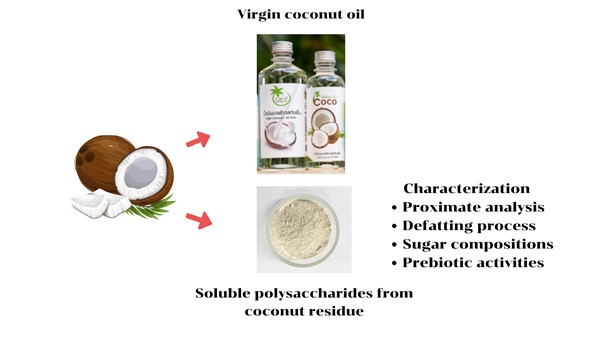
This study aimed to explore the potential of soluble polysaccharides extracted from defatted coconut residue (DCR) as a prebiotic. Our findings reveal that the defatting process of coconut residue (CR) changes its chemical composition of coconut residue in terms of moisture content (7.04 ± 0.04%), fat (3.99 ± 0.55%), protein (2.93 ± 0.18%), ash (0.76 ± 0.04%), and carbohydrate contents (46.58 ± 1.05%). The percentage of soluble polysaccharide was 2.50 ± 0.40. The extraction of soluble polysaccharides (SP) from DCR resulted in increased total sugar contents and non-reducing sugars. Structural analysis of SP by Fourier transform infrared (FT-IR) analysis showed a predominantly polysaccharide composition. High performance liquid chromatography (HPLC) analysis further identified mannose (27.87%) and glucose (25.00%) as the major monosaccharides present in SP. Remarkably, SP exhibited stronger resistance (92.42% resistance) to acidic condition in the human stomach compared to inulin (25.52% resistance) at pH 1. Furthermore, SP demonstrated prebiotic properties by promoting the growth of Lactobacillus acidophilus TISTR 2365. These findings confirmed the promising prebiotic properties of coconut residue after cold-pressed coconut oil processing, which may be used as an ingredient in functional foods and nutraceutical products.
Article Details

This work is licensed under a Creative Commons Attribution-NonCommercial-NoDerivatives 4.0 International License.
The content and information in the article published in Journal of Rajamangala University of Technology Srivijaya It is the opinion and responsibility of the author of the article. The editorial journals do not need to agree. Or share any responsibility.
References
Abbasiliasi, S., Tan, J.S., Bello, B., Ibrahim, T.A.T., Tam, Y.J., Ariff, A. and Mustafa, S. 2019. Prebiotic efficacy of coconut kernel cake’s soluble crude polysaccharides on growth rates and acidifying property of probiotic lactic acid bacteria in vitro. Biotechnology & Biotechnological Equipment 33(1):1216-1227. DOI: https://doi.org/10.1080/13102818.2019.1649603
AOAC. 2002. Official Methods of Analysis of AOAC International (17thed). Association of Analytical Chemists. Gaithersburg, USA.
Asano, I., Hamaguchi, K., Fuji, S. and Iino, H. 2003. In vitro digestibility and fermentation of mannooligosaccharides from coffee mannan. Food Science and Technological Research 9: 62-66. DOI: https://doi.org/10.3136/fstr.9.62
Asbury, R.E. and Saville, B.A. 2025. Manno-oligosaccharides as a promising antimicrobial strategy: pathogen inhibition and synergistic effects with antibiotics. Frontiers in Microbiology 16: 1529081. DOI: https://doi.org/10.3389/fmicb.2025.1529081
Bamigbade, G.B., Subhash, A.J., Kamal-Eldin, A., Nyström, L. and Ayyash, M. 2022. An Updated review on prebiotics: Insights on potentials of food seeds waste as source of potential prebiotics. Molecules 27(18): 5947. DOI: https://doi.org/10.3390/molecules27185947
Bello, B., Mustafa, S., Tan, J.S., Ibrahim, T.A.T., Tam, Y.J., Ariff, A.B., Manap, M.Y. and Abbasiliasi, S. 2018. Evaluation of the effect of soluble polysaccharides of palm kernel cake as a potential prebiotic on the growth of probiotics. 3 Biotech 8(8): 346. DOI: https://doi.org/10.1007/s13205-018-1362-4
Cai, W., Gu, X. and Tang, J. 2018. Extraction, purification, and characterization of the polysaccharides from Opuntia milpa alta. Carbohydrate Polymers 71: 403-410. DOI: https://doi.org/10.1016/j.carbpol.2007.06.008
Dong, Y., Han, M., Fei, T., Liu, H. and Gai, Z. 2024. Utilization of diverse oligosaccharides for growth by Bifidobacterium and Lactobacillus species and their in vitro co-cultivation characteristics. International Microbiology 27: 941-952. DOI: https://doi.org/10.1007/s10123-023-00446-x
Dubois, M., Gilles, K.A., Hamilton, J.K., Rebers, P.A. and Smith, F. 1956. Colorimetric method for determination of sugars and related substances. Analytical Chemistry 28(3): 350-356. DOI: https://doi.org/10.1021/ac60111a017
Gibson, G.R., Hutkins, R., Sanders, M.E., Prescott, S.L., Reimer, R.A., Salminen, S.J., Scott, K., Stanton, C., Swanson, K.S., Cani, P.D., Verbeke, K. and Reid, G. 2017. Expert consensus document: The International Scientific Association for Probiotics and Prebiotics (ISAPP) consensus statement on the definition and scope of prebiotics. Nature reviews. Gastroenterology & Hepatology 14(8): 491-502. DOI: https://doi.org/10.1038/nrgastro.2017.75
Gunarathne, R., Wijenayake, S., Yalegama, C., Marikkar, N.M. and Lu, J. 2024. Exploring the prebiotic characteristics of crude polysaccharides from coconut testa flour: A comparative analysis of local cultivar. Heliyon 10(9): e30256. DOI: https://doi.org/10.1016/j.heliyon.2024.e30256
Intaratrakul, K., Nitisinprasert, S., Nguyen, T.H., Haltrich, D. and Keawsompong, S. 2022. Manno-oligosaccharides from copra meal: Optimization of its enzymatic production and evaluation its potential as prebiotic. Bioactive Carbohydrates and Dietary Fibre 27: 100292. DOI: https://doi.org/10.1016/j.bcdf.2021.100292
Khuwijitjaru, P., Watsanit, K. and Adachi, S. 2012. Carbohydrate content and composition of product from subcritical water treatment of coconut meal. Journal of Industrial Engineering Chemistry 18: 225-229. DOI: https://doi.org/10.1016/j.jiec.2011.11.010
Kolida, S., Tuohy, K. and Gibson, G.R. 2002. Prebiotic effects of inulin and oligofructose. The British Journal of Nutrition 87: S193-S197. DOI: https://doi.org/10.1079/BJN/2002537
Korakli, M., Gänzle, M.G. and Vogel, R.F. 2002. Metabolism by bifidobacteria and lactic acid bacteria of polysaccharides from wheat and rye, and exopolysaccharides produced by Lactobacillus sanfranciscensis. Journal of Applied Microbiology 92(5): 958-965. DOI: https://doi.org/10.1046/j.1365-2672.2002.01607.x
Lin, X., Zhang, X. and Xu, B. 2024. Differences in physicochemical, rheological, and prebiotic properties of inulin isolated from five botanical sources and their potential applications. Food Research International 180: 114048. DOI: https://doi.org/10.1016/j.foodres.2024.114048
Mohd Nor, N.N., Abbasiliasi, S., Marikkar, M.N., Ariff, A., Amid, M., Lamasudin, D.U., Abdul Manap, M.Y. and Mustafa, S. 2017. Defatted coconut residue crude polysaccharides as potential prebiotics: study of their effects on proliferation and acidifying activity of probiotics in vitro. Journal of Food science and Technology 54(1):164-173. DOI: https://doi.org/10.1007/s13197-016-2448-9
Ng, S.P., Tan, C.P., Lai, O.M., Long, K. and Mirbosseini, H. 2010. Extraction and characterization of dietary fiber from coconut residue. Journal of Food, Agriculture & Environment 8(2): 172-177.
Peredo Lovillo, A., Romero Luna, H.E. and Jiménez Fernández, M. 2020. Health promoting microbial metabolites produced by gut microbiota after prebiotics metabolism. Food Research International 136: 109473. DOI: https://doi.org/10.1016/j.foodres.2020.109473
Prebiotics market size. 2023. Thailand Prebiotics Market Size & Outlook, 2023-2030. Available Source: https://www.grandview
research.com/ horizon/outlook/prebiotics-market/thailand, June 15, 2025.
Prosky, L. 1999. Inulin and oligofructose are part of the dietary fiber complex. Journal of AOAC International 82(2): 223-226. DOI: https://doi.org/10.1093/jaoac/82.2.223
Pulidindi, K. and Ahuja, K. 2024. Prebiotics Market Size. Global Market Insights. Available Source: https://www.gminsights.com/industry-analysis/prebiotics-market, July 13, 2024.
Raghavendra, S.N., Rastogi, N.K., Raghavarao, K.S.M.S. and Tharanathan, R.N. 2004. Dietary fibre from coconut residue: effects of different treatments and particle size on the hydration properties. European Food Research and Technology 218: 563-567. DOI: https://doi.org/10.1007/s00217-004-0889-2
Robertson, J.A., Ryden, P., Botham, R.L., Reading, S., Gibson, G. and Ring, S.G. 2001. Structural properties of diet-derived polysaccharides and their influence on butyrate production during fermentation. LWT-Food Science and Technology 34(8): 567-573. DOI: https://doi.org/10.1006/fstl.2001.0816
Rungruangsaphakun, J. and Keawsompong, S. 2018. Optimization of hydrolysis conditions for the mannooligosaccharides copra meal hydrolysate production. 3 Biotech 8(3): 1-9. DOI: https://doi.org/10.1007/s13205-018-1178-2
Sritrakul, N. and Keawsompong, S. 2021. Polysaccharides in copra meal: extraction conditions, optimization and characterization. International Journal of Agricultural Technology 17(1): 337-348.
Sulaiman, S., Abdul Aziz, A.R. and Aroua, M.K. 2013. Optimization and modeling of extraction of solid coconut waste oil. Journal of Food Engineering 114(2): 228-234. DOI: https://doi.org/10.1016/j.jfoodeng.2012.08.025
Thongsook, T. and Chaijamrus, S. 2018. Optimization of enzymatic hydrolysis of copra meal: compositions and properties of the hydrolysate. Journal of Food Science and Technology 55(9): 3721-3730. DOI: https://doi.org/10.1007/s13197-018-3302-z
Thungcholo, K. 2012. Non-reducing sugar extraction in laboratory and pilot plant scale and evaluation of the resistance to digestion in simulated upper gut condition. Master of Science, Prince of Songkla University, Thailand.
Torshabi, M., Bardouni, M.M. and Hashemi, A. 2023. Evaluation of antioxidant and antibacterial effects of lyophilized cell-free probiotic supernatants of three Lactobacillus spp. and their cytocompatibility against periodontal ligament stem cells. Iranian Journal of Pharmaceutical Research 22(1): e136438. DOI: https://doi.org/10.5812/ijpr-136438
Wang, X., Huang, M., Yang, F., Sun, H., Zhou, X., Guo, Y., Wang, X. and Zhang, M. 2015. Rapeseed polysaccharides as prebiotics on growth and acidifying activity of probiotics in vitro. Carbohydrate Polymers 125: 232-240. DOI: https://doi.org/10.1016/j.carbpol.2015.02.040
Yamabhai, M., Sak-Ubol, S., Srila, W. and Haltrich, D. 2014. Mannan biotechnology: From biofuels to health. Critical Reviews in Biotechnology 15: 1-11. DOI: https://doi.org/10.3109/07388551.2014.923372
You, S., Ma, Y., Yan, B., Pei, W., Wu, Q., Ding, C. and Huang, C. 2022. The promotion mechanism of prebiotics for probiotics: A review. Frontiers in nutrition 9: 1000517. DOI: https://doi.org/10.3389/fnut.2022.1000517
