
Encapsulated Freeze-Dried Lactic Acid Bacteria Enhance Immune Response and Support Growth of Penaeus monodon (Fabricius, 1798) in Hatchery and Earthen Pond Culture
Article Sidebar
Main Article Content
Abstract
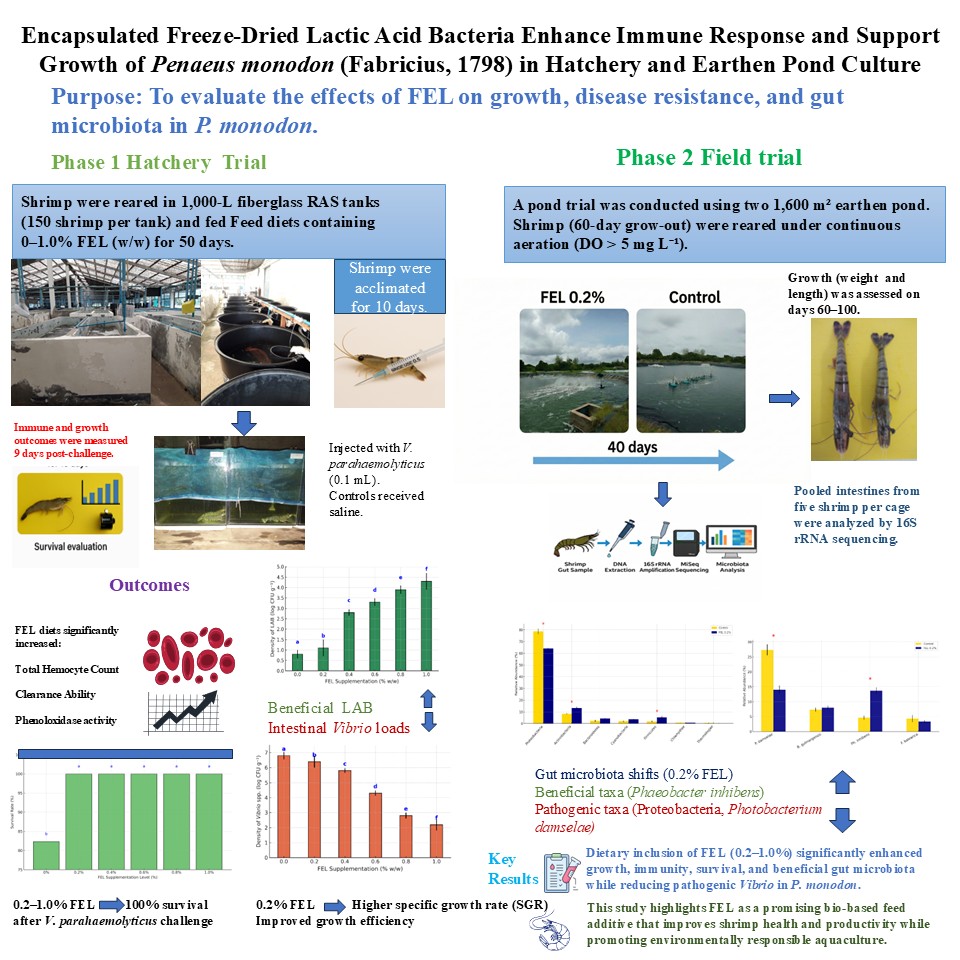
This study investigated the effects of dietary supplementation with freeze-dried encapsulated Lactobacillus spp. (FEL) on the immune response, intestinal microbiota, and growth performance of black tiger shrimp (Penaeus monodon) under both hatchery and pond conditions. FEL, prepared with four lactic acid bacteria (LAB) strains and encapsulated in sodium alginate, was incorporated into diets at concentrations of 0%–1.0% (w/w). In hatchery trials, juvenile shrimp fed FEL-supplemented diets (0.2–1.0%) exhibited significantly enhanced total hemocyte count, phenoloxidase activity, and clearance of Vibrio parahaemolyticus, achieving 100% survival compared with 82.22 ± 8.02% in controls (p < 0.001). Shrimp fed 0.2% FEL also showed a significantly higher specific growth rate (1.94% day-1) compared with controls (1.33% day-1, p < 0.05). Moreover, FEL supplementation promoted LAB colonization and reduced intestinal Vibrio densities. In pond trials, shrimp were cultured for 100 days, with growth monitoring conducted from day 60 to day 100. Microbiota analysis by 16S rRNA gene sequencing revealed an increased abundance of beneficial Firmicutes and Phaeobacter inhibens and a decreased abundance of Proteobacteria and Photobacterium damselae in FEL-fed shrimp. Shrimp receiving 0.2% FEL supplementation also exhibited consistently greater body weight and length than the control group, with significant differences observed at later sampling points (p < 0.05). These findings demonstrate that FEL supplementation can enhance innate immunity, modulate the gut microbiota, and promote shrimp growth, highlighting its potential as a sustainable probiotic feed additive for shrimp aquaculture.
Article Details

This work is licensed under a Creative Commons Attribution-NonCommercial-NoDerivatives 4.0 International License.
The content and information in the article published in Journal of Rajamangala University of Technology Srivijaya It is the opinion and responsibility of the author of the article. The editorial journals do not need to agree. Or share any responsibility.
References
Afzaal, M., Saeed, F., Hussain, S., Mohamed, A.A., Alamri, M. S., Ahmad, A., Ateeq, H., Tufail, T. and Hussain, M. 2020. Survival and storage stability of encapsulated probiotic under simulated digestion conditions and on dried apple snacks. Food Science & Nutrition 8(5): 5392-5401. DOI: https://doi.org/10.1002/fsn3.1815
AOAC. 2016. Official Methods of Analysis, 20th ed. AOAC International, Gaithersburg, MD, USA.
Anal, A.K. and Singh, H. 2021. Recent advances in microencapsulation of probiotics for applications in functional foods: A review. Critical Reviews in Food Science and Nutrition 61(5): 748-763.
Andriani, Y., Widanarni, W. and Ekasari, J. 2022. Encapsulation of probiotics for improved stability and efficacy in aquaculture: A review. Aquaculture Reports 24: 101088.
Argue, B.J., Arce, S.M., Lotz, J.M. and Moss, S.M. 2002. Selective breeding of Pacific white shrimp (Litopenaeus vannamei) for growth and resistance to Taura Syndrome Virus. Aquaculture 204(3-4): 447-460. DOI: https://doi.org/10.1016/S0044-8486(01)00830-4
Chin, Y.K., Chin, Y.K., Haifa-Haryani, W.O., Nazarudin, M.F., Ahmad, M.I., Azzam-Sayuti, M., Mohamad, A., Ida-Muryany, M.Y., Karim, M.M., Annas, S., Azmai, M.N.A., Amal, M.N.A., Mohd Nor, N. and Ina-Salwany, M. 2024a. The synergistic Lactobacillus plantarum L20 and Sargassum polycystum-added diet for improvement of black tiger shrimp Penaeus monodon’s growth, immune responses, bacterial profiles, and resistance against Vibrio harveyi. Aquaculture Reports 34: 101903. DOI: https://doi.org/10.1016/j.aqrep.2023.101903
Chin, Y.Y., Liew, H.C. and Ooi, P.T. 2024b. Dietary supplementation with Lactobacillus plantarum L20 and Sargassum polycystum enhances shrimp gut microbiota and disease resistance. Aquaculture Reports 29: 101601.
Fan, Y., Zhang, H., Liu, W., Zhang, Y. and Wang, W. 2023. Characterizing gut microbiota dynamics in Penaeus monodon fed probiotics using 16S rRNA sequencing. Microbial Biotechnology 16(2): 407-419.
Feng, Y., Liu, Y., Zhang, M. and Wang, J. 2020. Dietary supplementation of probiotics improves immune response and disease resistance in shrimp. Aquaculture Reports 17: 100361.
Gao, X., Zhang, J., Li, Y. and Chen, L. 2021. Dietary probiotics modulate gut microbiota and enhance feed conversion and intestinal integrity in Litopenaeus vannamei. Aquaculture Reports 21: 100812.
Hai, N.V. 2015. The use of probiotics in aquaculture. Journal of Applied Microbiology 119(4): 917-935. DOI: https://doi.org/10.1111/jam.12886
Han, J.E., Tang, K.F.J. and Lightner, D.V. 2022. Field and experimental evidence of Vibrio parahaemolyticus causing shrimp disease. Journal of Invertebrate Pathology 186: 107637.
Hosein, S.H., Khalili, M., Esteban, M.A. and Ringø, E. 2021. Probiotics as means of diseases control in aquaculture, a review of current knowledge and future perspectives. Frontiers in Microbiology 12: 634973.
Huisakul, M., Chaitanawisuti, N. and Natsukari, Y. 2007. Influence of dietary Lactobacillus spp. on gut microbiota in Penaeus monodon. Journal of the World Aquaculture Society 38(2): 201-209.
Kesarcodi-Watson, A., Kaspar, H., Lategan, M.J. and Gibson, L. 2012. Probiotics in aquaculture: The need, principles, and mechanisms of action and screening processes. Aquaculture 274(1-4): 1-14. DOI: https://doi.org/10.1016/j.aquaculture.2007.11.019
Khanjani, M.H., Mozanzadeh, M.T. and Gisbert, E. 2024. Probiotics, prebiotics, and synbiotics in shrimp aquaculture: Their effects on growth performance, immune responses, and gut microbiome. Aquaculture Reports 38: 102362. DOI: https://doi.org/10.1016/j.aqrep.2024.102362
Kim, Y.J., Kim, S.W. and Lee, S.M. 2022. Modulation of gut microbiota and immune response in shrimp by dietary lactic acid bacteria. Aquaculture Reports 25: 101073. DOI: https://doi.org/10.1016/j.aqrep.2022.101270
Kongnum, K. and Hongpattarakere, T. 2012a. Effect of probiotic bacteria isolated from the gastrointestinal tract of wild shrimp on immune response and disease resistance. Fish & Shellfish Immunology 32(1): 67-76.
Kongnum, K. and Hongpattarakere, T. 2012b. Effect of Lactobacillus plantarum isolated from digestive tract of wild shrimp on growth and survival of white shrimp (Litopenaeus vannamei) challenged with Vibrio harveyi. Fish & Shellfish Immunology 32(2): 170-177. DOI: https://doi.org/10.1016/j.fsi.2011.11.008
Lai, H.C., Ng, T.H., Ando, M., Lee, C.T., Chen, I.T., Chuang, J.C., Mavvel, D., Chang, S.H., Huang, Y.T. and Wang, H.C. 2015. Pathogenesis of acute hepatopancreatic necrosis disease caused by Vibrio parahaemolyticus in shrimp. Developmental & Comparative Immunology 52: 77-84.
Leano, E.M. and Mohan, C.V. 2020. Early mortality syndrome in shrimp: A review. Asian Fisheries Science 33(2): 85-96.
Li, W., Li, X., Chen, Y. and Zhang, Y. 2022. Effects of dietary encapsulated probiotics on growth, intestinal health and immune response in shrimp. Fish & Shellfish Immunology 125: 220-228.
Lulijwa, R., Rupia, E.J. and Alfaro, A.C. 2020. Probiotics and their effects on gut microbiota of aquatic animals. Applied Microbiology and Biotechnology 104(17): 7255-7271.
Martínez-Porchas, M., Vargas-Albores, F. and Miranda-Baeza, A. 2021. Next-generation sequencing in aquaculture: Application and perspectives. Aquaculture Reports 19: 100611.
Nguyen, T.H., Vo, H.T., Pham, T.L. and Doan, H.V. 2019. Effects of dietary lactic acid bacteria on immune response and disease resistance in black tiger shrimp (Penaeus monodon). Aquaculture Research 50(5): 1218-1229.
Nguyen, H.T., Trinh, T.L., Nguyen, T.T.H., Nguyen, H.Y.N. and Nguyen, P.T. 2025a. Effect of dietary extracellular polymeric substances on shrimp immune responses. Veterinary Integrative Sciences 23(3): e2025061-1-16.
Nguyen, H.T., Trinh, T.L., Nguyen, T.T.H., Nguyen, H.Y.N. and Nguyen, P.T. 2025b. Probiotic supplementation enhances resistance against Vibrio in shrimp. Aquaculture Reports 28: 101298.
Ringø, E., Hoseinifar, S.H., Ghosh, K., Van Doan, H., Beck, B.R. and Song, S.K. 2020. Probiotic use in aquaculture: Importance of gut microbiota modulation. Reviews in Aquaculture 12(2): 234-256.
Sirikharin, R., Thitamadee, S. and Limsuwan, C. 2022. Effects of encapsulated Bacillus spp. on gut microbiota and disease resistance in Penaeus monodon under semi-intensive culture. Thai Journal of Aquatic Animal Health 16(2): 45-56.
Soundarapandian, P. and Velmurugan, C. 2008. Biochemical composition of the white shrimp Litopenaeus vannamei (Boone) collected from pond culture. American-Eurasian Journal of Scientific Research 3(5): 191-194.
Sung, H.H., Lin, Y.C., Chen, C.K. and Chiang, S.R. 2021. Dietary supplementation of lactic acid bacteria improves resistance to Vibrio in shrimp. Aquaculture Reports 19: 100580.
Tran, D.T., Nguyen, T.Q., Pham, H.L. and Le, H.V. 2023. Encapsulated probiotics enhance growth and intestinal health in Pacific white shrimp under intensive farming conditions. Aquaculture 570: 739418.
van de Braak, C.B.T., Botterblom, M.H.A., Taverne, N., Rombout, J.H.W.M., Huisman, E.A. and van der Knaap, W.P.W. 2002. The roles of haemocytes and the lymphoid organ in the clearance of injected Vibrio bacteria in Penaeus monodon shrimp. Fish & Shellfish Immunology 13(4): 293-309. DOI: https://doi.org/10.1006/fsim.2002.0409
Vega-Carranza, A.S., Escamilla-Montes, R., Fierro-Coronado, J.A., Diarte-Plata, G., Guo, X., García-Gutiérrez, C. and Luna-González, A. 2024. Investigating the effect of bacilli and lactic acid bacteria on water quality, growth, survival, immune response, and intestinal microbiota of cultured Litopenaeus vannamei. Animals 14(18): 2676. DOI: https://doi.org/10.3390/ani14182676
Vieira, F.N., Buglione-Neto, C.C., Ferrarezi, J.V. and Seiffert, W.Q. 2021. Encapsulated probiotics improve intestinal microbiota stability and disease resistance in shrimp. Fish & Shellfish Immunology 114: 56-63.
Xiong, J.B. 2024. Updated roles of the gut microbiota in exploring shrimp etiology and health management. Microbiology Spectrum 12(2): e00965-24.
Zhang, Y., Liu, W., Chen, X. and Wang, Q. 2018. Effects of dietary probiotic supplementation on growth and immune response of Penaeus monodon. Aquaculture Research 49(10): 3478-3486.
Zheng, Y., Yu, M., Liu, J., Qiao, Y. and Wu, S. 2017. Effects of dietary probiotics on gut microbiota composition and growth performance in aquaculture species. Microbial Biotechnology 10(6): 1345-1356.
Zhou, Q., Zhang, Q., Wang, Y. and Xia, X. 2023. Probiotic Lactobacillus improves immunity and disease resistance in black tiger shrimp. Aquaculture International 31(1): 175-188.
Zokaeifar, H., Balcázar, J.L., Saad, C.R., Kamarudin, M.S., Sijam, K., Arshad, A. and Nejat, N. 2012. Effects of dietary probiotic supplementation on the immune response and disease resistance of Penaeus monodon. Fish & Shellfish Immunology 32(5): 750-755.
