
Evaluation of a Commercial β-Mannanase for Konjac Glucomannan Hydrolysis: Activity and Molecular Weight Analysis
Article Sidebar
Main Article Content
Abstract
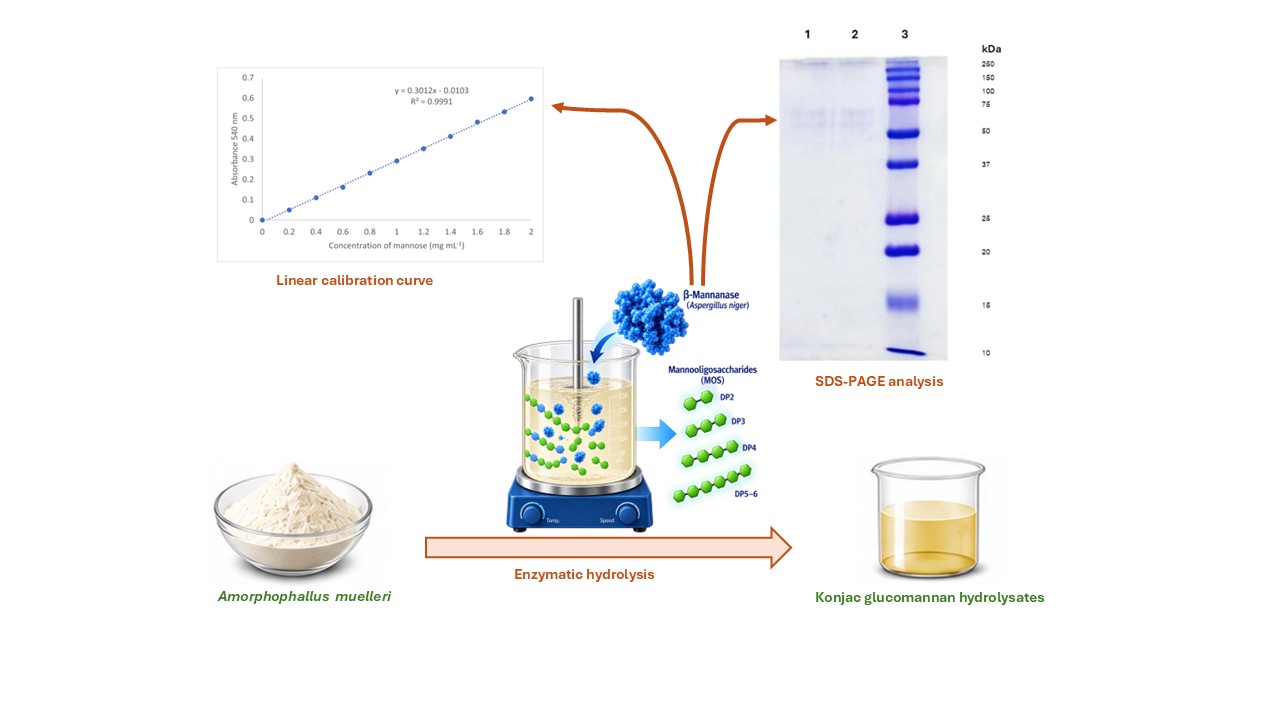
β-Mannanase (endo-1,4-β-D-mannanase) is a glycoside hydrolase with potential for producing mannooligosaccharides (MOS), which are recognized for their prebiotic properties. However, the applicability of commercial enzymes to specific substrates such as konjac glucomannan (KGM) remains insufficiently evaluated. This study investigated the hydrolytic activity and estimated the molecular weight of a commercial β-mannanase (Mannanase BGM “AMANO” 10) toward KGM. The enzyme exhibited measurable activity under the tested conditions, with a specific activity of approximately 100,574 U g-1 protein and a corresponding reducing sugar yield. SDS-PAGE analysis indicated an apparent molecular weight in the range of 50–75 kDa. These findings provide preliminary insights into the performance of the commercial enzyme on KGM and establish baseline information for its potential application in MOS production.
Article Details

This work is licensed under a Creative Commons Attribution-NonCommercial-NoDerivatives 4.0 International License.
The content and information in the article published in Journal of Rajamangala University of Technology Srivijaya It is the opinion and responsibility of the author of the article. The editorial journals do not need to agree. Or share any responsibility.
References
Arunrattanamook, N., Wansuksri, R., Uengwetwanit, T. and Champreda, V. 2020. Engineering of β-mannanase from Aspergillus niger to increase product selectivity towards medium chain length mannooligosaccharides. Journal of Bioscience and Bioengineering 130(5): 443-449.
Bailey, M.J., Biely, P. and Poutanen, K. 1992. Interlaboratory testing methods for assay of xylanase activity. Journal of Biotechnology 23(3): 257–270.
BeMiller, J. N. 2019. Carbohydrate Chemistry for Food Scientists. (3rd ed.). Woodhead Publishing, Elsevier
Bradford, M.M. 1976. A rapid and sensitive method for the quantitation of microgram quantities of protein utilizing the principle of protein-dye binding. Analytical Biochemistry 72(1): 248-254.
Cai, H., Zhou, Y. and Liu, S. 2022. Optimization of β-mannanase hydrolysis and fermentation characteristics of mannooligosaccharides. Food Chemistry 390: 133257.
CAZy database. 2024. Carbohydrate-active enzymes database. Available at: http://www.cazy.org, April 5, 2026.
Chai, Y., Wang, L., Liu, Y. and Chen, H. 2020. Classification and mechanism of β-mannanases from different microbial sources. Applied Microbiology and Biotechnology 104(14): 6237–6251.
Dawood, A. and Ma, K. 2020. Applications of Microbial β-Mannanases. Frontiers in Bioengineering and Biotechnology 8: 598630.
Ghose, T.K. 1987. Measurement of cellulase activities. Pure and Applied Chemistry 59(2): 257–268.
Hughes, R.L. 2020. A review of the role of the gut microbiome in personalized sports nutrition. Frontiers in Nutrition 6: 191.
Hu, X., Yu, J., Wang, X. and Wang, Y. 2020. High-level expression and characterization of a thermostable β-mannanase for mannooligosaccharide production. International Journal of Biological Macromolecules 151: 1075-1083.
IUPAC. 2018. Terminology of bioanalytical methods (IUPAC Recommendations 2018). Pure and Applied Chemistry 90(4): 641–684.
Jana, U.K., Kango, N. and Pletschke, B.I. 2021. Mannooligosaccharides: Production, characterization and bioactive applications. Food Chemistry 347: 129017.
Kaur, G., Kumar, V. and Sharma, N. 2007. Microbial β-mannanases: Production and applications. Applied Microbiology and Biotechnology 75(2): 287-300.
Kaur, J. and Dhawan, S. 2007. Microbial mannanases: An overview of production and applications. Critical Reviews in Biotechnology 27(4): 197-216.
Laemmli, U.K. 1970. Cleavage of structural proteins during the assembly of the head of bacteriophage T4. Nature 227(5259): 680–685.
Liu, Y., Wang, X., Chen, H., Zhang, J. and Zhang, H. 2022. Effects of dietary mannooligo saccharides on gut microbiota and intestinal barrier function. Food Research International 154: 110997.
Magengelele, M., Hlalukana, N., Malgas, A., Rose, S. H., Zyl, W.H. and Pletschke, B.I. 2021. Production and in vitro evaluation of prebiotic mannano-oligosaccharides prepared with a recombinant Aspergillus niger endo-mannanase, Man26A. Enzyme and Microbial Technology 150: 109893.
Malgas, S., van Dyk, J.S. and Pletschke, B.I. 2015. A review of the enzymatic hydrolysis of mannans and synergistic interactions between β-mannanase, β-mannosidase and α-galactosidase. World Journal of Microbiology and Biotechnology 31(8): 1167-1175.
Miller, G.L. 1959. Use of dinitrosalicylic acid reagent for the determination of reducing sugar. Analytical Chemistry 31(3): 426–428.
Murillo-Franco, S.L., Galvis-Nieto, J.D. and Orrego, C. E. 2025. Mannooligosaccharide production from açaí seeds by enzymatic hydrolysis: Optimization through response surface methodology. Environmental Science and Pollution Research 32: 27860–27871.
Pomsang, P., Ayuni, D., Phumsombat, P., Eugelio, F., Fanti, F., Compagnone, D. and Borompichaichartkul, C. 2024. Enzymatic hydrolysis and biological activities of Konjac glucomannan hydrolysate in different degree of polymerisation. International Journal of Food Science and Technology 59(11): 8341-8350.
Singh, R., Kaur, N. and Kennedy, J.F. 2018a. Chemistry and applications of konjac glucomannan. International Journal of Biological Macromolecules 112: 1030-1040.
Singh, S., Singh, G. and Arya, S.K. 2018b. Mannans: An overview of properties and applications in food products. International Journal of Biological Macromolecules 119: 79–95.
Singh, V., Patel, S. and Shah, N. 2019. Manno-oligosaccharides as prebiotics: Production, characterization, and applications. International Journal of Food Microbiology 301: 108197.
Slavin, J. 2013. Fiber and prebiotics: Mechanisms and health benefits. Nutrients 5(4): 1417-1435.
Song, Y.J., Sun, W.Y., Fan, Y.L., Xue, Y.F., Liu, D.D., Ma, C.P. and Zhang, T.C. 2018. Galactomannan degrading enzymes from the mannan utilization gene cluster of alkaliphilic Bacillus sp. N16-5 and their synergy on galactomannan degradation. Journal of Agricultural and Food Chemistry 66: 11055-11063.
Srivastava, P.K. and Kapoor, M. 2017. Production, properties, and applications of endo-β-mannanases. Biotechnology Advances 35(1): 1-19.
Sun, Y., Xu, X., Zhang, Q., Zhang, D., Xie, X., Zhou, H., Wu, Z., Liu, R. and Pang, J. 2023. Review of konjac glucomannan structure, properties, gelation mechanism and application in medical biology. Polymers 15(8): 1852.
Yang, H., Shi, P., Lu, H., Wang, H., Luo, H., Huang, H., Yang, P. and Yao, B. 2015. A thermophilic β-mannanase from Neosartorya fischeri P1 with broad pH stability and significant hydrolysis ability of various mannan polymers. Food Chemistry 173: 283-289.
Zhang, H., Liu, W., Zhang, J. and Chen, Y. 2019. Prebiotic potential of konjac glucomannan oligosaccharides and their effects on gut microbiota. Food & Function 10(10): 6424-6433.
Zhang, W., Li, M., Wang, L. and Gong, Y. 2021. Structural properties and functional potential of konjac glucomannan: A review. Food Hydrocolloids 120: 106987.
Zhou, Y., Tan, C., Zhang, X. and Li, L. 2021. Techno-economic evaluation of mannooligosaccharide production from biomass resources. Bioresource Technology 337: 125428.
Zhu, Y., Li, T., Zhang, L., Chen, X. and Wang, Y. 2022. Advances in analytical methods for carbohydrate quantification in food systems. Food Chemistry 374: 131812.
