
Calcium Ion Adsorption-Desorption Behavior on Maize Residue-Derived Biochar for Soil Nutrient Retention
Article Sidebar
Main Article Content
Abstract
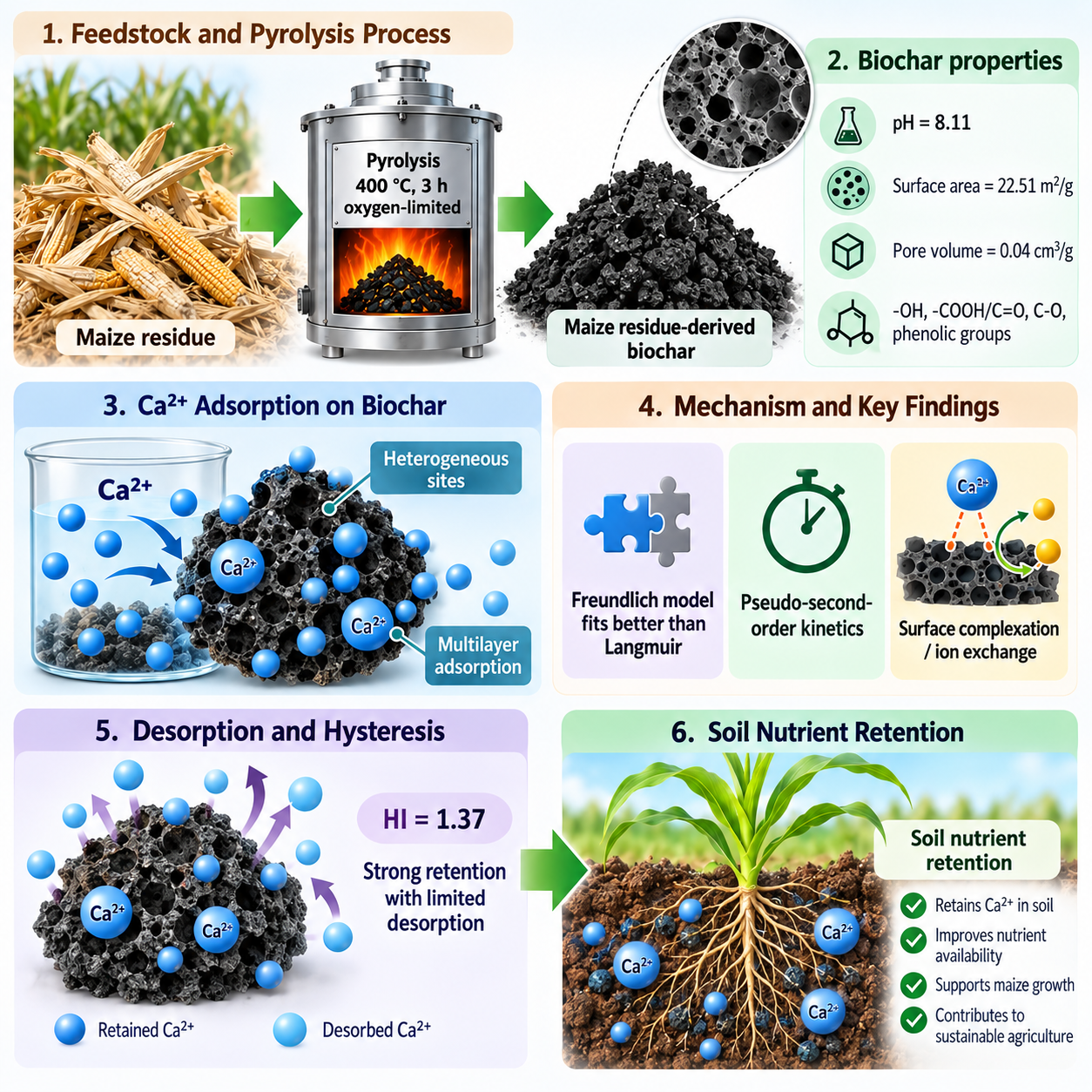
This research investigated the adsorption and desorption behavior of calcium ion (Ca2+) on maize residue-derived biochar prepared by pyrolysis at 400 °C for 3 h under oxygen-limited conditions. Batch adsorption experiments were conducted by mixing 1.0 g biochar with 30 mL Ca2+ solutions at initial concentrations of 50-90 mg/L and shaking at 100 rpm until equilibrium. The produced biochar had an alkaline pH of 8.11, a specific surface area of 22.51 m2/g, a pore volume of 0.04 cm3/g, and oxygen-containing functional groups including -OH, -COOH/C=O, C-O, and phenolic groups. Adsorption equilibrium was reached after 240 min. The adsorption data fitted the Freundlich model (R2 = 0.9828; KF = 1.6792 L/g; 1/n = 1.6567) better than the Langmuir model (R2 = 0.8478), while negative Langmuir parameters indicated that the monolayer assumption was not appropriate for this system. Kinetic analysis showed better agreement with the pseudo-second-order model (R2 = 1.00; qe, cal = 1.170 mg/g), suggesting that surface complexation or ion-exchange interactions contributed to the first adsorption layer. Subsequent retention might involve weaker adsorbate-adsorbate interactions on heterogeneous sites, consistent with Freundlich-type multilayer adsorption. The hysteresis index (HI = 1.37) suggested relatively strong calcium retention with limited desorption in deionized water. These findings indicate that maize residue-derived biochar has potential as a calcium-retention soil amendment; however, soil incubation and plant-response studies are required to validate agricultural performance under practical conditions.
Article Details

This work is licensed under a Creative Commons Attribution-NonCommercial-NoDerivatives 4.0 International License.
The content and information in the article published in Journal of Rajamangala University of Technology Srivijaya It is the opinion and responsibility of the author of the article. The editorial journals do not need to agree. Or share any responsibility.
References
Amalina, F., Razak, A.S.A., Krishnan, S., Sulaiman, H., Zularisam, A.W. and Nasrullah, M. 2022. Biochar production techniques utilizing biomass waste-derived materials and environmental applications: A review. Journal of Hazardous Materials Advances 7: 100134.
Barszcz, W., Łożyńska, M. and Molenda, J. 2024. Impact of pyrolysis process conditions on the structure of biochar obtained from apple waste. Scientific Reports 14: 10501.
Chen, J., Zhou, J., Zheng, W., Leng, S., Ai, Z., Zhang, W., Yang, Z., Yang, J., Xu, Z., Cao, J., Zhang, M., Leng, L. and Li, H. 2024. A complete review on the oxygen-containing functional groups of biochar: Formation mechanisms, detection methods, engineering, and applications. Science of the Total Environment 946: 174081.
Foo, K.Y. and Hameed, B.H. 2010. Insights into the modeling of adsorption isotherm systems. Chemical Engineering Journal 156(1): 2–10.
Freundlich, H. 1906. Over the adsorption in solution. Zeitschrift für Physikalische Chemie 57: 387–470.
Guedes, R.S., Pinto, D.A., Ramos, S.J., Dias, Y.N., Junior, C.F.C., Gastauer, M., Filho, W.M.S. and Fernandes, A.R. 2021. Biochar and conventional compost reduce hysteresis and increase phosphorus desorbability in iron mining waste. Revista Brasileira de Ciência do Solo 45: e0200174.
Hu, Y., Li, P., Yang, Y., Ling, M. and Li, X. 2022. Preparation and characterization of biochar from four types of waste biomass under matched conditions. BioResources 17(4): 6464–6475.
Intanoo, P. and Kongklay, K. 2022. A study of kale and eggplant growth growing in biochar-based growing media. Journal of Agricultural Research and Extension 40(1): 1–14.
Ippolito, J.A., Cui, L., Kammann, C., Wrage-Mönnig, N., Estavillo, J.M., Fuertes-Mendizabal, T., Novak, J.M., Spokas, K.A., Borchard, N. and Cayuela, M.L. 2020. Biochar as a sustainable strategy to improve soil properties and nutrient use efficiency: A review. Agronomy 10(10): 1567.
Janu, R., Mrlik, V., Ribitsch, D., Hofman, J., Sedláček, P., Bielská, L. and Soja, G. 2022. Biochar surface functional groups as affected by biomass feedstock, biochar composition and pyrolysis temperature. Carbon Resources Conversion 5(1): 36–46.
Joseph, S., Cowie, A.L., Van Zwieten, L., Bolan, N., Budai, A., Buss, W., Cayuela, M.L., Graber, E.R., Ippolito, J.A., Kuzyakov, Y., Luo, Y., Ok, Y.S., Palansooriya, K.N., Shepherd, J., Stephens, S., Weng, Z. and Lehmann, J. 2021. How biochar works, and when it doesn't: A review of mechanisms controlling soil and plant responses to biochar. GCB Bioenergy 13(11): 1731–1764.
Kabir, E., Kim, K.H. and Kwon, E.E. 2023. Biochar as a tool for the improvement of soil and environment. Frontiers in Environmental Science 11: 1324533.
Khan, M.A., Khan, S., Ding, X., Khan, A. and Alam, M. 2018. The effects of biochar and rice husk on adsorption and desorption of cadmium onto soils with different water conditions (upland and saturated). Chemosphere 193: 1120–1126.
Khongdee, N., Tongkoom, K., Iamsaard, K., Mawan, N., Yimyam, N., Sanjunthong, W., Khongdee, P. and Wicharuck, S. 2022. Closing yield gap of maize in Southeast Asia by intercropping systems: A review. Australian Journal of Crop Science 16(11): 1224–1233.
Langmuir, I. 1918. The adsorption of gases on plane surfaces of glass, mica and platinum. Journal of the American Chemical Society 40(9): 1361–1403.
Lonappan, L., Rouissi, T., Das, R.K., Brar, S.K., Ramirez, A.A., Verma, M., Surampalli, R.Y. and Valero, J.R. 2016. Adsorption of methylene blue on biochar microparticles derived from different waste materials. Waste Management 49: 537–544.
Malik, S. and Laura, J.S. 2025. Evaluating biochar properties derived from various agro-residues via pyrolysis: A comparative study. Oriental Journal of Chemistry 41(1): 120–126.
Mei, Y., Zhuang, S. and Wang, J. 2025. Adsorption of heavy metals by biochar in aqueous solution: A review. Science of the Total Environment 968: 178898.
Office of Agricultural Economics. 2023. Agricultural statistics of Thailand report. Ministry of Agriculture and Cooperatives, Bangkok. (in Thai)
Omara, P., Singh, H., Singh, K., Sharma, L., Otim, F. and Obia, A. 2023. Short-term effect of field application of biochar on cation exchange capacity, pH, and electrical conductivity of sandy and clay loam temperate soils. Technology in Agronomy 3: 16.
Pandian, K., Vijayakumar, S., Mustaffa, M.R.A.F., Subramanian, P. and Chitraputhirapillai, S. 2024. Biochar: A sustainable soil conditioner for improving soil health, crop production and environment under changing climate: A review. Frontiers in Soil Science 4: 1376159.
Phadtare, P.D. and Kalbande, S.R. 2022. Biochar production technologies from agricultural waste, its utilization in agriculture and current global biochar market: A comprehensive review. International Journal of Environment and Climate Change 12(11): 1010–1031.
Tran, H.N., You, S.J., Hosseini-Bandegharaei, A. and Chao, H.P. 2017. Mistakes and inconsistencies regarding adsorption of contaminants from aqueous solutions: A critical review. Water Research 120: 88–116.
Udawatta, M.M., Silva, R.C.L.D. and Silva, D.S.M.D. 2023. Surface modification of Trema orientalis wood biochar using natural coconut vinegar and its potential to remove aqueous calcium ions: Column and batch studies. Environmental Engineering Research 28(1): 210522.
Wdowiak, A., Podgórska, A. and Szal, B. 2024. Calcium in plants: An important element of cell physiology and structure, signaling, and stress responses. Acta Physiologiae Plantarum 46: 108.
Zeng, S. and Kan, E. 2022. Sustainable use of Ca(OH)₂ modified biochar for phosphorus recovery and tetracycline removal from water. Science of the Total Environment 839: 156159.
