
Impact of Seaweed Species and Density on Mitigating Cannibalism in Blue Swimming Crab (Portunus pelagicus) Juvenile
Article Sidebar
Main Article Content
Abstract
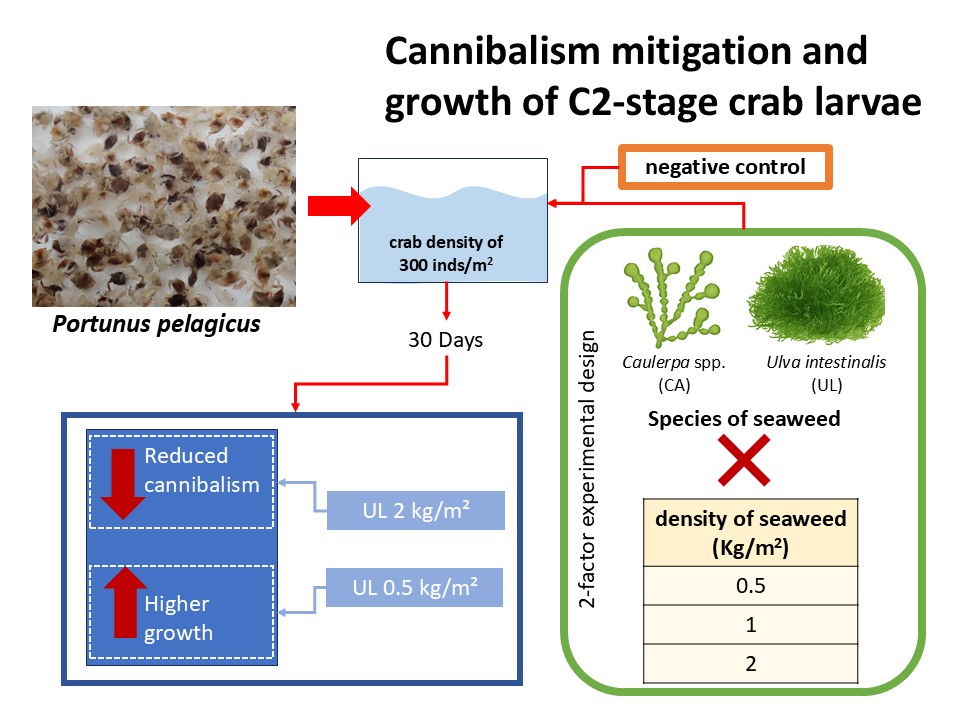
Cannibalism poses a major challenge in the aquaculture of crustaceans, particularly during the early nursery stages of the blue swimming crab (Portunus pelagicus), an economically important species that often experiences high mortality rates due to this behavior. This study investigated the effects of varying densities of Caulerpa lentillifera (CL), and Chaetomorpha crassa (CC), two green seaweed species, on reducing cannibalism in juvenile C2-stage crabs during their nursery phase. A two-factor experimental design was applied to crabs reared in controlled-environment indoor tanks for 30 days, based on seaweed density (0.5, 1, and 2 kg/m²) and species presence, with a negative control group lacking shelter. Based on the findings, while the seaweed species did not significantly influence growth parameters, the density of 0.5 kg/m² promoted higher growth rates, although these were not significantly different from the negative control. Conversely, the 2 kg/m² density of CC resulted in a substantial reduction in cannibalism, particularly from day 20 onward, with the lowest mortality rates observed under this treatment. These results underscore the importance of optimizing seaweed density and species type to enhance survival rates in crab juveniles, suggesting that CC at 0.5 kg/m² was optimal for growth, while CC at 2 kg/m² was most effective in minimizing cannibalism.
Article Details

This work is licensed under a Creative Commons Attribution-NonCommercial-NoDerivatives 4.0 International License.
The content and information in the article published in Journal of Rajamangala University of Technology Srivijaya It is the opinion and responsibility of the author of the article. The editorial journals do not need to agree. Or share any responsibility.
References
Al-Hafedh, Y.S., Alam, A. and Buschmann, A.H. 2015. Bioremediation potential, growth and biomass yield of the green seaweed, Ulva lactuca in an integrated marine aquaculture system at the Red Sea coast of Saudi Arabia at different stocking densities and effluent flow rates. Reviews in Aquaculture 7(3): 161-171.
APHA, AWWA and WEF. 2023. Standard methods for the examination of water and wastewater (24th ed). American Public Health Association.
Arumugam, N., Chelliapan, S., Kamyab, H., Thirugnana, S., Othman, N. and Noor, N.S. 2018. Treatment of wastewater using seaweed: A review. International Journal of Environmental Research and Public Health 15: 2851.
Boyd, C.E., McNevin, A.A. and Davis, R.P. 2022. The contribution of fisheries and aquaculture to the global protein supply. Food Security 14: 805-827.
Budzałek, G., Śliwińska-Wilczewska, S., Wiśniewska, K., Wochna, A., Bubak, I., Latała, A. and Wiktor, J.M. 2021. Macroalgal Defense against Competitors and Herbivores. International Journal of Molecular Sciences 22(15):7865.
Cai, J. and Galli, G. 2021. Top 10 Species Groups in Global Aquaculture 2019. Available Source: https://openknowledge.
fao.org/server/api/core/bitstreams/b9490d89-4bb7-4895-a994-4252ca70dbcd/content, October 16, 2025.
Chaiyawat, M., Eungrasamee, I. and Raksakulthai, N. 2009. Meat quality of blue swimming crab (Portunus pelagicus, Linnaeus 1758) fattened with different diets. Kasetsart Journal (Natural Science) 43: 132-142.
Daly, B., Swingle, J.S. and Eckert, G.L. 2009. Effects of diet, stocking density, and substrate on survival and growth of hatchery-cultured red king crab (Paralithodes camtschaticus) juveniles in Alaska, USA. Aquaculture 293(1-2): 68-73.
Department of Fisheries. 2024. Statistics of sea crabs culture survey 2023. Fishery Statistics Group, Fisheries Development Policy and Planning Division, Bangkok. (in Thai)
Fatihah, S.N., Julin H.T. and Chen C.A. 2017. Survival, growth and molting frequency of mud crab Scylla tranquebarica juveniles at different shelter conditions. AACL Bioflux 10(1): 1581-1589.
Haemasaton, T. and Pisuttharachai, D. 2017. Productivity improvement of mud crabs Scylla sarrata (Forskal) in cage-pond using different sheltering materials. Thaksin Journal 20(3): 1-7.
Islam, M., Siddiky, M.N.S.M. and Yahya, K. 2018. Growth, survival and intactness of green mud crab (Scylla paramamosain) broodstock under different captive grow out protocols. Saarc Journal of Agriculture 16(1): 169-180.
Kamleshbhai, B.P., Joshi, N.H., Tiwari, A. and Shaji, S. 2022. Seaweed classification, source and uses. Agriculture India Today 2(5): 54-57.
Kang, Y.H., Kim, S., Choi, S.K., Lee, H.J., Chung, I.K. and Park, S.R. 2021. A comparison of the bioremediation potential of five seaweed species in an integrated fish-seaweed aquaculture system: Implication for a multi-species seaweed culture. Aquaculture 13(1): 353-364.
Lagourgue, L., Sauvage, T., Zubia, M., Draisma, S.G.A., Vieira, C., Engelen, A. and Payri, C.E. 2024. Taxonomic insights into Caulerpa (Bryopsidales, Chlorophyta) species in French Polynesia: confirmation of 13 species and reinstatement of C. pickeringii Harvey and Bailey. Diversity 16(4): 243.
Leearam, C., Konsantad, R. and Arkronrat, W. 2023. Effect of shelter area ratio on mortality rate of blue swimming crab (Portunus pelagicus) due to cannibalism in young crab stage, pp. 248-255. In The 20th Kasetsart University Kamphaeng Saen National Conference. Kasetsart University, Nakhon Pathom. (in Thai)
Ly Van, K., Arsa, C.P., Nguyen Thi, N.A. and Ngoc, H.T. 2020. Use of different seaweeds as shelter in nursing mud crab, Scylla paramamosain: Effects on water quality, survival, and growth of crab. Journal of the World Aquaculture Society 53(1): 485-499.
Mahamad, H., Ruangchuay, R. and Bovornruangroj, N. 2023. Effect of salinity on growth of epiphytic green algae, Chaetomorpha crassa and Rhizoclonium riparium. Khon Kaen Agriculture Journal SUPPL 1: 48-54. (in Thai)
Mantri, V.A., Kavale, M.G. and Kazi, M.A. 2020. Seaweed biodiversity of India: Reviewing current knowledge to identify gaps, challenges, and opportunities. Diversity 12(1): 13.
Mirera, D.O. and Moksnes, P.O. 2013. Cannibalistic interactions of juvenile mud crab Scylla serrata: The effect of shelter and crab size. African Journal of Marine Science 35: 545-553.
Oniam, V., Arkronrat, W. and Binti Mohamed, N. 2015. Effect of feeding frequency and various shelter of blue swimming crab larvae, Portunus pelagicus (Linnaeus, 1758). Songklanakarin Journal of Science and Technology 37(2): 129-134.
Oniam, V., Taparhudee, W., Tunkijjanukij, S. and Musig, Y. 2011. Mortality rate of blue swimming crab (Portunus pelagicus) caused by cannibalism. Kasetsart University Fisheries Research Bulletin 35(2): 1-13.
Oniam, V., Taparhudee, W. and Yoonpundh, R. 2020. Installation of shelters on growth and survival of blue swimming crab (Portunus pelagicus) for development of its culture. Songklanakarin Journal of Science and Technology 42(1): 139-145.
Phinrub, W., Na Ranong, S. and Khamcharoen, M. 2019. Growth performance of blue swimming crab (Portunus pelagicus Linnaeus, 1758) in difference shelter. Journal of Science and Technology, Ubon Ratchathani University 22(3): 82-91. (in Thai)
Roleda, M.Y. and Hurd, C.L. 2019. Seaweed nutrient physiology: Application of concepts to aquaculture and bioremediation. Phycologia 58: 552-562.
Shelley, C. and Lovatel, A. 2011. Mud Crab Aquaculture: A Practical Manual. FAO Fisheries and Aquaculture, Rome, Italy.
Syafaat, M.N., Waiho, K., Azra, M.N., Abol-Munafi, A.B, Syahnon, M., Azmie, G., Ma, H. and Ikhwanuddin, M. 2021. Nursery culture of mud crab, genus Scylla, a review: The current progress and future directions. Animals 11(7): 2034.
Toi, H.T., Anh, N.T.N., Ngan, P.T.T., Nam, T.N.H. and Hai, T.N. 2023. Effects of stocking densities and seaweed types as shelters on the survival, growth, and productivity of juvenile mud crabs (Scylla paramamosain). Egyptian Journal of Aquatic Research 49(1): 401-407.
Xu, G., Endo, E. and Agatsuma, Y. 2018. Comparative study on the physiological differences between three Chaetomorpha species from Japan in preparation for cultivation. Journal of Applied Phycology 30: 1167-1174.
Zhang, H., Zhu, B., Yu, L., Liu, D., Wang, F. and Lu, Y. 2021. Selection of shelter shape by swimming crab (Portunus trituberculatus). Aquaculture Reports 21: 100908.
Zubia, M., Draisma, S.G.A., Morrissey, K.L., Varela-álvarez, E. and De Clerck, O. 2019. Concise review of the genus Caulerpa J.V. Lamouroux. Journal of Applied Phycology 32(1): 1-17.
